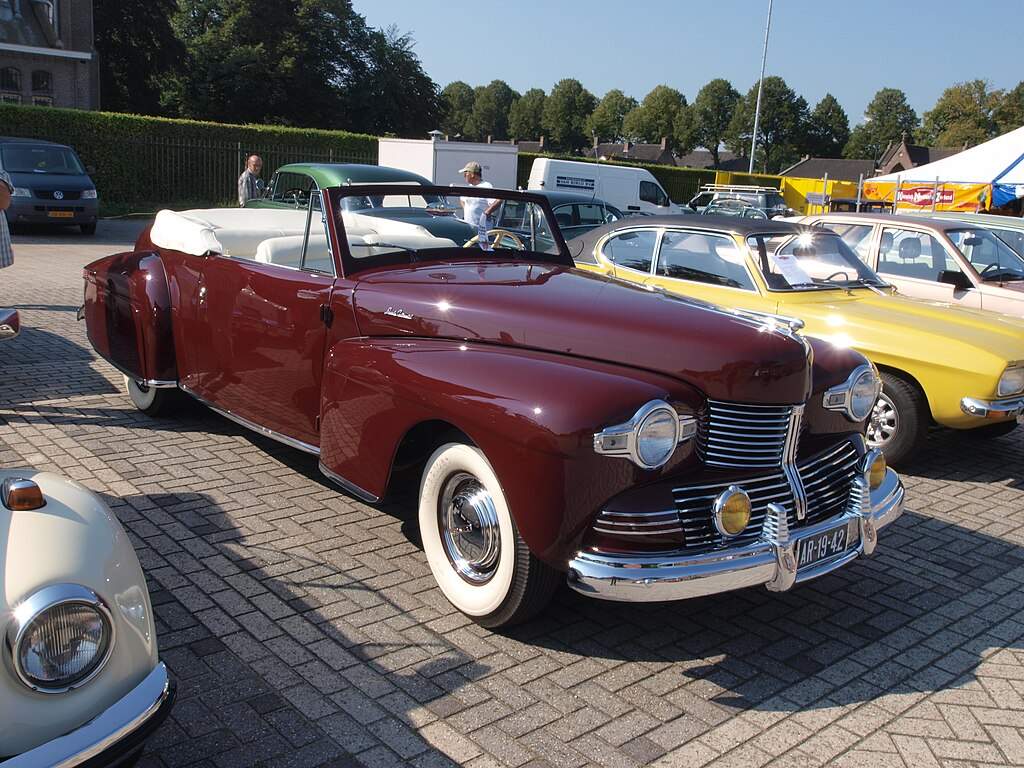

Featured Image by Alf van Beem, CC0, via Wikimedia Commons
What was going on
The year 1942 marked a sudden, jarring pause in American automotive history. As the nation fully mobilized for war, the production lines that once churned out symbols of prosperity and style were hastily converted to support the conflict effort. Amidst this backdrop of national urgency, the Lincoln Continental Cabriolet stood out as a final, breathtaking testament to pre-war luxury and meticulous design. This vehicle represented the pinnacle of Ford Motor Company’s refinement, blending European grand touring aesthetics with unmistakably American power. It was, in essence, an elegy to an era of peace and affluence, beautifully sculpted just before the world changed forever.
💵 Economy & Lifestyle
The economic landscape of early 1942 was dominated by rationing and patriotic fervor. Gas prices, while relatively low compared to post-war spikes, became increasingly irrelevant as strict gasoline and rubber rationing began for civilian use. The cost of living remained a concern for many, yet for the segment that could afford a Continental, these worries felt distant. Employment focused almost entirely on the war machine; consequently, factories hummed with unprecedented activity building planes, tanks, and ammunition. Youth culture quickly shifted from carefree socializing to supporting the war effort, with volunteerism and conservation becoming central tenets of daily life across the country.
📰 News/Politics
Politically, the world was firmly in the grip of World War II. Following the attack on Pearl Harbor months earlier, the United States was fully engaged in a global conflict. Major historical events included intense debates in Congress over massive war spending bills and the rapid implementation of nationwide defense directives. Furthermore, the serious implications of the War Production Board’s mandates meant the cessation of non-essential civilian vehicle production—a key event directly impacting this car’s lifespan.
🎵 Music
Musical tastes continued to evolve despite the grim news filtering from overseas. The vibrant sounds of Swing music remained enormously popular, with bandleaders like Glenn Miller and Benny Goodman packing dance halls whenever possible. However, the seeds of new genres were being sown; the beginnings of Rhythm and Blues (R&B) were taking shape in urban centers. Artists were creating music that spoke to both the yearning for escape and the steadfast resilience required by a wartime populace.
🎥 Movies & TV
Hollywood continued its role as a vital source of escapism and morale-boosting entertainment. Major film releases from the era often featured strong patriotic themes or glamorous romances set against dramatic backdrops. Culturally significant movies offered audiences a chance to momentarily forget the global struggle. Television, still in its infancy and heavily curtailed by wartime restrictions on materials, remained a niche interest, meaning the cinema was overwhelmingly the dominant visual medium for storytelling and shared cultural experience.
🏈 Sports
Sports provided necessary, albeit sometimes strained, continuity for the American public. The NFL and MLB battled valiantly to continue their seasons, often losing star players to military service, yet maintaining a crucial link to normalcy. Boxing, featuring champions like Sugar Ray Robinson, saw increased popularity as a spectacle of individual grit. Even with the nation focused on war, championship events served as powerful rallying points, offering moments of shared, unadulterated pride.
The elegance of this handcrafted machine, therefore, served as a poignant counterpoint to the austerity sweeping the nation. Its official debut was swiftly overshadowed, making the few examples produced seem like glittering, momentary visions of the world that was about to be painfully put on hold.
A Legacy of Distinction: The Continental’s Genesis

To appreciate the 1942 model, we must first acknowledge the Continental’s origins. Edsel Ford conceived the Continental as a uniquely elegant, personal vehicle. Legend has it that Edsel commissioned a custom one-off design for his personal use in 1938, based on the Lincoln-Zephyr. The prototype’s elongated hood, short deck, and flowing lines drew such attention it went into limited production.
The original 1940 Lincoln Continental, designed by Eugene Turenne Gregorie, was an instant sensation. Its low-slung profile and distinctive “continental” spare tire set a new benchmark for American automotive styling. It was lauded by architects, artists, and industrialists alike, earning a place in the Museum of Modern Art’s “Eight Automobiles” exhibition, a testament to its artistic merit. The Continental quickly became a symbol of sophisticated taste and understated luxury.
How People Reacted to It at Launch
Reaction to the Continental, even in its final 1942 guise, was overwhelmingly one of awe and admiration. It was instantly recognizable as something beyond the ordinary sedan. Critics and the affluent buyers who secured one saw it as the ultimate expression of American luxury motoring. The Cabriolet version, with its retractable top, especially captured the imagination, offering open-air motoring that felt both sophisticated and thrilling, even as society pulled inward.
Vehicle Performance Stats
- Engine: 306 cubic inch (5.0 L) L-head V12
- Horsepower: 130 hp @ 3,600 rpm
- Torque: Approximately 250 lb-ft
- Transmission: 3-speed manual with overdrive
- Curb Weight: Roughly 4,000 lbs
- Wheelbase: 125 inches
Journalist Reviews at the Time
The Continental’s success was defined by its unique blend of power and prestige, which was highly praised across the automotive and business press:
- Engineering Acclaim: Technical trade journals such as Automotive Industries celebrated the car’s V12 engine. While critics acknowledged its complexity, this unique engine was lauded for its exceptional smoothness and refinement, setting it apart from competitors’ V8s and straight-eights, and delivering power “with the quiet assurance of a seasoned diplomat.”
- Stylistic Supremacy: General interest and luxury publications, including the likes of Popular Mechanics, focused heavily on its iconic design. The press universally recognized the Continental as a stylistic leader, highlighting the Edsel Ford-designed long hood, integrated fenders, and the distinctive “Continental kit” as the benchmark for American automotive elegance.
Competitors
The Lincoln Continental was not without rivals in the rarefied air of the American luxury market, although its V12 engine and streamlined design gave it a unique identity. Its primary competitors offered a blend of prestige, size, and power, yet each prioritized a slightly different type of luxury experience for the wealthy buyer.
Cadillac Series 75 (1936–1942)

- Performance Stats
- Engine Type: L-head V8
- Approx. Horsepower: 140 hp
- Transmission: Hydra-Matic automatic
- Comparison The Cadillac was a physically larger car and its V8 delivered greater horsepower, allowing it to compete effectively on raw output. However, the Lincoln’s V12 was inherently quieter and smoother, appealing to the driver who valued refined engineering. Whereas the Cadillac projected overt status, the Continental delivered subtle, European-influenced style.
Packard Custom Super Eight One-Eighty (1941)

- Performance Stats
- Engine Type: L-head Straight-Eight
- Approx. Horsepower: 160 hp
- Transmission: 3-speed manual with overdrive
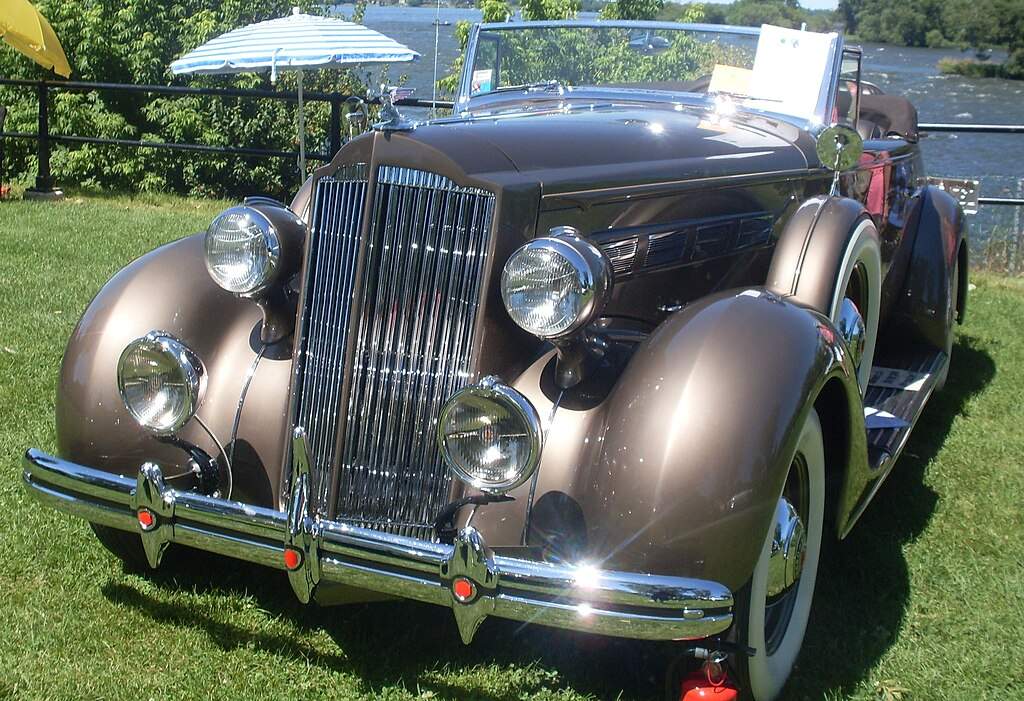
- Comparison Possessing the most power among its American rivals, the Packard had a strong appeal to buyers prioritizing proven, durable mechanicals. The Custom Eight offered a commanding road presence and a very traditional, stately ride quality. Comparatively, the Lincoln’s design was far more radical and sleek, contrasting sharply with Packard’s conservative lines.
Buick Roadmaster Series 70 (1948)

- Performance Stats
- Engine Type: 320 cubic inch Fireball Straight-Eight
- Approx. Horsepower: 165 hp
- Transmission: 3-speed manual (Compound Carburetion available)
- Comparison Buick’s top model, the Roadmaster, was a powerhouse, boasting the highest horsepower of the group at 165 hp from its advanced Straight-Eight engine, which utilized the innovative “Compound Carburetion” system. This placed it directly into performance competition with the Packard, while undercutting both Cadillac and Lincoln on price. The Roadmaster appealed to the performance-minded luxury buyer, contrasting sharply with the Continental’s emphasis on quiet, graceful, V12-driven style.
Summary of Competitor Comparisons
The Buick Roadmaster (Series 70) was the performance leader of this group, offering the highest horsepower at 165 hp, narrowly surpassing the Packard’s 160 hp. The Packard was the traditional luxury benchmark. Cadillac offered both size and technological convenience with its V8 and optional automatic transmission. The Lincoln Continental, however, stood apart by succeeding on aesthetic superiority and exclusive V12 mechanical refinement rather than sheer power figures. It was the clear choice for the buyer who sought the most graceful, sleekly designed, and mechanically unique car of the group, contrasting sharply with the higher-output rivals.
The 1942 Iteration: Refining an Icon
By 1942, the Continental had already established its iconic status. The design underwent subtle refinements for this model year, reflecting the evolving aesthetic trends of the time while retaining the core elements that made it so distinctive. The front grille received a more pronounced horizontal treatment, integrating the parking lights and lending a slightly more substantial appearance. The bumpers were also subtly revised, often incorporating overriders for added protection and visual weight.
However, the essence of the Continental remained its elegant silhouette. The long hood, a hallmark of classic automotive design, hinted at the powerful V12 engine beneath. The gracefully curved fenders flowed seamlessly into the body, creating a sense of uninterrupted motion even when standing still. The low beltline and generous glass area contributed to an airy and spacious feel within the cabin.
The Cabriolet version, with its power-operated convertible top, amplified the Continental’s inherent glamour. Lowering the top transformed the car into an open-air statement of freedom and style, perfect for leisurely drives along scenic coastal highways or making a grand entrance at exclusive social gatherings. The meticulous tailoring of the convertible top, when raised, maintained the car’s elegant lines, a testament to the craftsmanship of the era.
Engineering Excellence: The Heart of the Continental

Beneath the Continental’s stylish exterior lay a robust and refined mechanical foundation. The 1942 model was powered by Lincoln’s sophisticated L-head V12 engine. This 292 cubic inch (4.8-liter) unit produced a respectable 130 horsepower, providing smooth and ample power for comfortable cruising. The V12 was renowned for its quiet operation and effortless torque, befitting a luxury automobile of this caliber.
The transmission was a three-speed manual unit, typically equipped with an optional overdrive feature that allowed for more relaxed and fuel-efficient highway driving. The suspension system, featuring independent front suspension and a live rear axle with leaf springs, provided a comfortable and controlled ride for its time. Hydraulic drum brakes at all four corners ensured adequate stopping power.
Luxury and Craftsmanship: The Interior Experience
Stepping inside the 1942 Lincoln Continental Cabriolet was an experience in understated luxury. The cabin was appointed with high-quality materials, reflecting the craftsmanship of the era. Rich wool broadcloth or leather upholstery adorned the generously sized seats, providing exceptional comfort for both the driver and passengers.


Alf van Beem, Photos 1,2,3,4,5 CC0, via Wikimedia Commons
The dashboard was a study in elegant simplicity, typically crafted from beautifully finished wood or painted metal. The instrumentation was clear and functional, providing essential information to the driver without unnecessary clutter. Details such as chrome accents, plush carpeting, and thoughtfully placed controls contributed to the overall sense of refinement.
In the Cabriolet model, the power-operated top mechanism was a marvel of engineering for its time, allowing occupants to effortlessly transform the car from a closed coupe to an open-air roadster. The top, when lowered, neatly concealed itself beneath a tonneau cover, preserving the car’s clean lines.
A Fleeting Moment: Production Interrupted
Tragically, the production run of the 1942 Lincoln Continental was cut short by the escalating events of World War II. As the United States geared up for wartime production, automobile manufacturing for civilian use was drastically curtailed. The last civilian-market Lincoln Continentals rolled off the assembly line in February 1942, making the 1942 model year particularly significant and rare.

The cessation of production marked a turning point for the American automotive industry and for the Lincoln Continental itself. When production resumed after the war, the automotive landscape had shifted, and while the Continental would eventually return, the pre-war elegance of the 1940-1948 models held a unique and cherished place in automotive history.
Legacy and Rarity: A Collector’s Dream
Today, the 1942 Lincoln Continental Cabriolet is a highly sought-after collector car. Its combination of stunning pre-war styling, luxurious appointments, and the rarity stemming from its abbreviated production run make it a prized possession for discerning enthusiasts.
Owning a 1942 Continental Cabriolet is not just about possessing a beautiful automobile; it’s about owning a piece of history. It represents a time when craftsmanship and elegant design were paramount, a fleeting moment of automotive artistry before the demands of a global conflict reshaped the world. These cars are carefully preserved and cherished, often appearing at prestigious Concours d’Elegance events, where their timeless beauty can be admired by generations.
The 1942 Lincoln Continental Cabriolet stands as a testament to Edsel Ford’s vision and Eugene Gregorie’s design genius. It embodies the spirit of American luxury and the elegance of a bygone era. Though its production was tragically brief, its impact on automotive design and its enduring appeal to collectors ensure that the memory of this magnificent machine will continue to captivate and inspire for years to come. It remains a poignant reminder of a time when beauty and craftsmanship held a special significance, a fleeting glimpse of elegance on the eve of a world at war.