

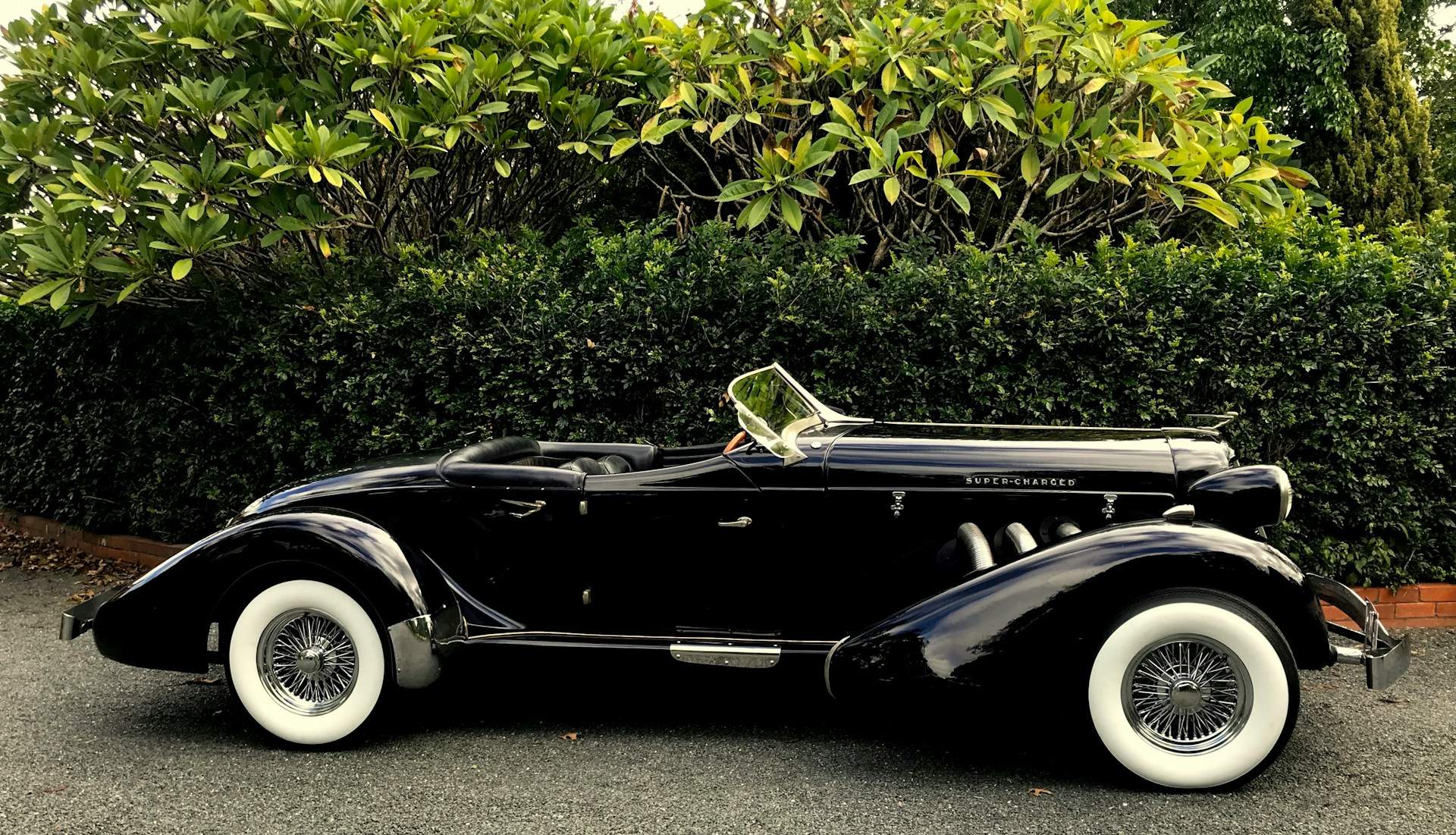

Featured Image by Gary Cox on Unsplash
Introduction
The 1930s in America were a period of stark contrasts. Despite its shadow, the Great Depression spurred remarkable automotive design creativity. Amidst this backdrop emerged the Auburn Automobile Company, an Indiana-based manufacturer. Despite its eventual demise, it produced some of the most breathtaking and technologically advanced automobiles of its time. Among its stellar creations, the Auburn 852 Supercharged Speedster stands as an enduring icon. It is a testament to the audacious spirit and artistic flair of the “Golden Age of American Automobiles.”
What was going on?
Economy and Lifestyle 📉
Gas prices remained low, a meager 10 cents per gallon, but the cost of living was still a massive strain. Over 15% of the workforce remained unemployed. While President Franklin D. Roosevelt’s New Deal programs—including Social Security and unemployment insurance—provided a fragile safety net, many families survived by migrating from the Dust Bowl in search of scarce jobs, or by simply learning to be poor.
News and Politics 🌍
Internationally, the political landscape was volatile. News of growing aggression dominated headlines, including Adolf Hitler’s remilitarization of the Rhineland and Benito Mussolini’s formal annexation of Ethiopia, marking a clear escalation toward a new global conflict. Back home, Roosevelt cemented his policies with a landslide reelection victory, consolidating the power of the New Deal Coalition.
Music, Movies, and TV 🎷🎬
The arts offered a welcome escape. The Swing Era was in full force; Big Band Jazz artists like Benny Goodman and Tommy Dorsey provided a soundtrack of upbeat, complex rhythms to dance halls across the country. In Hollywood, films like Charlie Chaplin’s commentary on the machine age, Modern Times, and the screwball comedy My Man Godfrey offered both thoughtful critiques and lighthearted distraction.
Sports 🥇⚾
On the sports stage, one of the most powerful statements against Nazi ideology occurred at the Berlin Olympics, where the legendary Black American athlete Jesse Owens won four gold medals, defying Hitler’s notion of Aryan supremacy. Furthermore, the New York Yankees won the World Series, further establishing their dominance in Major League Baseball.
Against this backdrop of economic hardship, political tension, and dazzling cultural optimism, the American public yearned for symbols of speed, luxury, and defiance. They sought proof that American ingenuity and craftsmanship could still produce a masterpiece. This powerful desire for a statement of bold success is precisely what the Auburn Automobile Company intended to capture with the stunning final evolution of its signature model. The stage was set, therefore, for the dramatic debut of one of the most breathtaking and potent pre-war automobiles.
A Legacy Forged in Innovation
The Auburn Automobile Company had humble beginnings, evolving from the Eckhart Carriage Company in the late 19th century. By the early 20th century, the Eckhart brothers, Frank and Morris, had transitioned to automobile production. While initially successful, the company faced financial headwinds, leading to its acquisition by a group of Chicago investors in 1919. It was the arrival of Errett Lobban Cord in 1924 that truly transformed Auburn’s trajectory. A dynamic and ambitious businessman, Cord injected fresh energy and vision into the company. He recognized the importance of both style and performance. Under his leadership, Auburn began to produce vehicles that were not only mechanically sound but also visually striking.
Cord’s strategy involved creating a portfolio of distinct automotive brands to cater to different segments of the luxury market. He acquired Duesenberg in 1926, placing the engineering and design-renowned marque at the pinnacle of American luxury. In 1929, he established the Cord Corporation, which introduced innovative front-wheel-drive vehicles under the Cord name. Auburn occupied the middle ground, offering a compelling blend of style, performance, and relative value.
The Dawn of the Speedster

Auburn’s 1928 “Speedster” was a sporty, boat-tailed model with a Lycoming straight-eight engine. The early Speedster personified the era’s shift to cars as statements of style and speed. However, it was the arrival of Gordon Buehrig at Auburn that would elevate the Speedster to legendary status.
Buehrig, a gifted designer who had previously worked with Duesenberg, was tasked with restyling the Auburn line for 1934. Despite unpraised initial efforts, he refined the design for 1935. With a limited budget, Buehrig masterfully transformed the Auburn’s appearance, introducing elements that would define its iconic look. These included a more elegant grille, gracefully integrated semi-pontoon front fenders, and a more substantial hood.
The Birth of the 851 and 852 Supercharged Speedsters
The 1935 model year saw the introduction of the Auburn 851 Speedster, a car that would become instantly recognizable and highly coveted. Buehrig’s design reached its zenith with the Speedster, characterized by its long, sweeping hood, sharply raked windshield, and the signature “boattail” rear end, elegantly accented with chrome and striping. The curvaceous bodywork and low-slung profile exuded a sense of speed and dynamism, perfectly capturing the spirit of the Art Deco era.

Beneath its stunning exterior, the 851 Speedster boasted impressive mechanicals. It was powered by a 280 cubic-inch Lycoming straight-eight engine. Recognizing the growing demand for performance, Auburn offered an optional Schweitzer-Cummins centrifugal supercharger. This forced-induction system significantly boosted the engine’s output from 115 horsepower to a remarkable 150 horsepower at 4,000 rpm. Its hood-emerging chrome pipes subtly hinted at the supercharger.
To further enhance its performance and drivability, the supercharged Speedsters were equipped with a Columbia dual-ratio rear axle. Auburn’s innovative feature offered two ratios per three speeds, creating a six-speed equivalent. The steering wheel lever enabled easy ratio switching, aiding both leisurely cruising and spirited driving.
Each supercharged 851 Speedster proudly displayed a plaque on the dashboard. The plaque certified the Auburn was driven 100.8 mph before shipment. This was a testament to the car’s performance capabilities, achieved by famed speed record driver Ab Jenkins on the Bonneville Salt Flats. This certification added to the Speedster’s allure, solidifying its image as a genuine high-performance machine.

The 1936 model year saw the introduction of the Auburn 852 Speedster. While virtually identical in design to its predecessor, the 852 designation reflected minor updates and the continuation of this iconic model into Auburn’s final years of production.
Design and Art Deco Influence
Many regard the Auburn 852 Supercharged Speedster as a masterpiece of Art Deco automotive design. The Art Deco movement, which flourished in the 1920s and 1930s, emphasized streamlined forms, geometric patterns, and luxurious materials. The Speedster embodies these principles with its flowing lines, the dramatic sweep of its fenders, and the elegant tapering of its boattail rear. The use of chrome accents, particularly along the side exhaust and highlighting the body’s contours, further exemplifies the Art Deco aesthetic.

The long hood and low-slung body create a sense of motion even when the car is stationary. The sharply raked windshield adds to the aerodynamic feel, while the prominent grille, though refined in Buehrig’s redesign, still conveys a sense of power. High-quality materials typically appointed the interior, reflecting the car’s premium status.
The Speedster’s design did not just focus on aesthetics; it also contributed to its performance. The streamlined shape helped to reduce drag, allowing the car to achieve impressive speeds for its era. The integration of the supercharger and the dual-ratio axle further enhanced its performance capabilities, making it a true driver’s car.
Performance and Handling
The performance and handling of Auburn 852 Supercharged Speedster offered was both exhilarating and refined for its time. The supercharged Lycoming straight-eight engine provided ample power and torque, allowing for brisk acceleration and a top speed exceeding 100 mph, a significant achievement in the 1930s. The Columbia dual-ratio rear axle provided a level of versatility that was uncommon at the time, allowing drivers to tailor the gearing to suit different driving conditions.
The hydraulic brakes, standard on all Auburn models from 1934 onwards, provided confident stopping power. The suspension system, featuring solid axles and semi-elliptic leaf springs, delivered a ride that drivers considered relatively comfortable for a sports car of that era, although it would not match the smoothness of larger, more luxurious sedans.
The Speedster’s low center of gravity, a result of its design and engineering, contributed to its relatively good handling. While not a sports car in the modern sense, it offered a more engaging and dynamic driving experience than many of its contemporaries. The sound of the supercharged straight-eight engine, with its distinctive whine and the burble from the side exhaust, undoubtedly added to the sensory thrill of driving this remarkable machine.
The End of an Era
Despite the brilliance of the 852 Supercharged Speedster and the other models in the Auburn lineup, the company, along with the entire Cord Corporation, succumbed to the economic pressures of the Great Depression and some questionable financial practices. Production ceased in 1937, marking the end of an era for these innovative and stylish automobiles.
However, the legacy of the Auburn 852 Supercharged Speedster endures. Its striking design, advanced engineering for its time, and the romanticism of its era have made it a highly prized collectible. It represents a pinnacle of American automotive design, a fusion of art and engineering that continues to captivate enthusiasts and serves as a reminder of the audacious spirit of the 1930s.
Today, the Auburn 852 Supercharged Speedster is a regular participant in prestigious concours d’elegance events around the world, where its timeless beauty and historical significance are celebrated. It stands as a symbol of a bygone era, a testament to the creativity and craftsmanship that defined the “Golden Age of American Automobiles,” and a lasting tribute to the vision of Errett Lobban Cord and the artistry of Gordon Buehrig. The rumble of its supercharged engine and the gleam of its boattail continue to evoke a sense of speed, style, and the enduring allure of a truly iconic automobile.
You may also like:
Historical Significance & Reviews:
- 1936 Auburn 852 SC Boattail Speedster – Audrain Auto Museum:
- 1936 Auburn 852 Speedster S/C – Franschhoek Motor Museum:
Specifications & Features:
- Original Auburn 851 / 852 Speedster Data – auburnspeedsters.com:
- 1936 AUBURN MODEL 852 STRAIGHT EIGHT SUPERCHARGED ‘BOATTAIL’ SPEEDSTER | Christie’s:
Market Value & For Sale:


Auburn-Cord-Deusenberg is an incredible example of ‘the right cars at the wrong time’. You are absolutely correct, the company produced 3 marques representing perhaps the best combination of innovation, performance and gorgeous styling. Unfortunately, it was a time when most of the population would struggle to keep a 15-year-old Model T on the road.
Thanks for the comment. I can’t get over how beautiful this car is.