

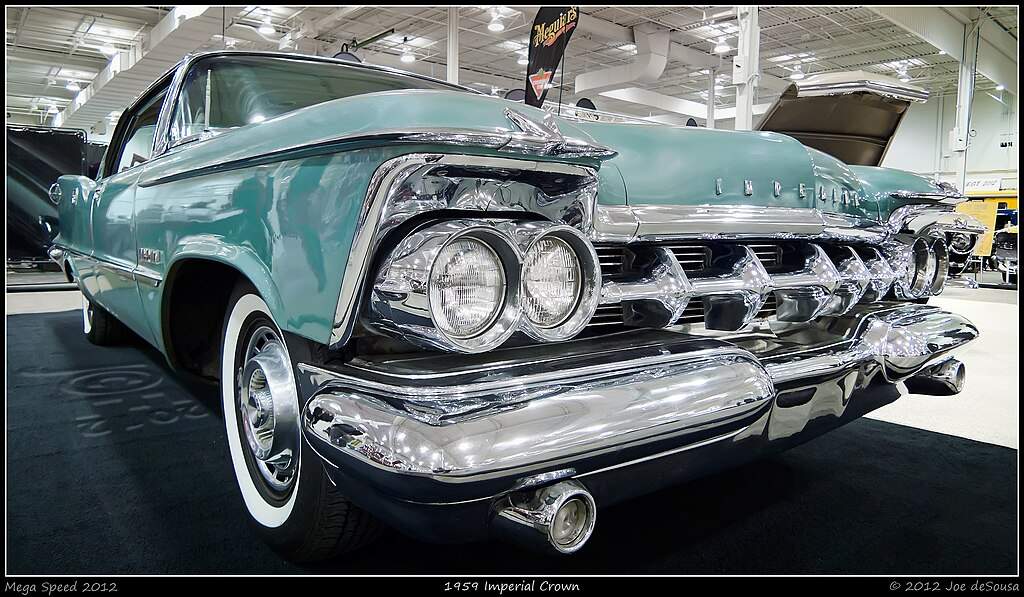

Featured Image by Mustang Joe, CC0, via Wikimedia Commons
Introduction: What Was Going On?
The Imperial Crown represented the zenith of Chrysler’s ambition to dominate the American luxury car market. This massive machine debuted at a time when U.S. consumer confidence was peaking, yet geopolitical tensions remained high. It stood as a confident, extravagant statement of American manufacturing and design prowess. Designed to compete with the best of Detroit, the 1959 Imperial was a spectacular, high-powered answer to the demand for ultimate prestige and comfort. It perfectly captured the feeling of a vibrant nation embracing the Jet Age aesthetic.
💵 Economy & Lifestyle
The nation largely rebounded from the 1957–58 recession, experiencing increased purchasing power and a general economic boom. Consequently, consumers had the discretionary income necessary to consider expensive, top-tier vehicles. The average cost of a gallon of gas was only $0.25, making the purchase of a large, V8-powered cruiser a practical consideration. This economic confidence fueled a growing youth culture that was beginning to assert its own tastes. Furthermore, the postwar surge in housing and suburban growth created a perfect environment for the ultimate family status symbol.
📰 News/Politics
Political events framed the era with a blend of domestic stability and international anxiety. The Cold War remained the central focus of global politics, with the Soviet Union actively competing in the space race. Meanwhile, significant geopolitical shifts occurred in the Western Hemisphere when Fidel Castro successfully seized power in Cuba on January 1st, 1959. Therefore, while American families enjoyed domestic prosperity, the nation’s leaders were constantly engaged in high-stakes international strategy.
🎵 Music
Musical tastes were quickly evolving during 1959. Although rock and roll remained widely popular, the genre was in transition following the tragic “Day the Music Died” plane crash earlier in the year. Sophisticated pop and early soul sounds began gaining traction. Significantly, artists like Bobby Darin brought a mature, stylish sound to the radio with hits like “Mack the Knife.” Additionally, the early roots of Motown were taking hold, signaling a profound change in the music industry’s landscape.
🎥 Movies/TV
The entertainment industry was focused on delivering both high drama and domestic escapism. Classic, idealized family life and crime sagas dominated the new medium of television. Furthermore, the popular TV show The Untouchables premiered, captivating viewers with its gritty police drama. On the other hand, the year cemented the foundation of global consumption when the Barbie doll made its debut at the New York Toy Fair, instantly becoming a cultural phenomenon.
🏈 Sports
The American sports landscape offered significant championships and rising legends. The Boston Celtics swept the Minneapolis Lakers to capture the NBA title, demonstrating their early dominance in professional basketball. Meanwhile, the Los Angeles Dodgers took the World Series crown. Auto racing also began its climb in popularity, establishing a stronger national following. This high-octane sports culture reinforced the nation’s appetite for speed, power, and competition, qualities often reflected in its automobiles.
This blend of affluence and ambition created the perfect market. It was an extravagant era, providing an ideal launchpad for the most visually dramatic automobile of the year.
Position the Car in Its Time
The Imperial Crown was engineered with a clear mandate: to be the most luxurious, distinctive, and exclusive vehicle on the American road. It was created specifically as the flagship of Chrysler Corporation’s Imperial division, aiming to surpass the prestige of the Cadillac Eldorado. Its public reaction was immediate and polarized. Journalists and buyers alike were captivated by the stunning Virgil Exner-designed “Forward Look” styling. However, its most debated feature was the dramatic, towering tailfins that were deliberately taller than any Cadillac’s, ensuring the car could not be ignored.
Design and Styling: A Symphony of Chrome and Fins

The most immediately striking aspect of the 1959 Imperial Crown was its dramatic styling. Under Virgil Exner, Chrysler’s “Forward Look” design peaked; the Imperial was its most extravagant expression. A massive, egg-crate grille with quad headlights dominated the front, a hallmark of luxury cars from that era. Heavy chrome bumpers, often incorporating intricate detailing, added to the car’s substantial appearance.

However, it was the rear that truly defined the ’59 Imperial. Towering, sharply pointed tailfins, canted outward for an even more dramatic effect, were the undisputed stars of the show. These weren’t mere suggestions of fins; they were prominent, almost architectural elements that contributed significantly to the car’s overall length and visual impact. Integrated within these fins were the taillights, often described as “gun sight” or “dagger” shaped, adding to the futuristic and slightly aggressive aesthetic.
The side profile was equally impressive, characterized by long, sweeping lines and generous use of chrome trim. Wide chrome bands often ran along the lower body, accentuating the car’s length and adding a touch of sparkle. The greenhouse, with its large windows and thin pillars, provided excellent visibility for the occupants, a characteristic often prioritized in luxury vehicles of the time.
The sheer size of the 1959 Imperial Crown was also noteworthy. It stretched nearly 228 inches in length, making it one of the longest cars on the market. This substantial footprint translated into a commanding presence on the road and a spacious interior.
Interior Luxury: Pampering Passengers in Style
Stepping inside the 1959 Imperial Crown was like entering a plush lounge on wheels. The interior was lavishly appointed with high-quality materials, including rich fabrics, supple leather (in some trims), and gleaming chrome accents. Deeply cushioned seats, often available in a variety of upholstery options and vibrant colors, promised a comfortable ride for all occupants.
The dashboard was a testament to the era’s design trends, featuring a wide, sweeping layout with numerous gauges and controls. The instrument cluster was typically housed in a stylish binnacle, and the overall design emphasized a sense of grandeur and sophistication. Features like power windows, power steering, power brakes, and air conditioning (often an optional extra) were available, further enhancing the luxury experience.
Rear passengers were treated to ample legroom and headroom, befitting a car of this stature. The rear seats were often as plush and comfortable as the front, and amenities like center armrests and reading lights added to their comfort. The overall ambiance of the interior was one of quiet opulence, designed to isolate occupants from the noise and rigors of the outside world.
Engineering and Performance: Power and Smoothness
Beneath the imposing sheet metal resided a potent powertrain designed to deliver both power and a smooth, effortless driving experience. The standard engine for the 1959 Imperial Crown was Chrysler’s robust 413 cubic inch Wedge-head V-8. This “Golden Lion” engine, with its wedge-shaped combustion chambers, produced a healthy 350 horsepower at 4,600 rpm and a substantial 475 lb-ft of torque. This significant power was channeled through Chrysler’s efficient Three-speed push-button TorqueFlite automatic transmission, known for its smooth and reliable operation.
Consequently, this massive luxury car carried a Curb Weight of over 4,800 pounds. Despite this bulk, the 129-inch Wheelbase provided a composed and stable driving experience. Furthermore, the chassis utilized the sophisticated Torsion-Aire suspension system, which prioritized isolation from road imperfections over aggressive handling. Ultimately, the Imperial was a relatively exclusive choice; only approximately 2,279 units of the 4-Door Hardtop were produced, selling at an initial MSRP of $5,571. The combination of the powerful V8 and advanced chassis made the Imperial a highly distinctive and luxurious cruiser.
Trim Levels and Body Styles: Catering to Different Tastes
The 1959 Imperial was available in several distinct trim levels and body styles, allowing buyers to choose a model that best suited their needs and preferences:
- Crown: This was the top-of-the-line trim, offering the most luxurious appointments and features. It was available as a two-door hardtop, a four-door hardtop, and a four-door sedan.
- LeBaron: Positioned below the Crown, the LeBaron still offered a high level of luxury and was available in the same body styles as the Crown.
- Custom: This was the entry-level Imperial trim, though it still offered a significant level of standard equipment and luxury compared to mainstream cars. It was available as a two-door hardtop, a four-door hardtop, and a four-door sedan.
- Southampton: This designation was used for the four-door hardtop models across all trim levels.
- Convertible: For those who desired open-air motoring, the Imperial Crown Convertible offered a stunning and exclusive option. These convertibles were particularly rare and are highly sought after by collectors today.
Each trim level featured distinct exterior and interior trim details, allowing for a degree of personalization. Buyers could also choose from a wide array of exterior paint colors and interior upholstery options.
Competitors
The Imperial Crown fought for the top spot against two automotive titans: the Lincoln Continental Mark IV and the ultra-exclusive Cadillac Eldorado Brougham. This battle involved high-stakes competition over size, power, and prestige, particularly at the highest tier of luxury.
1959 Cadillac Eldorado Brougham (Pininfarina)

Vehicle performance stats
- Engine: 390 cubic inch V8 (Triple Carburetor)
- Horsepower: 345 hp at 4,800 rpm
- Transmission: Four-speed Hydra-Matic automatic
- Wheelbase: 130 inches
- Production: 99 total units
- MSRP: $13,075 (nearly double the Imperial’s price)
Comparison: The Italian-bodied Brougham was the epitome of luxury, featuring a highly restrained, sleek design with subtle fins and a squared-off roofline—a deliberate contrast to the Imperial’s flamboyance. Although the Brougham offered a four-speed transmission advantage, its price was astronomical. The Imperial Crown, conversely, was flamboyant and significantly more attainable while still offering cutting-edge technology like Torsion-Aire suspension.
1959 Lincoln Continental Town Car (Formal Sedan)

Vehicle performance stats
- Engine: 430 cubic inch V8
- Horsepower: 350 hp
- Transmission: Three-speed Turbo-Drive automatic
- Wheelbase: 131 inches
- Production: 6,146 units
- MSRP: $6,845
Comparison: The Lincoln Town Car was the longest and widest car of the trio. It matched the Imperial’s 350 hp output but used a larger displacement engine. The Town Car’s MSRP was notably higher than the Imperial Crown’s, confirming its premium position in the four-door hardtop segment. Ultimately, the Imperial separated itself by offering optional swivel seats and its unique, non-conventional Free-Flight instrument panel, providing a distinct alternative to both the reserved Brougham and the powerful Lincoln.
Summary of the comparison
The luxury battle of 1959 was defined by clear differences in strategy. The Cadillac Brougham claimed the top price and exclusivity with its subtle, Pininfarina-styled body. Conversely, the Lincoln offered the maximum physical size. The Imperial Crown, however, was the technical dark horse. It provided comparable power, the superior Torsion-Aire suspension, and a distinctively flamboyant style, carving out a bold niche between the restrained Brougham and the powerful Lincoln.
Market Reception and Legacy: A Symbol of an Era
The 1959 Imperial Crown, while undeniably impressive, faced stiff competition in the luxury car market. Cadillac and Lincoln held strong positions, and the Imperial, despite its bold styling and luxurious features, never quite achieved the same sales volume. However, it garnered a loyal following among those who appreciated its distinctive design and powerful performance.

Today, the 1959 Imperial Crown is highly regarded by classic car enthusiasts and collectors. Its dramatic styling, particularly those towering tailfins, makes it an instantly recognizable icon of the late 1950s. Restored examples are often showcased at car shows, and their rarity, especially the convertible models, contributes to their desirability and value.
The 1959 Imperial Crown serves as a fascinating snapshot of a bygone era in American automotive history. It embodies the confidence, the exuberance, and the sheer audacity of the late 1950s, a time when bigger was often considered better and style reigned supreme. It stands as a testament to Chrysler’s ambition to compete at the highest levels of the luxury car market and remains a captivating example of Detroit’s golden age of automotive design. Its powerful engine, luxurious interior, and, above all, its unforgettable styling ensure its place as a true automotive legend. The sight of those majestic tailfins still evokes a sense of wonder and nostalgia for a time when cars were not just modes of transportation, but rolling works of art.
For a complete, in-depth video review of the 1959 Imperial Crown, including its history, exterior, interior, and ride, you can find it here at JW Reviews.


.jpg)
