

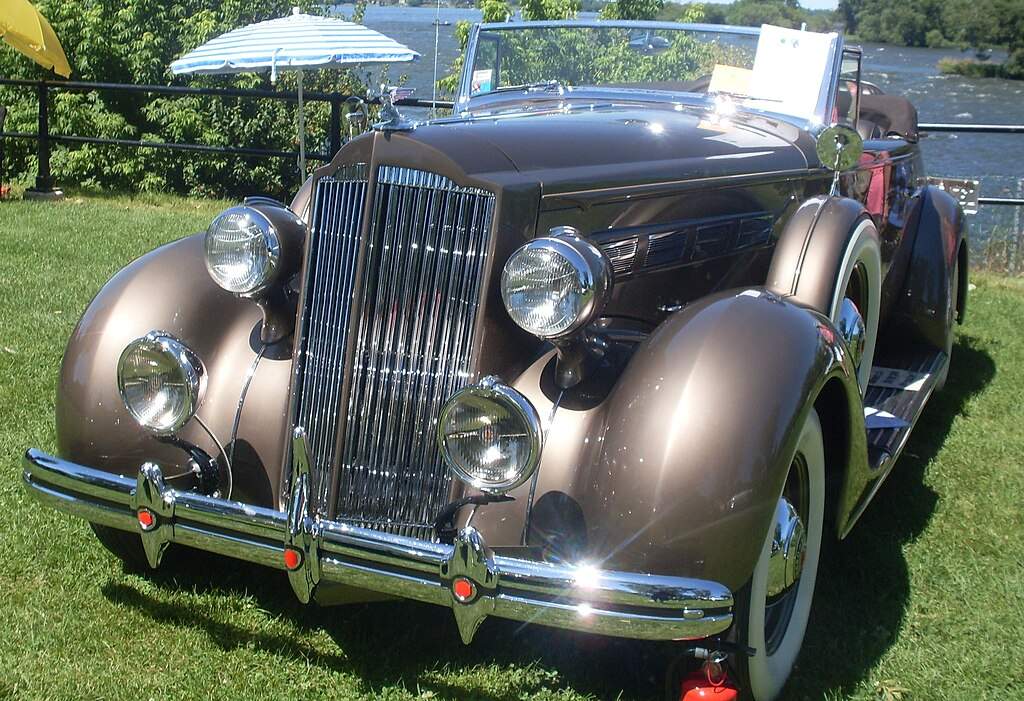

Featured Image by Bull-Doser, Public domain, via Wikimedia Commons
What was going on
The year was 1935. America still deeply felt the crushing weight of the Great Depression. Nevertheless, a palpable, cautious optimism began to flicker across the nation. The stock market collapse of 1929 fundamentally reshaped the American experience.
💵 Economy & Lifestyle
Cost of living remained a major concern. Though prices had fallen along with incomes, many families relied on extra wage earners to scrape by. Youth culture, though still deeply affected by scarcity, started seeking new forms of expression away from the austere reality. Furthermore, this period saw the government dramatically expanding its role in stabilizing the economy through massive federal works programs.
📰 News/Politics
Franklin D. Roosevelt’s New Deal dominated the political landscape. Major legislative actions were enacted to provide relief and long-term security. For example, the Works Progress Administration (WPA) and the landmark Social Security Act both became law. Isolationist sentiment remained strong throughout the year. Consequently, Congress passed the first Neutrality Act, trying to steer the U.S. clear of looming European conflicts.
🎵 Music
The airwaves swelled with a vibrant new sound. The raw energy of earlier jazz began yielding to the smoother, highly arranged style known as Swing. Big bands fronted by leaders like Benny Goodman and Duke Ellington defined this emergent “Swing Era,” giving restless Americans a much-needed rhythmic escape. Even Broadway contributed, with George Gershwin’s Porgy and Bess achieving major success.
🎥 Movies/TV
Hollywood offered grand escapism from the hardship. The Golden Age of film was in full swing, with studios delivering spectacle and fantasy. Major releases embraced lavish musical numbers and adventure, attempting to lift spirits. The revolutionary three-color Technicolor process was maturing, promising ever more eye-popping visual experiences for audiences who paid dimes for admission.
🏈 Sports
Professional sports offered rare moments of unified celebration. Detroit notably earned the rare title of “City of Champions” in 1935 after the Detroit Tigers won the World Series and the Detroit Lions won the NFL Championship. On the boxing stage, Joe Louis, a Detroit native, was rising rapidly toward his own long reign as Heavyweight Champion. Nationally, the New York Yankees dominated headlines throughout the decade, maintaining their powerhouse status in the American League, though the Tigers prevented them from reaching the World Series in 1935.
This era demanded both resilience and hope. Into this fragile economic landscape, a storied name took a momentous gamble. It introduced a vehicle intended to keep the Packard name alive. Furthermore, this car was aimed at a populace previously priced out of its luxury. The company debuted the Packard 120, positioning it perfectly as the aspiration for the striving middle class.
The 1935–1937 Packard 120: Luxury for the Masses
This era demanded both resilience and hope. Into this fragile economic landscape, a storied name took a momentous gamble. It introduced a vehicle intended to keep the Packard name alive. Furthermore, this car was aimed at a populace previously priced out of its luxury. The company debuted the Packard 120, positioning it perfectly as the aspiration for the striving middle class.
A Response to the Times

The Great Depression had cast a long shadow over the American automotive industry. Packard, a name corresponding with luxury and lavishness, found itself struggling to maintain its position in a market grappling with economic hardship. Recognizing the need for a more accessible luxury car, Packard introduced the 120 in 1935.
The “120” designation, derived from the car’s 120-inch wheelbase, hinted at its more modest size and price compared to Packard’s larger, more expensive models. However, “modest” was a relative term. The 120, while more compact than its predecessors, still exuded an aura of refinement and sophistication.
How People Reacted to It at Launch
The market reaction was swift and overwhelmingly positive. Many considered the One-Twenty the fastest-selling model in the immediate post-Depression era. Its success was instrumental in averting what many considered an “unlikely demise” for the venerable marque. This new car offered genuine Packard solidity, engineering, and style at a price accessible to white-collar workers who still possessed savings. Buyers immediately recognized the value proposition.
Vehicle Performance Stats (Packard 120 – 1935 Model)
- Engine: 257 cubic inch (4.2 L) L-head Inline-Eight
- Horsepower: 110 bhp @ 3850 rpm
- Transmission: 3-speed manual
- Suspension: Independent front suspension (Safe-T-Flex)
- Brakes: Hydraulic
- Curb Weight: Approximately 3,688 lb
Technical and Commercial Reception
The success of the Packard 120 was due to its verifiable facts, which were lauded across the automotive and business press:
- Technical Edge: The “Safe-T-Flex” independent front suspension was the car’s most lauded feature by engineering publications like the SAE Journal. This system utilized unequal A-arms with coil springs and immediately gave the Packard 120 a superior ride quality compared to most competitors who still used solid axles.
- Commercial Success: Business and trade reports were dominated by the car’s sales figures. Its phenomenal production total of 24,995 units for the 1935 model year was the definitive proof of concept, validating the risky “downmarket” strategy of General Manager Max Gilman. The press universally recognized this strategy as the move that kept the venerable Packard company solvent.
Competitors: The Battle for the Mid-Luxury Market
The Packard 120 did not enter an empty field; it faced established players eager to keep the recovering middle-market busy. Packard’s success was dependent on how well it could differentiate itself from these key rivals.
1. Chrysler Imperial Airflow

The Chrysler Imperial Airflow was positioned in the higher-tier segment of the market, which was significantly more expensive than the Packard 120’s price. Its focus was radical engineering rather than conventional style.
- Key Stats (Imperial Airflow C-2): 320 cubic inch Straight-Eight engine; up to 130 bhp; Unitized all-steel body construction; superior 50/50 weight distribution with passengers.
- Comparison to Packard 120: The Airflow offered a mechanical advantage with its pioneering unitized body (offering better rigidity and safety) and its engine-forward design that resulted in superior ride quality and handling—a physics advantage the Packard 120’s traditional chassis could not match. However, its downfall was its looks: the Airflow’s streamlined, futuristic silhouette was rejected by buyers who preferred the traditional elegance of the Packard.
2. LaSalle (General Motors)

The LaSalle, GM’s companion marque to Cadillac, was a direct styling rival to the Packard, aiming for the same sophisticated, entry-level luxury buyer.
- Key Stats (LaSalle Series 35-50): 248 cubic inch V8 engine (a major difference from the Packard’s Inline-Eight); 105 bhp; Synchromesh transmission.
- Comparison to Packard 120: The LaSalle’s chief advantage was its Cadillac-engineered V8 engine, which offered smoother operation than most inline engines of the era. The LaSalle also had a strong reputation for styling under the influence of designer Harley Earl. However, the Packard 120 had a slight horsepower advantage and, critically, the unrivaled cachet of the Packard name itself, which buyers felt transcended GM’s attempt at near-luxury.
3. Buick Buick Series 60

Buick, specifically the Series 60 (Century) and Series 90 (Limited), represented the traditional high-volume choice in the upscale market segment, known for their robust build quality and powerful engines.
- Key Stats (Buick Series 60): 278 cubic inch Valve-in-Head Straight-Eight engine; 100 bhp; new “Turret Top” all-steel roof (General Motors safety feature).
- Comparison to Packard 120: Buick offered the safety of GM’s all-steel roof construction across all its models. The Packard 120 slightly surpassed the Buick in raw horsepower and introduced a more modern independent front suspension (Safe-T-Flex) that gave it a significant ride comfort advantage over the Buick’s solid axle design. Packard also benefited from the perception of being a true independent luxury brand, whereas Buick was known as the top tier of a mass-market corporation.
Summary of Competitive Comparison
The success of the Packard 120 was not due to a single overwhelming technical superiority but to a masterful balance of factors that perfectly met the economic and psychological demands of 1935.
In terms of Engineering and Ride Quality, the Chrysler Imperial Airflow was technically superior, offering a safer, more rigid body and a revolutionary suspension geometry. However, its radical styling and higher price led to its commercial failure. The Packard 120, by contrast, achieved a market advantage over the conventional designs of LaSalle and Buick by introducing its own modern refinement, the Safe-T-Flex independent front suspension, and by delivering respectable horsepower that was comparable or slightly better than its most direct volume rivals.
In the realm of Brand Cachet and Styling, Packard was unbeatable. The LaSalle, though an attractive GM product, could not match the emotional resonance of the Packard crest. Buyers understood the Packard 120 to be a genuine, if smaller, luxury car, whereas the LaSalle was merely a near-luxury creation. By maintaining a traditional, elegant look, the Packard 120 avoided the market rejection that plagued the highly innovative, yet polarizing, Chrysler Airflow.
Ultimately, the Packard 120 won the fierce battle for the mid-luxury dollar by offering the highest perceived prestige at the most aggressive price point, while still including key modern engineering features that surpassed its nearest volume competitors like Buick.
A Design Triumph

The 120’s styling was a triumph. Clean, flowing lines, sweeping fenders, and a prominent chrome grille with vertical bars created a visual signature that was both elegant and imposing. The car’s Art Deco influences were evident in its streamlined silhouette and the graceful curves of its bodywork. A wide range of body styles catered to diverse tastes, from sedans and coupes to convertibles and station wagons, ensuring there was a 120 to suit every preference.
A Refined Interior
Inside, the 120 offered an environment of refined luxury. High-quality materials, such as leather and wood, were used throughout the cabin. The instrument panel, while simple by today’s standards, was well-designed and easy to read, providing the driver with all the necessary information.

Under The Hood
Powering the 120 was a robust 257 cubic-inch (4.2-liter) straight-eight engine, delivering a respectable 110 horsepower. This engine, while not overly powerful by modern standards, provided ample power for comfortable cruising and effortless highway driving.

The 120 exhibited surprisingly good handling for its era. Independent front suspension, a relatively advanced feature at the time, contributed to a smooth and responsive ride. Hydraulic brakes offered improved stopping power compared to earlier mechanical systems, enhancing safety and driver confidence.
A New Era for Packard

The 120 proved to be a resounding success, revitalizing Packard’s fortunes and solidifying its position as a leading manufacturer of luxury automobiles. It attracted a new wave of buyers who sought a taste of luxury without the exorbitant price tag of Packard’s larger models.
The 120’s impact extended beyond sales figures. It established a new standard for luxury in the American market, demonstrating that elegance and refinement could be achieved within a more accessible price range.
A Lasting Legacy
Today, the 1935–1937 Packard 120 remains a highly sought-after classic car. Its timeless design, robust engineering, and historical significance continue to captivate collectors and enthusiasts worldwide. The 120 stands as a testament to Packard’s enduring legacy, a reminder of an era when American automotive craftsmanship reigned supreme.


.jpg)