

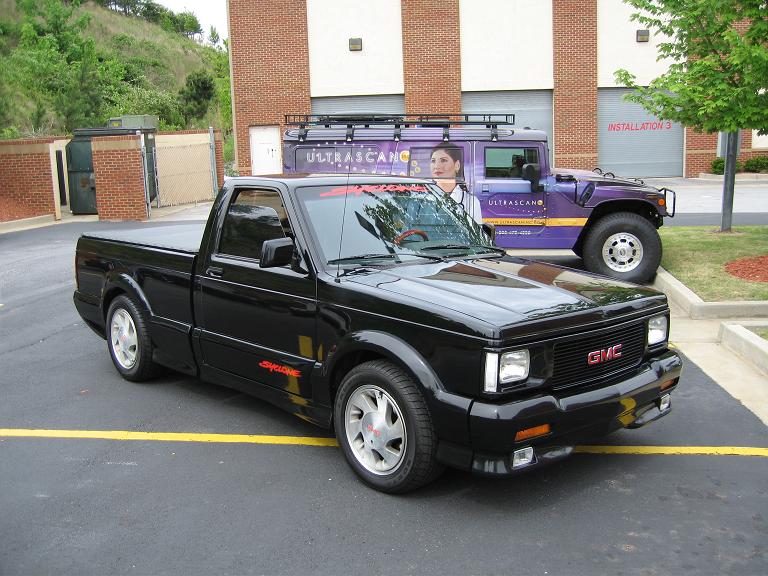

Featured Image from Willyson at English Wikipedia, Public domain, via Wikimedia Commons
Introduction
The GMC Syclone stands as one of the most unexpected and legendary performance machines ever produced by an American automaker, radically redefining the compact pickup truck segment. Launched in 1991, this monochromatic, all-wheel-drive terror was engineered with a turbocharged V6 to deliver supercar-slaying acceleration, a feat unheard of for a vehicle with a cargo bed. It instantly earned a reputation for humbling expensive exotics, setting a new global benchmark for quickness that endures in automotive folklore today. However, this vehicle did not debut in a vacuum; to truly understand the Syclone’s audacious existence, one must first look at the unique social, political, and cultural climate of the early 1990s that shaped its arrival.
What Was Going On?
💵 Economy & Lifestyle
The United States was in the midst of a recession during this time. Consequently, the cost of living remained relatively stable, and inflation rates slowed compared to previous years. The price of gas, which had spiked due to the Middle East conflict in 1990, began to ease in 1991, offering some relief to drivers. For many young Americans, this period fostered a sense of disillusionment and anti-establishment sentiment, which directly influenced youth culture and consumption habits. Ultimately, this economic environment created a market hungry for exciting, high-value performance.
📰 News/Politics
Globally, the year was defined by the end of the Cold War era. Operation Desert Storm saw U.S.-led coalition forces successfully eject Iraqi troops from Kuwait. Furthermore, the world watched as the Soviet Union began its dramatic dissolution into separate states, fundamentally reshaping the political map. Back home, a videotaped beating of Rodney King by LAPD officers in March of 1991 sparked a national conversation about police accountability and systemic injustice, highlighting deep social rifts.
🎵 Music
Musically, 1991 marks a pivotal year that shifted the mainstream sound. Grunge exploded onto the scene, led by bands like Nirvana and Pearl Jam. They offered an authentic, raw alternative to the polished hair metal that dominated the late 1980s. Meanwhile, hip-hop cemented its place as a powerhouse genre, with acts like N.W.A. and A Tribe Called Quest releasing influential, culture-defining albums. Consequently, this year challenged established norms in the music charts forever.
🎥 Movies/TV
The silver screen offered blockbuster escapism and critically acclaimed thrillers. Terminator 2: Judgment Day captivated audiences with groundbreaking special effects and a thrilling sci-fi narrative. Furthermore, the year delivered dark suspense with The Silence of the Lambs, which would sweep the Oscars the following year. Disney also enjoyed a major success with the animated classic Beauty and the Beast. These major releases showed that Hollywood was embracing both technological spectacle and complex storytelling.
🏈 Sports
In the world of American sports, dynasties began their ascendance. Michael Jordan finally secured his first NBA Championship with the Chicago Bulls, marking the start of a legendary run. Additionally, the Minnesota Twins defeated the Atlanta Braves in a World Series widely considered one of the greatest ever played, where five games were decided by a single run. In the NFL, the Washington Redskins dominated the season, eventually winning Super Bowl XXVI. Therefore, 1991 became synonymous with the triumph of rising stars and dramatic underdog victories.
Against this backdrop of cultural disruption, economic uncertainty, and rising athletic greatness, a manufacturer known for utility and reliability launched something utterly unexpected. The GMC Syclone arrived as a perfectly cynical, over-the-top performance statement, ready to challenge everything drivers thought they knew about performance.
Position the Car in Its Time

The Syclone was the brainchild of GMC’s desire to create a “halo” vehicle, injecting excitement into the truck division after the end of the legendary Buick Grand National production. GMC engineers collaborated with Production Automotive Services (PAS) to build the fastest production vehicle possible using the compact Sonoma pickup chassis. They aimed for sheer acceleration. At launch, the reaction was stunned disbelief; journalists and enthusiasts could not believe a pickup truck could outperform true sports cars. Ultimately, the Syclone’s performance immediately overshadowed its utility, as its meager 500-pound payload rating emphasized its purpose as a high-speed novelty.
GMC Syclone
Vehicle Performance Stats
- Engine: 4.3L Turbocharged V6 (LB4) with a Mitsubishi TD06-17C turbocharger and Garrett liquid-intercooler
- Horsepower: 280 hp
- Torque: 350 lb-ft
- Transmission: 4-speed automatic (4L60)
- Drivetrain: Full-Time All-Wheel Drive (35% front / 65% rear torque split)
- 0–60 mph: 4.3 seconds
- Quarter-Mile: 13.4 seconds
- Production Total: 2,995 units (1991 model year only)
Journalist Reviews at the Time
Period reviewers were captivated by the truck’s launch capability and its deceptive nature.
Car and Driver magazine famously stated that the Syclone’s existence meant “Never before has the word ‘truck’ been synonymous with ‘Ferrari-baiter.'” This quote highlighted the vehicle’s shocking ability to out-accelerate exotic machinery. Specifically, the Syclone’s all-wheel-drive system allowed journalists to repeatedly replicate the spectacular 4.3-second 0-60 mph sprint, a feat unmatched by any rear-wheel-drive vehicle at its price point.
Other journalists praised the truck’s excellent straight-line speed but also noted its compromised handling when compared to dedicated sports coupes. Autoweek called the Syclone a “very exciting toy” and a tool that could “get down to some serious—if limited—business.” They cautioned drivers that its 500-pound payload and lack of ABS in the rear meant the truck demanded respectful handling, particularly during braking.
Competitors
The GMC Syclone had no direct truck rivals in 1991. It competed solely against top-tier domestic and international sports cars based on performance figures. Direct competitors included the era’s flagship vehicles from Chevrolet and Ferrari.
Chevrolet Corvette (C4) ZR-1

Manufacturer: Chevrolet
The ZR-1 represented the absolute peak of American performance at the time. This specialized Corvette variant, known as the “King of the Hill,” featured a unique, all-aluminum engine co-designed with Lotus. Consequently, it boasted the highest horsepower figures from a domestic automaker.
- Vehicle Performance Stats
- Engine: 5.7L LT5 V8 (Dual Overhead Cam, 32-valve)
- Horsepower: 375 hp
- Torque: 370 lb-ft
- 0–60 mph: ~4.9 seconds
- Quarter-Mile: ~13.2 seconds
Comparison: In contrast to the Syclone, the mighty ZR-1 was a dedicated track machine. Yet, the Syclone’s sophisticated AWD and turbocharged low-end torque delivered a superior launch, beating the ZR-1 to 60 mph. However, because the ZR-1 boasted 95 more horsepower, it would quickly overcome the truck. It often edged out the Syclone in the quarter-mile, demonstrating its superior high-end speed. The ZR-1, therefore, remained the faster car, but the Syclone was quicker off the line.
Ferrari 348 ts

Manufacturer: Ferrari
Ferrari embodied exotic performance, utilizing classic mid-engine design and a high-revving V8, commanding a price tag many times higher than the GMC.
- Vehicle Performance Stats
- Engine: 3.4L Naturally Aspirated V8
- Horsepower: 300 hp
- Torque: 224 lb-ft
- 0–60 mph: ~5.6 seconds
- Quarter-Mile: ~14.5 seconds
Comparison: The $122,000 Ferrari suffered a public defeat against the $25,500 Syclone in a famous drag race. Specifically, the Ferrari’s lack of torque and reliance on rear-wheel drive meant the Syclone simply pulled away at the start. Therefore, the humble GMC earned permanent bragging rights as the vehicle that humbled the Italian exotic. The Ferrari did, however, maintain a significant advantage in handling and top speed.
Complete Summary of Competitor Comparisons
The GMC Syclone was engineered to be a singular purpose vehicle: a straight-line terror. It succeeded brilliantly. The truck’s AWD system provided the critical advantage, instantly mitigating wheel spin and translating power into forward motion with brutal efficiency. The Syclone consistently beat high-end cars, even the powerful ZR-1, in the crucial 0-to-60 mph sprint. While the ZR-1 and Ferrari had superior top speeds and track prowess, the Syclone dominated the street’s most common contest: the quick launch. Ultimately, the Syclone proved that domestic ingenuity could challenge, and often surpass, the world’s most renowned performance machines in pure acceleration.
Racing & Cultural Impact

The Syclone’s Motorsports history is defined by its success in unsanctioned street racing and drag racing culture. The Syclone’s unique launch ability made it a legend in the world of stoplight battles. Drivers appreciated its ability to hide immense speed behind a standard truck façade. Consequently, it became the ultimate “sleeper.” Owners quickly learned the limits of the stock engine internals, yet the Syclone community rapidly developed aftermarket upgrades, further enhancing its reputation on the quarter-mile circuit. In pop culture, the Syclone solidified its status by achieving the cover of Car and Driver. Additionally, GMC used ten special edition Marlboro Syclones as prizes for the Marlboro Racing contest in 1992, further embedding the truck in performance media and marketing narratives of the era.
What It Means Today
Collector Value Due to its single-year production run of just under 3,000 units, the GMC Syclone has retained a strong collector value. Low-mileage examples frequently sell for significant figures at auction, often appreciating well beyond their original sticker price. Its rarity ensures sustained interest in the classic car market.
Enthusiast Following The enthusiast following for the Syclone remains intensely loyal. Owners and fans participate in dedicated clubs and online communities focused on preservation and performance modifications. Furthermore, its unique place in history makes it a highly celebrated part of the performance truck segment.
Legacy The Syclone’s most important legacy is its influence on the entire automotive industry. It proved to major manufacturers that a performance-focused utility vehicle was not only possible but desirable. Ultimately, the Syclone laid the groundwork for modern, high-horsepower trucks like the Ford F-150 Raptor and the Ram 1500 TRX.
Conclusion
The GMC Syclone stands as a powerful testament to daring engineering. Launched during a period of cultural upheaval and economic caution, the black pickup served as a powerful, cynical statement that American muscle could triumph over European prestige. Its limited production and legendary speed secured its place in history, ensuring that the Syclone’s legacy as the original supercar-slaying truck endures today.
Sources
Tested: 1991 GMC Syclone vs. Ferrari 348ts – Car and Driver
- Credit Use: Performance stats (0-60, 1/4 mile), comparison narrative, and the quote mentioning “Ferrari-baiter.”
1991 GMC Syclone – International SyTy Registry
- Credit Use: Engine specs, production figures, and original engineering details.
GMC Syclone Market – CLASSIC.COM
- Credit Use: Collector value, market appreciation, and rarity.
The Iconic GMC Syclone: Redefining High-Performance Trucks in the Early ’90s – Vision Buick GMC (For legacy discussion)
- Credit Use: Legacy and influence on the modern performance truck segment (Raptor/TRX)


.jpg)