
Featured Image by Public Domain, CC BY-SA 4.0, via Wikimedia Commons
What Was Going On: The External Climate
💵 Economy & Lifestyle
Wartime economic boom from 1915 to 1918 created both opportunity and upheaval. Factory wages doubled between 1914 and 1919, but the 72.4% cost-of-living rise made families struggle. Near the end, gasoline cost about 25 cents per gallon for car owners. War production pulled workers into factories, causing urbanization and a shift from farms. Youth rejected Victorian codes, enjoying movies and dancing, promising a new age.
📰 News/Politics
The European conflict transformed into a World War, which the U.S. initially resisted. After the Lusitania sank in 1915 and Germany resumed unrestricted submarine warfare, the U.S. joined the war in April 1917. This major political choice brought the Selective Service Act and mobilized millions of men. Progressive movements rose; Jeannette Rankin became the first woman in the House of Representatives, boosting suffrage.
🎵 Music
Ragtime exploded commercially; Jazz gained national interest as Victorola phonographs made records accessible. The Original Dixieland Jazz Band and their syncopated rhythms, like “Tiger Rag,” grew popular in major cities. However, Tin Pan Alley patriotic songs remained the most dominant genre. “I Didn’t Raise My Boy” (1915) showed neutrality, but George M. Cohan’s “Over There” (1917) boosted national morale.
🎥 Movies/TV
The silent film era peaked, fundamentally shaping American culture. D.W. Griffith’s epic, The Birth of a Nation (1915), became a phenomenon, setting new standards for film scope. People quickly weaponized the medium for the war, using stars like Chaplin and Pickford to promote Liberty Bonds. Movies soon became primary mass entertainment, drawing huge audiences and creating the first global movie stars.
🏈 Sports
The war profoundly impacted Baseball, still called the “national pastime.” Hundreds of MLB players enlisted or took essential industrial jobs to avoid the draft. The war effort shortened the 1918 season; the Boston Red Sox won the World Series with Babe Ruth. During the 1918 World Series, people began playing “The Star-Spangled Banner,” cementing a lasting tradition.
The African American Experience
This specific period was a crucible of change for Black Americans, characterized by both massive upheaval and fierce ambition. The two most dominant forces shaping life were the Great Migration and the impact of World War I.
The Great Migration’s Peak
Thousands of Black southerners fled the economic oppression of sharecropping and the terror of Jim Crow laws, seeking better lives in northern industrial centers. The years between 1916 and 1918 saw the greatest volume of this unprecedented northward movement. Furthermore, northern industries, desperate for labor to support the war effort, actively recruited this new workforce. These migrants created a new urban Black proletariat, which consequently laid the groundwork for future political and economic power, even in the face of new forms of Northern segregation.
Wartime Service and the “Double V”
Over 380,000 Black men served in the segregated U.S. armed forces, with approximately 200,000 deployed to Europe. Many Black leaders, including W.E.B. Du Bois, urged them to “Close Ranks” and serve with distinction, hoping that patriotism would earn them equal rights—a “Double V” for victory over Fascism abroad and racism at home. For example, the 369th Infantry Regiment, the “Harlem Hellfighters,” gained legendary status after serving in continuous combat for a record number of days with the French Army, demonstrating bravery that was recognized internationally, though often ignored at home.
Surging Racial Violence
Despite the calls for national unity, this era was marred by a violent resurgence of white supremacy. The Ku Klux Klan was reborn in 1915, and their lynchings of Black citizens rose steadily throughout the war. Furthermore, as migrants arrived in the North, racial friction flared, resulting in devastating race riots in cities like East St. Louis in 1917, where dozens of Black people were killed.
Rising Black Business and Advocacy
Within this turmoil, a resilient movement for self-determination gained strength, championing Black-owned businesses as the path to true independence. Leaders like Booker T. Washington and Frederick Patterson himself promoted economic autonomy through the National Negro Business League. Consequently, the NAACP achieved a landmark legal victory in 1915 when the Supreme Court struck down the “grandfather clause,” a key instrument used to prevent Black Americans from voting.
Against this backdrop of intense struggle, patriotic contribution, and growing self-confidence, Frederick Patterson moved his family’s successful carriage business, founded by his formerly enslaved father, Charles Richard Patterson, into the bold new world of automotive manufacturing. This transition was a direct, entrepreneurial response to the economic forces and the social pressures of the time.
C.R. Patterson & Sons: The Patterson-Greenfield
From Carriages to Cars: The Patterson-Greenfield Story
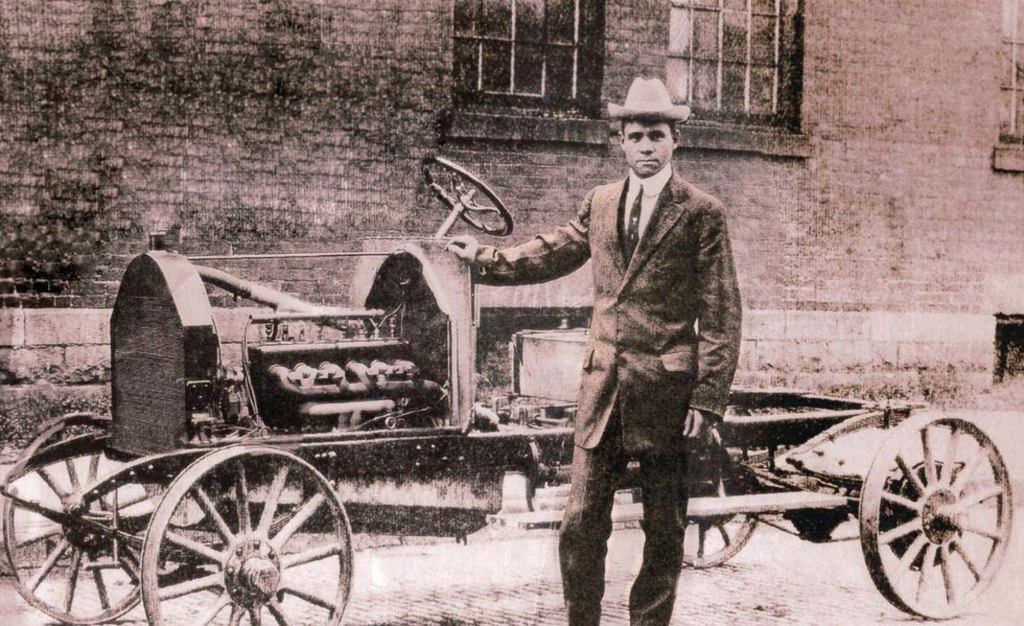
The Patterson-Greenfield automobile was produced by C.R. Patterson & Sons of Greenfield, Ohio. This firm achieved historical distinction by becoming The Only Black-Owned Automaker in the United States. The company’s origins trace back to a carriage business established by Charles Richard Patterson, a man who escaped slavery in Virginia to become a successful blacksmith and entrepreneur in Ohio. After Charles died in 1910, his son, Frederick Douglass Patterson, a college-educated businessman and civil rights advocate, pivoted the successful carriage-making firm to the new automotive future. The company utilized an integrated workforce of skilled craftsmen, which was highly unusual during this racially charged period of history.
Performance Stats
The Patterson-Greenfield was designed for quality and value, aiming for the high-end carriage buyer rather than the mass market. It was a custom-built vehicle, produced in small numbers (estimated between 30 and 150 units) between 1915 and 1918.
- Engine: The car featured a robust, purchased Continental 4-cylinder engine, rated to produce between 30 and 40 horsepower.
- Top Speed: The vehicle was capable of reaching a top speed of approximately 50 miles per hour.
- Key Features: It included modern features that were not standard on cheaper models, such as an electric starter, electric lighting, a full-floating rear axle, cantilever suspension springs for a smoother ride, and a split windshield for ventilation.
The Ford Model T Comparison
The greatest challenge to the Patterson-Greenfield was the industrial giant, the Ford Motor Company, and its revolutionary Model T. The Patterson car was positioned as a quality, hand-built alternative, but it simply could not compete with the sheer scale and efficiency of mass production.
- Patterson-Greenfield: The car was custom-made and sold for a price of $685 to $850. It was marketed as a luxurious and dependable family vehicle, comparable in quality to more expensive, upscale brands.
- Ford Model T: Ford, which had perfected the assembly line, produced the Model T in massive quantities, reducing its price dramatically during this period. By 1917, the Model T’s base price was often below $400, making it accessible to the common worker and dominating the market. The volume of production was staggering, with Ford producing hundreds of thousands of units per year, eclipsing the small, custom output of the Patterson firm.
Complete Summary of Competitor Comparisons
The comparison reveals the core difficulty for the Patterson-Greenfield: it was a quality, hand-built product entering a market that was rapidly transitioning to high-volume, cost-cutting mass production led by Ford. While the Patterson vehicle offered superior features and craftsmanship for a competitive price against higher-end rivals, the sheer affordability and availability of the Model T made the custom-built business model quickly unsustainable.
This challenge forced a major decision for The Only Black-Owned Automaker of the era. Frederick Patterson demonstrated profound business acumen by recognizing this market reality; therefore, he ceased car production in 1918 to concentrate the company’s efforts on the burgeoning commercial market by manufacturing specialized truck and bus bodies, a niche where custom quality and bespoke design still commanded a strong price. The company successfully sustained this focus for two more decades.
Transition and Triumph: The Greenfield Bus Body Company

The story of the Patterson-Greenfield car, while significant, proved to be only a transitional chapter in the company’s long history. After struggling to compete with the assembly-line efficiency of Henry Ford’s mass-market strategy, Frederick Patterson demonstrated his remarkable business acumen by executing a complete strategic pivot in 1918. He recognized that the future of their manufacturing success lay not in the competitive passenger car market, but in the highly specialized and growing commercial vehicle sector.
From Full Vehicle to Custom Bodywork
In the early 1920s, C.R. Patterson & Sons officially reorganized and became the Greenfield Bus Body Company. This change signaled the company’s new focus on manufacturing high-quality, custom-built bodies for trucks and buses. This specialty niche offered a distinct advantage because it required the old-world craftsmanship of a carriage maker, a skill set that had been the Patterson family’s strength for decades. The company’s status as The Only Black-Owned Automaker continued to be a silent but powerful symbol of economic independence. The company shifted from building a complete, drivable automobile to expertly crafting the cabin and passenger sections, which were then fitted onto chassis purchased from larger manufacturers like Ford and General Motors.
Performance Stats
Success in this commercial sector was not measured by top speed, but by durability, passenger capacity, and bespoke design. The company’s products gained a reputation for being sturdy and reliable, upholding the Patterson slogan: “If it’s a Patterson it’s a good one.”
- Primary Product: The firm’s most successful product was the school bus body, a booming market as rural schools across America began consolidating.
- Production Volume: At its peak in the 1920s, the company was the largest Black-owned manufacturing firm in the nation, employing an integrated workforce of over 70 individuals. Production volumes were impressive, with reports indicating they built as many as 500 bus bodies per month at the height of their success.
- Market Share: The company’s regional dominance was undeniable. At one point, approximately one-third of all school buses operating in Ohio, Indiana, Kentucky, West Virginia, and Pennsylvania featured a “Patterson-Built” body.
General Commercial Body Builders Comparison
The Greenfield Bus Body Company was able to effectively outmaneuver the large auto giants in this specific market by focusing on customization and quality. Unlike Henry Ford’s emphasis on mass-produced identical passenger cars, commercial clients like school boards, transit companies, dairies, and furniture movers required specialized bodies designed for specific, often heavy-duty, purposes.
- Greenfield Bus Body Co.: The company specialized in crafting robust, durable bodies for a variety of needs, including hearses, insulated cargo trucks, and multi-passenger transit buses, in addition to the school bus line. Their ability to deliver customized, high-quality wood and metal bodies quickly was their competitive edge.
- Large Auto Manufacturers (Ford/GM): These companies focused on chassis production and standard truck models, often leaving the complicated, bespoke bodywork to smaller, specialized firms. Therefore, Patterson’s company was able to partner with, rather than directly compete against, the Detroit auto titans by purchasing their chassis and transforming them into finished commercial products.
Complete Summary of Competitor Comparisons
The successful transition to truck and bus bodies proved Frederick Patterson’s ingenuity, moving the company from an impossible competition against Ford’s assembly line to a profitable partnership in a specialized industrial niche. The commercial market valued the hand-built quality and the customization capabilities inherited from the company’s carriage-making days. Furthermore, the longevity and success of the firm demonstrated the resilience and skill of The Only Black-Owned Automaker in a segregated America. Thus, this strategic pivot not only allowed the company to survive but also ensured that The Only Black-Owned Automaker thrived as the largest Black-owned manufacturer in the U.S. for an entire decade. Despite this success and Frederick Patterson’s involvement in the National Negro Business League, he often relied on sending a white proxy to meet with customers in a deeply segregated America, showcasing the constant necessity of navigating racial barriers even when operating a superior enterprise.
The End of an Era
Frederick Patterson passed away in 1932, near the height of the Great Depression. Although his son, Postell Patterson, took the reins, the crippling effects of the economic collapse were insurmountable. Coupled with the increasing trend toward consolidation and the massive capital needed for new equipment in the rapidly modernizing industry, the business struggled to secure the necessary financing to survive. The Only Black-Owned Automaker had fought the good fight through three generations of change. After a brief reorganization and move in 1938, the company, renamed the Gallia Body Company, was ultimately forced to close its doors in 1939. After 74 years and three generations, a unique and pioneering chapter in African American industrial history came to a close, solidifying the legacy of The Only Black-Owned Automaker.
Article Source Links
C.R. Patterson & Sons Company (1893-1939)
The C. R. Patterson & Sons Company – Remarkable Ohio
C.R. Patterson & Sons – The First Black Owned Car Company
C.R. Patterson and Sons | Black History, Automobiles, & Patterson-Greenfield Car
The Little-Known Tale of the Only African American Automaker
A Black-Owned Company Built Cincinnati’s First Buses
Frederick D. Patterson (1901-1988)
Frederick Douglass Patterson – The Clerk’s Black History Series