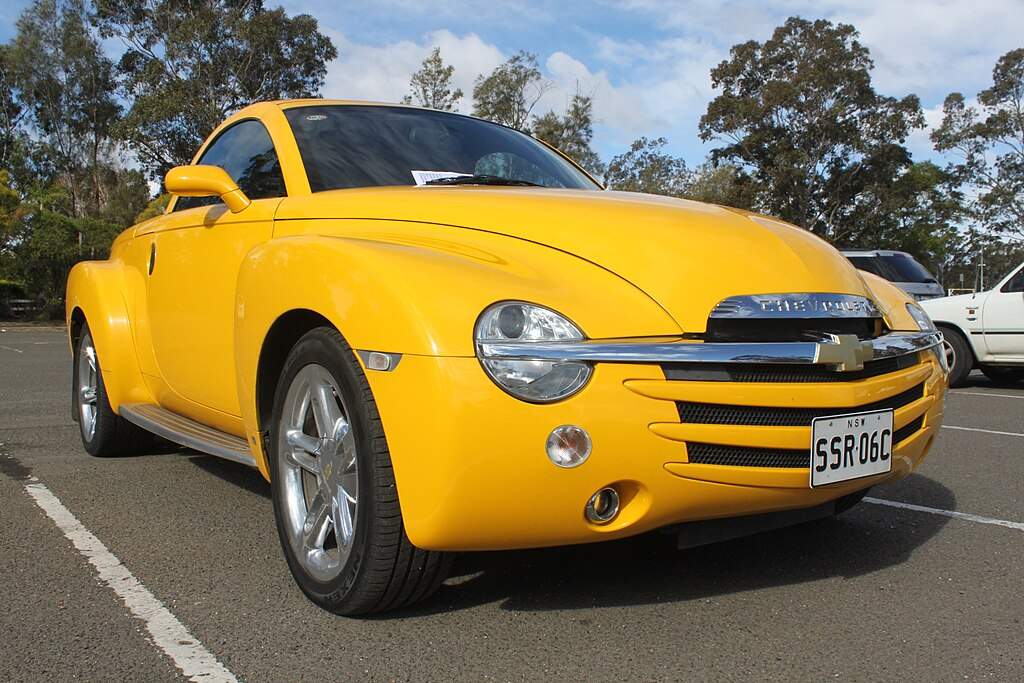

Jeremy, CC BY 2.0, via Wikimedia Commons
Chevrolet engineered the SSR as a daring departure from traditional automotive design, aiming to capture the hearts of nostalgia-driven buyers during the early 2000s. This unique machine, formally known as the Super Sport Roadster, combined the bulging fenders of a late-1940s Advance Design pickup with the modern convenience of a power-retractable hardtop. While many critics initially struggled to categorize it, the vehicle served as a high-profile “halo” car intended to inject excitement into the brand’s lineup. Specifically, it was designed to bridge the gap between heavy-duty heritage and modern lifestyle luxury. Underneath its curvaceous body sat a sturdy truck frame the GMT360 platform, yet its soul leaned toward the flamboyant world of custom street rods. Today, it stands as a testament to a time when major manufacturers were willing to take massive risks on niche, experimental concepts.
What Was Going On?
The dawn of the 21st century arrived with a strange mixture of optimism and anxiety as the world adjusted to a new millennium. During this period, the global community was still recalibrating after the excitement and relief of the Y2K transition. Initially, the economy faced hurdles following the dot-com bubble burst, which wiped out massive amounts of speculative paper wealth. However, by 2003, a massive real estate boom began to take hold of the national economy. Low interest rates encouraged Americans to view their suburban homes as reliable piggy banks for consumer spending. This newfound equity fueled a surge in luxury spending across almost every sector of the automotive market. Consequently, consumers flocked to “lifestyle” vehicles that prioritized style and personal expression over sheer practical utility. In this environment, expensive toys like the SSR found a narrow but eager demographic of affluent buyers.
💸 Economy and Lifestyle
Meanwhile, gas prices hovered around $1.50 to $1.80 per gallon, which represented a significant rise from the 1990s levels. Despite these rising costs, the American public remained obsessed with large, powerful engines and high-displacement performance. Jobs in the suburban service and construction sectors were growing rapidly, and the “McMansion” became the ultimate status symbol of the decade. Culturally, there was a deep, palpable yearning for a simpler and more recognizable time during these rapid technological shifts. This “retro-futurism” influenced everything from kitchen appliances to major architectural projects and fashion trends. People wanted the comfort of the past combined with the reliability of the future. Consequently, the SSR’s rounded fenders served as a visual balm for a society moving into an uncertain digital age.
🏛️ News and Politics
Politically, the landscape was entirely dominated by the aftermath of the September 11 attacks and the resulting policy shifts. The United States officially entered the Iraq War in early 2003, a move that colored the entire national mood. This conflict led to a surge in overt patriotism and a preference for iconic American brands that felt traditional. In the news, stories about the burgeoning “War on Terror” sat alongside headlines about the first successful human genome sequencing. At the same time, the Department of Homeland Security became a permanent fixture in the American household. This era felt both high-tech and traditionalist, creating a perfect environment for a vehicle that looked backward while moving forward. National pride was at an all-time high, and domestic manufacturers leaned heavily into their classic design roots.
🎵 Music and Entertainment
The airwaves were a battlefield between pop princesses and hip-hop icons like Beyoncé and 50 Cent. Simultaneously, the silver screen saw The Lord of the Rings sweep the Oscars, while Finding Nemo showcased digital animation leaps. Television was transformed as reality TV exploded with American Idol, turning ordinary people into overnight celebrities. This obsession with the “extraordinary” meant drivers didn’t just want a car—they wanted a conversation piece that could command the spotlight at any stoplight.
🏆 Sports
The sports world was defined by the birth of new dynasties and the shattering of old ghosts. The New England Patriots were cementing their dominance under Tom Brady, mirroring the SSR’s attempt at performance leadership. Most iconic to the “retro” era was the 2004 Boston Red Sox finally breaking the 86-year-old “Curse of the Bambino.” This triumph proved that even the most stubborn history could be rewritten—a sentiment Chevy hoped to capture by modernizing a classic 1947 design for the 21st century.
Transition to the Machine
These varied cultural forces converged to create a market where logic often took a backseat to pure, unadulterated emotion. The SSR was not a response to a practical need, but rather a response to a cultural vibe. It was a rolling celebration of American optimism and mechanical excess during a time of great change. As we pivot from the world stage to the garage, it becomes clear why Chevrolet felt the time was right for a truck that could lose its roof.
Position the Car in Its Time

Chevrolet created the SSR because they wanted to prove that a corporate giant could still be “cool” and innovative. During the late 1990s, flamboyant concept cars were the stars of every major international auto show. When the SSR concept debuted at the Detroit Auto Show in 2000, the reaction was electric and immediate. Executives saw the frenzy and decided to fast-track the project into production to capitalize on the retro-styling trend. They utilized a modified version of the GMT360 platform, which also underpinned the reliable Chevrolet TrailBlazer. By doing this, they saved millions in development costs while creating something that looked entirely bespoke and hand-built.
A Masterpiece of “Digital Birth”
What many don’t realize is that the Chevrolet SSR was a pioneer in engineering history. It was one of General Motors’ first vehicles to be designed almost entirely in a digital environment. Using 3D math models and virtual reality goggles, designers bypassed the traditional months-long clay modeling process to speed the car toward production. However, moving from screen to steel revealed a challenge: those deep, 1940s-style fenders were so curvaceous that modern stamping machines couldn’t form them without tearing the metal. Chevrolet had to “re-learn” the lost art of deep-draw stamping, utilizing a specialized process called Inverted Toggle Draw to give the SSR its iconic, muscular hips.
The Michael Bay Debut
To launch this “Super Sport” icon, Chevrolet went full Hollywood. They hired action movie director Michael Bay to direct the SSR’s debut commercial. The ad, titled “Car Carrier” (verified here via Encyclopedia.com’s business history), featured a fleet of new Chevrolets—led by the Slingshot Yellow SSR—performing high-speed stunts to the tune of Steppenwolf’s “Magic Carpet Ride.” The Money Shot: The commercial famously ends with the SSR dramatically backing onto a moving car carrier at highway speeds.
Initially, the public reaction at launch was a mix of awe and deep financial confusion. When the first production units arrived in 2003, people loved the styling but balked at the high price tag. With an original MSRP starting around $42,000, it was significantly more expensive than a Corvette. Moreover, the early 2003 and 2004 models featured a 5.3-liter Vortec V8 that some felt lacked the “muscle” promised by those massive rear fenders. This engine produced 300 horsepower and 331 lb-ft of torque, which had to move nearly 4,760 pounds of steel. As a result, the early SSR required about 7.7 seconds to reach 60 mph from a standstill. While respectable for a truck, these numbers failed to impress the high-performance crowd.
The performance narrative changed dramatically in 2005 when Chevrolet decided to give the SSR a heart transplant. They introduced the 6.0-liter LS2 V8, the same high-output engine found in the C6 Corvette and the Pontiac GTO. This new powerplant pushed the output to a formidable 390 horsepower and 405 lb-ft of torque. For the final 2006 model year, Chevrolet tweaked the LS2 even further. Models equipped with the 4-speed automatic transmission produced 395 horsepower, while those with the new Tremec 6-speed manual reached a full 400 horsepower. This massive increase in power slashed the 0-60 time to a blistering 5.3 seconds. Suddenly, the SSR had the “super sport” performance to match its aggressive, wide-hipped stance.
The SSR eventually found its way into the heart of pop culture, often appearing as the ultimate California cruiser. Imagine a warm evening in 2004 on the Sunset Strip. A Slingshot Yellow SSR pulls up to a premier at the Grauman’s Chinese Theatre. The driver, a rising Hollywood producer, presses a button to activate the roof. Passersby stop and stare, unsure if they are looking at a vintage hot rod or a prop from a sci-fi movie. It appeared in music videos and became a frequent prize on national game shows. Even Richard Hammond famously drove one across Central Europe in an episode of The Grand Tour, cementing its status as a global curiosity.
Why It Was Overlooked: The Anatomy of a Misfire
Despite the high-profile marketing and the LS2 upgrade, the Chevrolet SSR struggled to find its footing. To understand why it was overlooked, we have to look at the fierce “retro-rivalry” of the era.
1. The Retro Rivals
The SSR wasn’t just competing with other trucks; it was fighting for the wallets of “lifestyle” buyers who wanted a modern car with a vintage soul.
- The Ford Thunderbird (2002–2005):

The T-Bird targeted the same nostalgia but focused on refined 1950s luxury cruising. It was a softer, more comfortable ride that appealed to buyers who found the SSR’s truck-based suspension too harsh.
- The Plymouth Prowler:

While it lacked a V8, the Prowler offered a far more radical, open-wheel “out-of-the-box” custom look. It stole the attention of buyers who wanted the most extreme visual statement possible. Buyers often chose the Thunderbird for its elegance or the Prowler for its shock value, leaving the SSR in a confusing middle ground.
2. The Identity Crisis
The SSR suffered from being a truck that couldn’t do “truck things” and a sports car that couldn’t do “sports car things.”
- Utility: It could only tow 2,500 pounds, and the carpeted bed with its hard tonneau cover made it impossible to haul dirty loads without risking thousands in damage.
- Price: At $42,000, it cost as much as a C5 Corvette. Enthusiasts looking for raw speed usually went for the Corvette, while those needing a truck bought a Silverado for thousands less.
- The Stigma: In the early 2000s, the hot rod community valued cars that were “built, not bought.” The SSR felt like a corporate attempt to package rebellion, alienating the very “grease monkeys” who should have been its biggest fans.
What It Means Today
Today, the Chevrolet SSR has transitioned from a polarizing oddity into a sought-after modern classic. Collector value has remained surprisingly resilient, especially for the final 2005 and 2006 models. Because of the LS2 engine and the manual transmission option, these later trucks command a significant premium on the used market.
The Holy Grails: Signature Series and FPR
For the serious collector, two specific editions stand above the rest:
- The Signature Series: These were the very first 25 units ever produced. Finished in exclusive Ultra Violet paint, they each came with a unique “pedigree” box containing memorabilia, autographs, and scrapbooks.
- The Final Production Run (FPR): The last 1,000 units produced in 2006 feature special badging. These are considered the ultimate investment SSRs, representing the pinnacle of the model’s refinement.
The enthusiast following for the SSR is exceptionally loyal and active. Groups of owners frequently organize “rally” events where dozens of these colorful trucks line up together. They share tips on maintaining the complex roof sensors and sourcing specific replacement parts like the wood-slat bed inserts. Because the production run was relatively short—roughly 24,000 units—owners feel like members of an exclusive club. They don’t see a compromised truck; they see a versatile roadster with a trunk large enough for a week’s worth of luggage.
Ultimately, the legacy of the Chevrolet SSR is one of corporate bravery. It represents the peak of the “retro-craze” and remains the most functional of the bunch. Its LS-based powertrain is famous for its reliability, ensuring these mechanical marvels stay on the road for future generations. It serves as a reminder that the automotive industry is at its best when it stops chasing spreadsheets and starts chasing dreams.
Conclusion

The Chevrolet SSR is a fascinating time capsule from an era of massive cultural and technological transition. It arrived when the world was moving from the analog 20th century into the digital 21st. Its design looked back to the 1940s, its platform was rooted in the 1990s, and its roof technology pointed toward the future. While it was never a volume seller, it succeeded in its primary mission: it made people look at Chevrolet differently.
As we look back, the SSR stands as a bold exclamation point in American automotive history. It reminds us that cars can be more than just transportation; they can be art, entertainment, and a source of joy. Whether you see it as a truck, a convertible, or a hot rod, you cannot deny its physical presence. Its lasting significance lies in its refusal to blend in, proving that even in a world of silver sedans, there is always room for a little bit of yellow paint and a whole lot of soul.