
Featured Image By Calreyn88, CC0, via Wikimedia Commons
Czinger 21C: The Hypercar That Defied 2020
What Was Going On?
Early 2020 was a year unlike any other. The COVID-19 pandemic halted life around the globe, emptying streets, closing borders, and throwing economies into freefall. In the United States, gasoline prices dropped below $2 per gallon as oil demand collapsed. Remote work quickly became the norm, changing daily routines and reshaping household spending. Car sales slumped, but interest grew in SUVs, hybrids, and used vehicles as buyers sought practicality and security.
Politically and socially, the year was charged. Governments rolled out massive stimulus packages to stabilize economies, while the death of George Floyd in May ignited worldwide protests and renewed debates on race, justice, and policing. It was a time of both isolation and mass mobilization, with digital platforms connecting people in ways never seen before.
Music became both escape and expression. Hip hop and R&B artists like Drake, The Weeknd, Beyoncé, and Doja Cat dominated the charts, while TikTok propelled songs into instant global hits. Themes ranged from introspection to high-energy release, offering a soundtrack to life in lockdown.
Entertainment shifted to at-home viewing. Film production stalled, so streaming services exploded in popularity. Audiences turned to binge-worthy TV, comfort comedies, and blockbuster films released straight to their living rooms. Unprecedented disruption faced sports—leagues canceled, postponed, or played seasons in empty arenas, creating surreal moments for fans and athletes alike.
In the midst of this uncertain, almost suspended world, something boldly futuristic appeared. In March 2020, the Czinger 21C hypercar was unveiled—an audacious blend of technology, design, and performance. While much of the world felt paused, the 21C was proof that innovation could still accelerate forward.
Czinger 21C: A Hypercar Born from Turbulent Times
Introduction & Unveiling

March 2020 was meant to be the Czinger 21C’s grand debut at the Geneva Motor Show. When the event was canceled due to the pandemic, Czinger shifted to a digital and private reveal in London, presenting a car so unconventional it seemed like it had driven in from the future. For a world in lockdown, it was a reminder that progress hadn’t stopped.
Czinger Vehicles, founded in Los Angeles by Kevin and Lukas Czinger, set out to disrupt the hypercar market not just with speed, but with a revolution in manufacturing. The 21C would be their opening statement—a halo project demonstrating both extreme performance and cutting-edge production methods.
Design: Fighter Jet for the Road
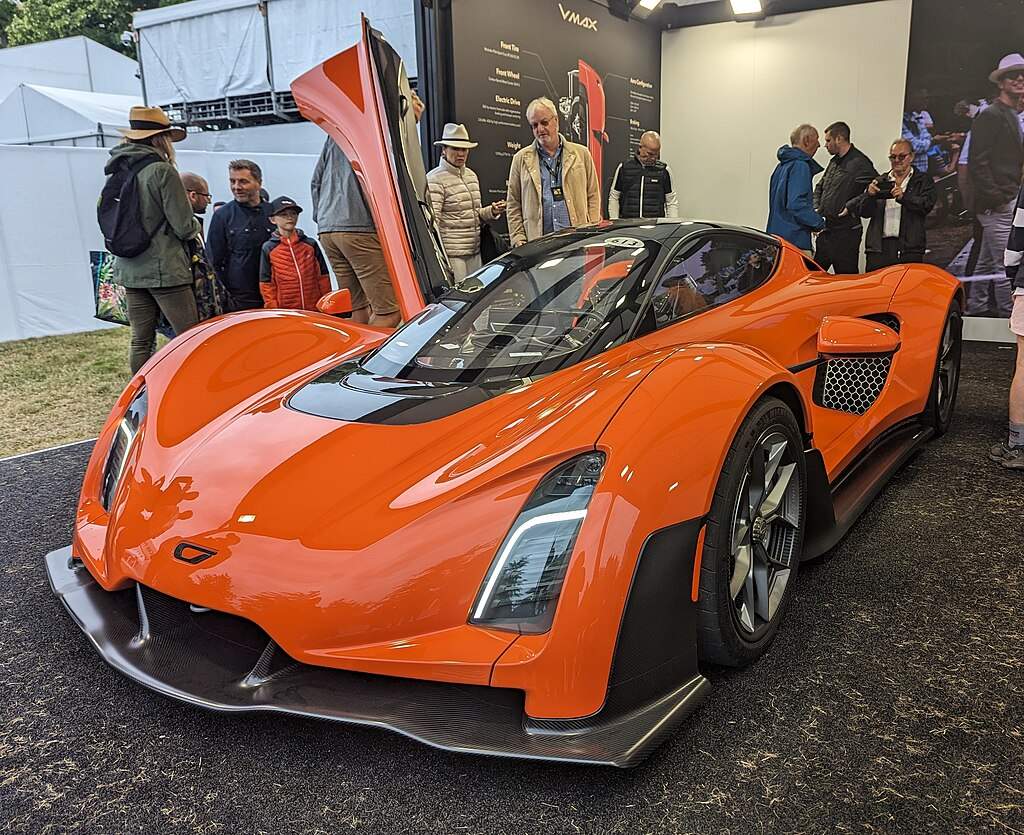
From the first glance, the Czinger 21C stands apart. Its most striking feature is the tandem seating—driver up front, passenger directly behind—reducing frontal area and improving aerodynamics. The cockpit canopy is shaped like a fighter jet’s, flanked by muscular bodywork that channels air precisely to radiators, brakes, and diffusers.
The body is a sculpted mix of carbon fiber panels and 3D-printed structural nodes, each designed for strength and minimal weight. A towering rear wing, aggressive front splitters, and sculpted side inlets aren’t just for show; they generate enormous downforce—over 1,200 kg at high speeds in the track configuration. The proportions are pure performance: low, wide, and purposeful.

Inside, the cabin is minimal yet high-tech. Gullwing doors open to reveal exposed carbon weave, a racing-inspired steering wheel, digital displays, and 3D-printed titanium controls. Every surface is functional, with luxury expressed through precision rather than excess.
Power and Performance
At the heart of the 21C is a 2.9-liter twin-turbo V8 that revs past 11,000 rpm, producing about 950 horsepower on its own. Three electric motors—two driving the front wheels and one assisting the V8—push total output to 1,250 horsepower. The system works through a seven-speed sequential transaxle with hydraulic clutch, sending power to all four wheels with torque-vectoring for optimal grip.
The numbers are staggering:
- 0–60 mph in 1.9 seconds
- Quarter-mile in roughly 8.1 seconds
- 0–186 mph in 15 seconds
- Top speed of up to 268 mph in low-drag spec
The power-to-weight ratio is around 2.2 pounds per horsepower, thanks to a curb weight under 2,800 pounds. Few production cars in history have approached this level of raw efficiency.
Chassis, Suspension, and Brakes

The Czinger 21C’s chassis is a showcase of the company’s Divergent Adaptive Production System—a method that uses generative design, 3D printing, and advanced alloys to create strong, lightweight components without traditional tooling. Over 350 parts in the car are 3D-printed, including suspension elements and brake housings.
The suspension uses race-grade geometry with adjustable ride height and active damping. Brakes are carbon-ceramic with 3D-printed calipers and integrated suspension mounts, minimizing weight while maximizing stiffness. Active aerodynamics adjust wing and flap positions to balance drag and downforce depending on speed and driving mode.
Manufacturing Innovation
While the performance figures are headline-grabbing, the real story may be how the 21C is built. Czinger’s process allows rapid redesign, waste reduction, and localized production. Each part is optimized by AI for strength and weight, then printed in metals like titanium and Inconel before being hand-finished.
This approach could reshape not just exotic car manufacturing, but the entire automotive supply chain. For now, the 21C is a proof of concept, but its technology is already attracting interest from other manufacturers.
Track Performance
The 21C’s abilities aren’t confined to the spec sheet. It holds production car lap records at Laguna Seca and the Circuit of the Americas, beating established hypercars from McLaren and Koenigsegg. At Goodwood Festival of Speed, it posted one of the fastest runs ever for a road-legal car, demonstrating that its performance is more than marketing.
Driver Impressions

When Top Gear’s Jack Rix slid into the Czinger 21C’s central driving seat, he described the position as giving “laser-like focus,” allowing the driver to place the car with surgical precision. Initial throttle response, he noted, comes with “a fraction of hesitation” from the hybrid system before unleashing a “dam-burst of torque” that catapults the car forward.
The twin-turbo V8 and electric motors work in unison to deliver an uninterrupted surge of power, with Rix describing the upshifts under throttle as feeling like “a punch from a heavyweight.” Even at road speeds, he found the steering quick and precise, offering “proper feedback” through corners — a rarity in modern hypercars.
Perhaps most surprising to him was the ride quality. “It’s actually compliant,” he observed, noting that the 21C’s suspension setup absorbed imperfections without compromising control. At higher speeds, the aero loads “pin you down,” creating a planted, almost unshakable composure.
Rix summed it up simply: “The more confident you get, the more it seems to amplify that confidence.”
Pros and Cons
Pros
- Groundbreaking acceleration and top speed
- Radical, aerodynamically efficient design
- Innovative manufacturing with sustainability benefits
- Exclusive production run ensures rarity
Cons
- Multi-million-dollar price limits accessibility
- Radical seating and styling may not appeal to all
- Limited production means most will never see one in person
Purpose and Competitors
The Czinger 21C was built to showcase what’s possible when performance and manufacturing innovation meet. While its direct rivals include the Bugatti Chiron, McLaren Senna, Rimac Nevera, and Koenigsegg Jesko, none share its unique approach to construction. Czinger isn’t just competing on speed—it’s redefining how cars can be made.
Production Run

Only 80 units of the Czinger 21C will be built, split between a road-focused version and a track-optimized “Lightweight Track” model. Each is essentially tailor-made for its buyer, with customization extending to performance setup, materials, and even aerodynamic tuning.
Conclusion
In a year defined by uncertainty, the Czinger 21C was a statement of intent: that even in the most challenging times, human creativity and technological ambition could push forward. It is as much a rolling laboratory as it is a hypercar, combining record-breaking performance with a radical vision for the future of manufacturing.
The 21C may be rare, expensive, and extreme, but it stands as proof that innovation doesn’t wait for the world to calm down—it thrives in disruption.
Related Articles: