
Featured Image by Karrmann, CC BY-SA 3.0, via Wikimedia Commons
Introduction: The “Rocket” Reborn
Blasting across the Fort Stockton test track, it reached a verified top speed of 267.88 mph (431.10 km/h), a truly astonishing figure that placed it among the fastest machines on the planet. This record-breaker, however, did not come from a boutique European supercar builder. Instead, its unlikely origin lay with the respectable, and often staid, American division of General Motors: Oldsmobile. It seemed almost impossible that a company known for comfortable cruisers and sensible sedans could produce a machine capable of such raw velocity.
The main purpose of this radical machine, the Oldsmobile Aerotech, was far more prosaic than its velocity suggests. It served as a high-profile testbed and promotional tool for Oldsmobile’s revolutionary new engine, the Quad 4. The program was a dramatic, public demonstration designed to instantly recast the division’s image as a high-technology engineering leader. Ultimately, the Aerotech carved out a unique place in automotive history, setting multiple closed-course and endurance records that remain a testament to daring GM engineering.
🌎 What Was Going On?
The mid-to-late 1980s was a period defined by both material comfort and profound transition, shaping the environment in which the Aerotech was conceived. Furthermore, the cultural moment emphasized bold statements and a focus on high-tech achievement.
💰 Economy & Lifestyle
The late 1980s began with the tail end of a sustained economic expansion. Yet, this prosperity was brittle, bracketed by the Black Monday stock market crash of October 1987 and the subsequent recession that started in 1990. Gas prices, which had seen dramatic volatility in the decade prior, remained relatively low and stable, often hovering around $1.00 per gallon. Indeed, cheap fuel promoted larger vehicles and performance aspirations. The cost of living and real estate values were generally appreciating, contributing to the culture of consumption that defined the era. Nevertheless, economic anxiety lingered due to corporate restructuring and downsizing across many industries. A significant shift toward high-technology products was underway, with the first IBM-compatible computers moving into more homes, redefining the future of employment and culture. Consequently, a vehicle designed to showcase high-tech engineering appealed directly to the modern consumer mindset.
🏛️ News/Politics
The latter part of the 1980s and early 1990s were dominated by monumental geopolitical change. In 1989, the Berlin Wall fell, symbolically ending the Cold War, a dramatic moment watched globally. Subsequently, the Soviet Union officially collapsed in 1991, leaving the United States as the world’s sole superpower. On the home front, George H.W. Bush won the 1988 presidential election. His administration was largely defined by the swift and successful Gulf War in 1991, where Operation Desert Storm led to a surge in national pride and a focus on technological military superiority. Nevertheless, by the 1992 election, the domestic economic recession fueled public dissatisfaction, resulting in Bill Clinton’s victory. The national mood swung between technological triumph abroad and economic uncertainty at home.
🎧 Music
The late 80s were characterized by the commercial zenith of Hair Metal and arena rock acts like Bon Jovi and Def Leppard, while pop was ruled by megastars such as Michael Jackson, Madonna, and Whitney Houston. Subsequently, the musical landscape underwent a seismic change with the introduction of Grunge and alternative rock. This shift was definitively signaled by the mainstream success of Nirvana’s album Nevermind in 1991, which famously dethroned Michael Jackson from the charts. Meanwhile, the emergence of Gangsta Rap with artists like N.W.A. established hip-hop as a dominant cultural and commercial force. Therefore, the culture was embracing both highly polished, corporate entertainment and raw, revolutionary counter-culture.
🎬 Movies/TV
Hollywood experienced a boom in blockbusters and defining cultural releases. Major movie hits included Top Gun (1986), E.T. the Extra-Terrestrial (1982), and the Indiana Jones sequels, promoting spectacle and high production value. The movie RoboCop (1987), for instance, offered a vision of a high-tech, yet gritty future. On television, programs like The Cosby Show and Cheers dominated network ratings. Crucially, the growth of cable television expanded viewing options significantly. Shows like Miami Vice (1984-1989) showcased a slick, high-fashion aesthetic that influenced culture and car design alike, associating speed and technology with cutting-edge style.
🏆 Sports
The sports world was equally vibrant. Basketball saw the peak of the rivalry between the Boston Celtics (Larry Bird) and the Los Angeles Lakers (Magic Johnson). Michael Jordan, however, was already emerging as the dominant global icon, leading the Chicago Bulls to their first championship in 1991.
In football, the San Francisco 49ers, led by Joe Montana, were a dynasty, winning multiple Super Bowls. Boxing was dominated by the terrifying ascent of Mike Tyson. Consequently, the cultural emphasis was squarely on peak performance and record-breaking feats, creating a perfect backdrop for the unveiling of the sleek, futuristic Oldsmobile Aerotech.
The Birth of a Speed Machine
Oldsmobile’s Audacious Gambit: The Aerotech Project and the Quad 4 Engine
The Aerotech project was conceived with the primary goal of changing Oldsmobile’s perception among American consumers. For decades, the division had been seen as reliable, but ultimately, safe and unexciting. The brand needed a shot of technological excitement. Therefore, the engineering team was tasked with creating a visible, undeniable proof of concept for their new Quad 4 engine. This modern, high-output, four-valve-per-cylinder engine was Oldsmobile’s ticket to the future, and General Motors wanted a demonstration that exceeded any standard production car.
Detailing the engineering team’s ambition, led by Ted Louckes, the goal was not merely to break a record; it was to shatter expectations. Louckes, the Oldsmobile Chief Engineer, understood that only a moonshot project could provide the necessary shockwave. The team aimed to show that American engineering, particularly from Oldsmobile, was competitive with the best from Europe. Furthermore, they wanted a project that would capture the imagination of the public and the automotive press, essentially creating instant marketing collateral.
Le Mans Meets Indy: Inside the Radical Design of the Oldsmobile Aerotech
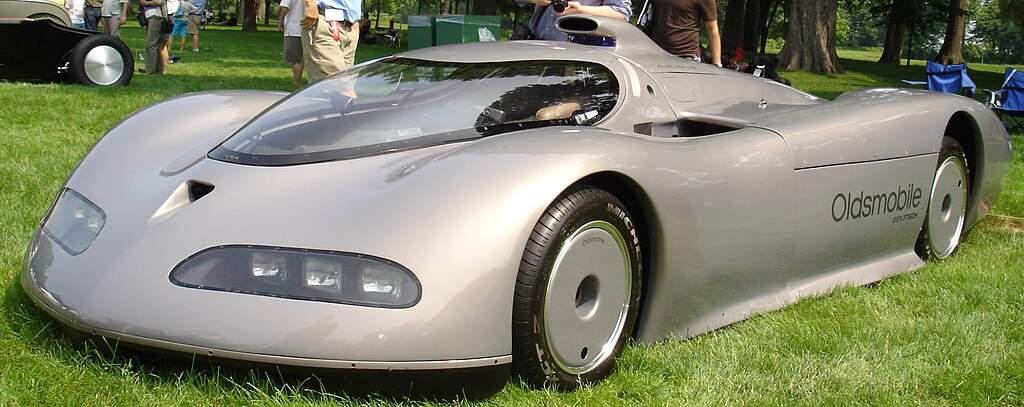
The design process was led by Ed Welburn, a rising star in GM design who would later become the company’s Vice President of Global Design. Welburn’s inspiration came directly from the sleek, low-slung prototypes that ran at the 24 Hours of Le Mans, specifically referencing the menacing profile of the Porsche 917. The design had to be functional, utterly dominant in aerodynamics, and visually spectacular. Consequently, the result was a dramatic, enclosed-wheel, wedge-shaped body that looked ready for the Mulsanne Straight.
The choice of foundation for the vehicle was not an Oldsmobile platform. Instead, the team utilized a modified March Indy car chassis, known for its robust, lightweight, and adaptable structure. Over this racing frame, they fitted advanced, lightweight carbon fiber bodywork. This construction choice was crucial for achieving the necessary strength and minimal weight required to challenge speed records. Ultimately, the Aerotech was a machine built from the best racing technology available to prove the capability of a mass-market engine.
Engineering Innovation – Short-Tail vs. Long-Tail
Optimized Aerodynamics: The Dual Configuration Strategy
The pursuit of absolute speed required the Aerotech team to develop two distinct, specialized aerodynamic configurations. The concept of interchangeable bodywork allowed the car to optimize its form for different types of record attempts. This approach maximized both stability on the oval and minimum drag on the straightaways.
Short-Tail and Long-Tail: Aerotech’s Specialized Quest for Handling and Top Speed
The short-tail (ST) version was specifically designed for closed-course handling. This body was shorter overall and featured larger rear spoilers and diffusers. Furthermore, the goal was to produce significantly more downforce, which provided stability and grip for sustained high-speed cornering on the oval track. This configuration was crucial for setting the closed-course speed record, where maintaining speed through the bends was paramount.
Conversely, the long-tail (LT) version was built solely for minimal drag and maximum top speed on a straightaway. Its extended, tapered rear bodywork smoothed the airflow as much as possible, effectively cutting through the air to reduce the speed penalty from aerodynamic resistance. This configuration created a highly streamlined profile, allowing the car to punch through the air with less energy, which was essential for setting the fastest flying-mile record.
Advanced Underbody Downforce Control
A significant technological element that placed the Aerotech ahead of its time was the innovative adjustable underbody panels. These panels were used to control the car’s downforce and drag dynamically. By manipulating the flow of air beneath the car, the driver could fine-tune the balance between stability and outright speed, depending on the conditions and the specific demands of the run. This represented a sophisticated approach to ground effects, a concept usually reserved for dedicated Formula 1 or endurance racing prototypes.
The Heart of the Beast: The Turbocharged Quad 4

The heart of the entire project was the engine, a highly modified version of Oldsmobile’s production 2.0-liter Quad 4. While the production Quad 4 was a solid performer in passenger cars, the Aerotech’s engine was a different animal entirely. It was fitted with a massive turbocharger system and other race-grade components. Consequently, the four-cylinder powerhouse produced a staggering output, ranging between 750 to over 1,000 horsepower during the high-boost runs. This output level was monumental for an engine of its small displacement. Indeed, achieving over 500 horsepower per liter was an unprecedented feat for a General Motors engine, thoroughly validating the basic Quad 4 architecture
Records Fall in Fort Stockton
The Moment of Truth: A.J. Foyt Takes the Oldsmobile Aerotech to Fort Stockton
The moment of truth arrived in August 1987 at the Fort Stockton Test Track in Texas. Oldsmobile chose this remote, highly controlled facility for its long, high-speed oval and the ability to maintain absolute secrecy. The track provided the ideal conditions for challenging both sustained-speed and maximum-velocity records.
For the driver, Oldsmobile enlisted the services of the legendary American racer, A.J. Foyt. A four-time Indy 500 winner, Foyt brought the necessary skill, experience, and, crucially, star power to legitimize the attempt. His involvement instantly lent tremendous credibility to the entire program.
Shattering Expectations: A.J. Foyt and the Aerotech’s Record-Breaking Run
During the speed runs, Foyt first piloted the Aerotech short-tail (ST) version around the oval. This configuration was optimized for sustained high speed on the curved track. The result was a stunning World closed-course speed record of 257.123 mph (413.799 km/h). This figure proved the car’s stability and the relentless power of the turbocharged Quad 4 over distance.
Subsequently, the team switched to the low-drag long-tail (LT) version for the absolute straight-line speed test. Foyt performed two crucial passes, one in each direction, to negate the effect of any prevailing wind. The incredible average speed for these two runs was 267.399 mph (430.342 km/h), setting the World flying-mile record for a closed course. The top individual speed achieved was slightly higher.
The significance of these records cannot be overstated. Oldsmobile successfully bested speed records held or challenged by sophisticated prototypes from global competitors, including efforts from companies like Mercedes-Benz. Therefore, the Aerotech’s achievement, derived from a relatively small, four-cylinder production engine, instantly delivered the technological credibility Oldsmobile desperately sought.
The Endurance Runs – Aurora Power

The Aurora V8 Endurance Test: Oldsmobile’s Shift from Speed to Durability
Following the initial speed records, Oldsmobile saw an opportunity to demonstrate the durability of their next new engine. This decision led to the construction of a third Aerotech prototype in the early 1990s. However, this version was fundamentally different from the 1987 car, as it was powered by the new 4.0-liter Oldsmobile Aurora V8 engine. The Aurora V8 was an all-new, DOHC (Double OverHead Cam) powerplant slated for use in luxury and performance Oldsmobile models.
The goal of these later runs was no longer about a single-lap speed burst; instead, it was a rigorous, highly visible durability test. Oldsmobile aimed to demonstrate that the new Aurora V8 could perform at maximum output for an extended period without failure. This shift was key to promoting the Aurora V8 as a reliable, high-technology engine ready for the demands of the modern consumer.
Forty-Seven Records: The Aerotech Proves the Aurora V8’s Endurance and Reliability
Consequently, in December 1992, at the same Fort Stockton track, the Aerotech was put through a grueling test of endurance. The team ran the car continuously over eight days. The drivers, operating in shifts, pushed the Aurora-powered Aerotech through multiple long-distance runs. This demanding schedule showcased the V8’s robust construction.
This massive record haul was a powerful testament to the engine’s engineering quality. The continuous high-speed running resulted in an astounding 47 speed endurance records, ranging from 10 kilometers to 25,000 kilometers. The most telling statistic was the average speed maintained during these grueling endurance tests, which hovered around 180 mph (289.68 km/h). Maintaining such a high average speed for over a week under varying conditions proved that the Aurora V8 was not only powerful but exceptionally robust and reliable.
Legacy and Aftermath
The Legacy of Speed: How the Aerotech Engineered Oldsmobile’s Image Change
The Aerotech was an unmitigated success for Oldsmobile as a publicity and engineering pillar. The widespread media coverage of the record runs gave the company the much-needed image boost it sought. Indeed, the success directly bolstered the image and sales of the production Quad 4 engine, which became associated with high performance and advanced technology. The message was clear: if Oldsmobile could build an engine capable of 267 mph, its consumer engines were clearly cutting-edge.
The question often arises as to why the Aerotech never became a production model. The simple answer is that it was never intended to be a production prototype. It was designed and built purely as an experimental test vehicle and a publicity stunt. The carbon-fiber construction, bespoke March chassis, and hand-built, highly-boosted engine were prohibitively expensive for any mass-market application. Furthermore, its ultra-low profile and enclosed wheels made it entirely impractical for road use or for meeting safety standards. It was a purpose-built record holder, not a showroom model.
The Unsung Hero: Aerotech’s Enduring Legacy in American Automotive History
The Aerotech is now regarded as an unsung hero of American automotive history. It stands as a powerful symbol of the ambitious engineering and risk-taking that occasionally emerged from General Motors, defying the stereotype of conservative domestic design. The project demonstrated that even within a vast, cautious corporation, passionate engineers could produce world-class performance vehicles.
Today, the surviving cars have achieved historical significance. The original Quad 4 Aerotech has been restored to its 1987 speed-run glory. Furthermore, one of the Aurora V8 endurance cars is also preserved, providing a physical link to a bold era of American speed and engineering excellence. These relics serve as a constant reminder of the division’s brief, glorious moment at the pinnacle of high-speed achievement.
Conclusion: An Enduring Legend

The Oldsmobile Aerotech remains a stunning artifact of American automotive ambition from the late 1980s and early 1990s. It was a visionary project that went far beyond mere marketing, serving as a genuinely challenging testbed for new engine technology. The car’s success in shattering speed and endurance records was a powerful, global demonstration of American engineering prowess. In short, its records stand as a testament to Oldsmobile’s bold performance aspirations, proving that a dependable American brand could, when challenged, produce one of the fastest and most technologically advanced vehicles in the world. Its legacy is that of a “rocket” that delivered on its promise, forever changing the perception of the division it represented.
Essential Sources for the Oldsmobile Aerotech Article
1. Oldsmobile Aerotech – Wikipedia
This is a comprehensive source that covers the vehicle’s overview, history, the roles of key figures like Ted Louckes and Ed Welburn, the dual-configuration design (ST/LT), and the specific record numbers.
- Key Information: Louckes’s vision, Ed Welburn’s Porsche 917 inspiration, the March 84C CART chassis, the two engine versions (Batten/Feuling), and the exact speed records (257.123 mph and 267.399 mph).
- Link: https://en.wikipedia.org/wiki/Oldsmobile_Aerotech
2. The Oldsmobile Aerotechs were perhaps America’s hottest prototypes – Hagerty Media
Hagerty provides an excellent feature that confirms the project’s purpose of promoting the Quad 4 engine and the key record figures, including the fact that the Aerotech surpassed the record held by the Mercedes-Benz CIII-IV prototype.
- Key Information: Confirms the V8 version was based on the Northstar/Aurora architecture and set 47 speed endurance records. It details the failure of the short-tail’s first attempt against the Mercedes record before the successful subsequent run.
- Link: https://www.hagerty.com/media/automotive-history/the-oldsmobile-aerotechs-were-perhaps-americas-hottest-prototypes/
3. The Oldsmobile Aerotech—A Designer’s Fairytale – Dean’s Garage (Ed Welburn Interview)
This article is highly valuable as it features an interview with the car’s designer, Ed Welburn, giving critical first-hand accounts of the design process, including the Le Mans inspiration (Porsche 917), the secrecy, and the internal politics.
- Key Information: Confirms design origin, the separate Olds design studios, the name Aerotech came from marketing, and Ted Louckes as the “godfather” of the project.
- Link: https://www.deansgarage.com/the-oldsmobile-aerotech-a-desgners-fairytale/
4. The Story of the Oldsmobile Aerotech… – autoevolution
This source corroborates the development timeline, the engine power outputs, and the staggering nature of the endurance runs.
- Key Information: Confirms the 900 hp (single-turbo) and 1,000+ hp (twin-turbo) outputs, and the comparison that the Aerotech hit 250 mph 18 years before the Bugatti Veyron. It also details the 47 endurance records set by the V8 version.
- Link: https://www.autoevolution.com/news/the-story-of-the-oldsmobile-aerotech-the-275-mph-supercar-you-never-knew-existed-197103.html