

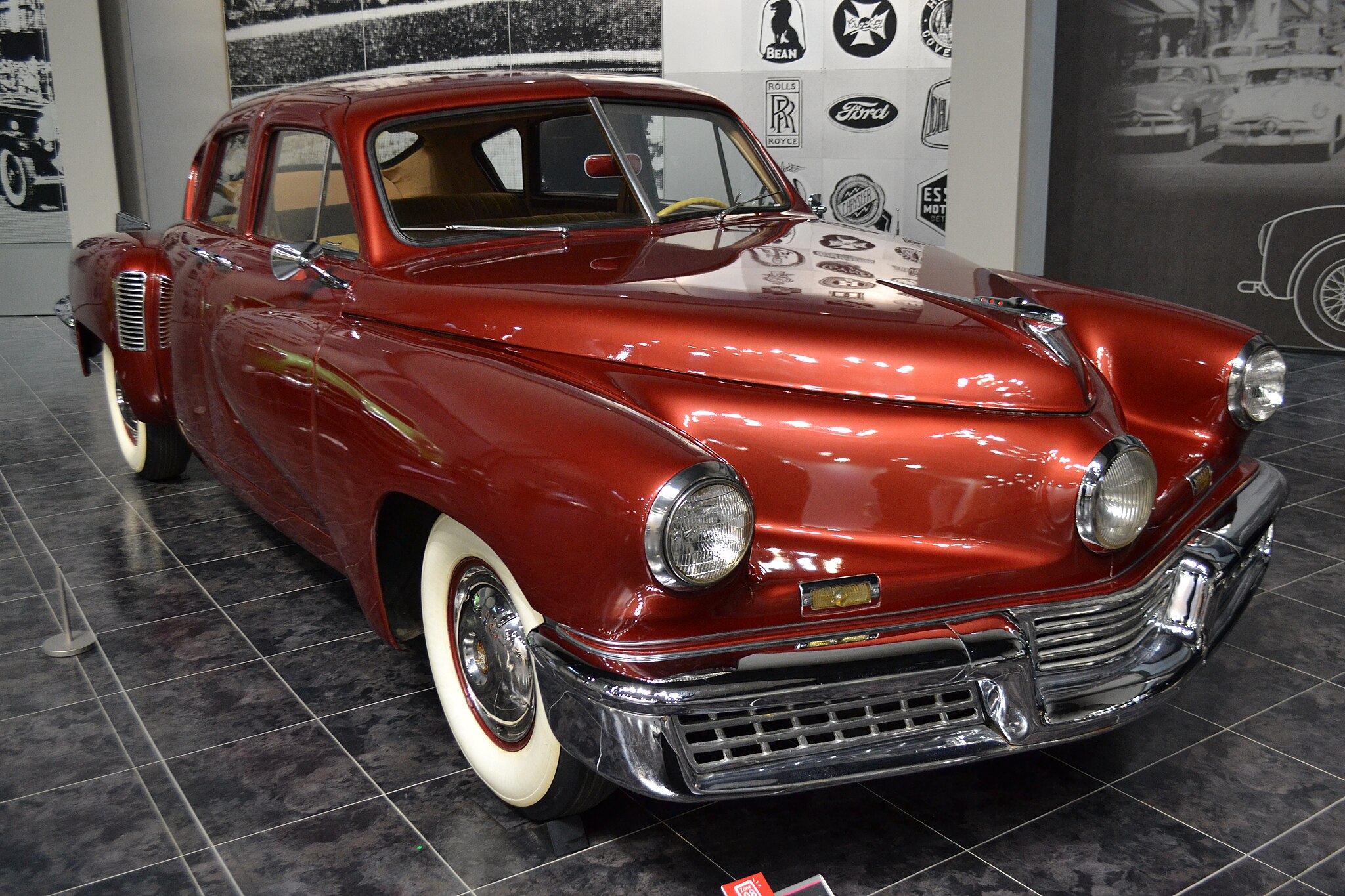

Featured Image by 先従隗始, CC0, via Wikimedia Commons
Introduction – What Was Going On?
💵 Economy & Lifestyle
Following World War II, a vibrant, if slightly strained, American economy was experiencing an intense shift from wartime production to peacetime consumerism. A significant backlog of demand existed, primarily because domestic car manufacturing had ceased entirely between 1942 and 1945. Consumers were hungry for modern vehicles, creating a seller’s market for the handful of established automakers. However, economic adjustments, like rising inflation, began eroding consumer purchasing power.
Furthermore, a brief, yet significant, post-war recession began in late 1948, bringing with it a rise in the unemployment rate and a subsequent drop in consumer spending. Despite these financial fluctuations, the rise of the middle class was underway, greatly aided by the GI Bill of Rights, which enabled veterans to afford homes and college education. This societal expansion fostered a powerful consumer culture and a desire for truly new, not merely refreshed, products.
📰 News/Politics
Globally, the year 1948 was deeply entrenched in the emerging Cold War era. Tensions between the United States and the Soviet Union dominated foreign policy, creating a pervasive sense of uneasiness and fear domestically regarding Communism. Conversely, at home, the government was attempting to maintain economic stability, evidenced by the passage of tax reductions via the Revenue Act of 1948, designed to stimulate spending. The public closely scrutinized the government’s ability to stabilize the economy after the Employment Act of 1946 passed. Government oversight, particularly of financial dealings, grew increasingly assertive in this politically charged environment.
🎵 Music
Popular music from the late 1940s was an eclectic mix that showcased America’s broad cultural tastes. Big Band and Swing remained popular, while vocalists like Bing Crosby and Doris Day dominated the charts. Meanwhile, the rhythmic sounds of R&B were establishing a foothold, setting the stage for rock and roll. Hit songs of the period, such as Pee Wee Hunt’s “Twelfth Street Rag,” provided a soundtrack that offered a blend of nostalgia and fresh energy.
🎥 Movies/TV
The film industry was experiencing its golden age. Major movie releases included critically acclaimed films like John Huston’s The Treasure of the Sierra Madre, which won multiple Academy Awards. Westerns, musicals, and film noir dominated the box office. Television was a new medium, still in its infancy, with only a small percentage of American homes owning a set. Yet, it was quickly becoming the revolutionary entertainment format that would soon reshape American leisure.
🏈 Sports
The American sporting world was enjoying a post-war boom. In MLB, the Cleveland Indians captured the World Series in 1948. Boxing was highlighted by the enduring reign of heavyweight champion Joe Louis. The NFL and NBA were both working to solidify their place in the national consciousness. A collective return to normalcy was reflected in the large crowds and enthusiastic coverage of professional athletics. This overall sense of forward momentum and the belief that anything was possible established the perfect cultural backdrop for an innovative disruptor like the Tucker.
The existing automotive industry, dominated by the “Big Three” (Ford, General Motors, and Chrysler), primarily sold cars that were merely updated versions of their pre-war designs. Preston Tucker, an independent entrepreneur, recognized this stagnant market and believed the public deserved something truly modern. His grand vision was the inspiration behind the unveiling of his radically designed sedan, which had been previously publicized as “The Car You’ve Been Waiting For.
Tucker 48: A Legacy of Innovation and Intrigue
The Tucker 48, a car that embodied both brilliance and tragedy, remains an intriguing scandal in automotive history. Conceived by Preston Tucker, a charismatic entrepreneur with a passion for innovation, the Tucker 48 aimed to revolutionize the American automobile industry. Though its production run was tragically short-lived, the Tucker 48’s legacy endures as a testament to visionary thinking, relentless ambition, and the enduring allure of the “what ifs” in automotive design.

A Visionary Design: The Tucker Sedan
Tucker wasn’t afraid to take risks. He envisioned a car that would be safer, more comfortable, and more technologically advanced than anything on the market. The Tucker sedan boasted groundbreaking features for its time.

The Tucker 48 prioritized passenger safety with features like a padded dashboard, seatbelts, and a shatterproof windshield. Its most striking safety innovation was the “cyclops eye,” a centrally mounted headlight that swiveled with the steering wheel, illuminating corners more effectively.

Technological Prowess of the Tucker Torpedo
Preston Tucker incorporated cutting-edge technology into the Tucker Torpedo, including an automatic transmission, power steering, and power windows. These features were rare or non-existent in most cars of the era. The ambitious nature of the Tucker Torpedo, with its many innovative features, presented significant production challenges.
Delays in securing parts and assembling the complex components hampered production and contributed to rising costs. The high cost of development and production, coupled with the challenges of securing adequate funding, put a significant strain on the Tucker Corporation’s finances.
Opposition and the Demise of the Tucker 48
The Tucker 48 remains one of the most compelling “what-if” stories in the history of American industry. This unique vehicle perfectly captured the post-war optimism and the hunger for genuine innovation. Unfortunately, Tucker’s visionary ambitions were met with fierce resistance from the established automotive giants. Detroit’s powerful automakers, fearing competition from this upstart, launched a smear campaign against Tucker, accusing him of fraud and financial misconduct. These calculated attacks, coupled with unforeseen production challenges and considerable financial constraints, subsequently led to the company’s ultimate demise.

Journalist Reviews at the Time
Automotive journalist Tom McCahill published a positive review in the August 1948 Mechanix Illustrated. He praised the Tucker 48’s smooth ride, quick acceleration, and roomy interior. However, relentless negative press and legal woes overshadowed this praise. The public’s perception of the car became inextricably linked to the controversy and the drama surrounding its founder.
Brilliance Bankrupted: The Ill-Fated Tucker Dream
The intense scrutiny from the Securities and Exchange Commission (SEC) proved too much for the fledgling company to overcome. The resulting trial for fraud, though ultimately ending in an acquittal for Preston Tucker, had already bankrupted the corporation and killed the dream. Therefore, production ceased in 1949. Only 51 Tucker Torpedos were ever produced, making each one a rare artifact. Despite its brief, ill-fated life, the car’s revolutionary features—the pop-out windshield, the padded dash, the center “Cyclops Eye” directional headlight, and the rear-mounted engine—have forever established it as a bold, brilliant anomaly. Its spirit of audacious engineering continues to inspire, reminding enthusiasts and designers alike that the status quo is always ripe for a challenge.
Enduring Impact of the Tucker Torpedo
Despite its short-lived production run, the Tucker Torpedo left an indelible mark on automotive history. Its innovative features, many of which are now commonplace in modern cars, demonstrated the potential for significant advancements in automotive safety and technology. The Tucker Torpedo’s legacy extends beyond its technological innovations.
It serves as a cautionary tale about the challenges faced by innovators who dare to challenge the established order. Tucker’s story highlights the importance of perseverance and resilience in the face of adversity, even when faced with seemingly insurmountable odds.

The “What Ifs” of the Tucker 48
The Tucker Torpedo’s enduring appeal lies in its status as a “what if” car. What if Tucker had been able to overcome the obstacles he faced? What if the Tucker 48 had achieved mass production? Would it have revolutionized the automotive industry? Would it have become a household name, alongside Ford and Chevrolet? These questions continue to fuel speculation and fascination among automotive enthusiasts.
Cultural Significance of the Tucker Torpedo
The Tucker Torpedo’s legacy is also intertwined with its cultural impact. The 1988 film “Tucker: The Man and His Dream,” starring Jeff Bridges as Preston Tucker, brought the story of the Tucker 48 to a wider audience, captivating viewers with its dramatic narrative of ambition, innovation, and betrayal.
The film helped to solidify the Tucker Torpedo’s place in popular culture, ensuring that its story would continue to inspire and intrigue for generations to come. The Tucker Torpedo’s unique design, coupled with its dramatic history, has made it a cultural icon. It is often featured in automotive museums and exhibitions, and continues to be a source of fascination for car enthusiasts around the world.
The Tucker 48 as a Collector’s Item
Today, the surviving Tucker Torpedos are highly sought-after collector’s items, commanding astronomical prices at auctions. These rare and valuable vehicles serve as tangible reminders of Preston Tucker’s vision and the enduring allure of the “what ifs” in automotive history.
Despite its short-lived production run, the Tucker 48 remains a question mark in automotive history. It serves as a testament to the power of visionary thinking, the importance of innovation, and the enduring allure of the “what ifs.” While its production may have been cut short, the Tucker Torpedo’s legacy continues to inspire and intrigue, reminding us of the potential for greatness, even in the face of adversity.

.jpg)
.jpg)
.jpg)
.jpg)
