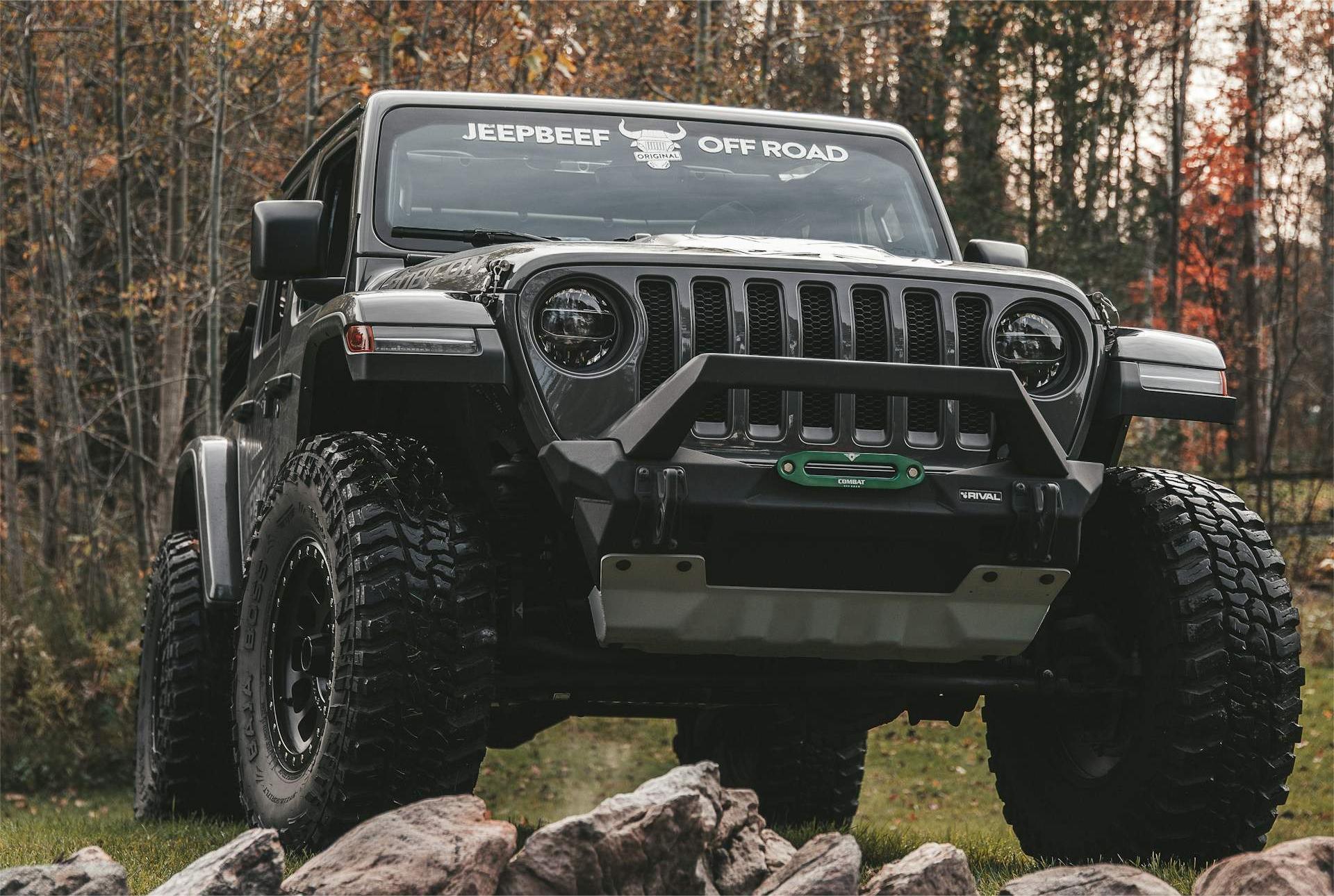

Featured Image by Paul C on Unsplash
The Jeep Wrangler is much more than a simple vehicle; it truly stands as a cultural artifact. Moreover, it remains an automotive legend. Its lineage, of course, traces directly back to the iconic Willys MB. That rugged utility vehicle played a pivotal role in shaping the Allied victory during World War II. Consequently, the Wrangler continues today to embody an indomitable spirit of adventure. Furthermore, it demonstrates the unmatched capability that defined its heroic ancestors. Therefore, the story of this legendary off-roader is a compelling narrative of military necessity. In addition, it covers civilian adoption and continuous, yet cautious, evolution. This detailed exploration delves into the history, generational changes, and engineering prowess of the Jeep. Finally, it covers the vibrant subculture that has cemented the Wrangler’s place as a global icon of freedom.
The Jeep Wrangler: A Legacy Forged in War

The deep roots of the Jeep lie not in suburban showrooms but in the sands of North Africa and the mud-soaked battlefields of Europe. In 1940, the U.S. Army urgently sought a lightweight, highly maneuverable vehicle suitable for reconnaissance, light transport, and general utility work. Specifically, the military’s demanding specifications included four-wheel drive, a fold-down windshield, and a low silhouette. Eventually, three companies submitted prototypes: American Bantam, Ford, and Willys-Overland.
The resulting Willys MB, a four-wheel-drive marvel, became instantly synonymous with American ingenuity and military might across the globe. Initially, the Willys-Overland model, dubbed the “Quad,” was the heaviest submission. However, its robust engine, the “Go-Devil” four-cylinder, gave it a crucial performance edge. Thus, the final standardized design largely followed Willys’ plan, combining the best features of all three prototypes. Consequently, over 640,000 units of the Willys MB and its Ford-built twin, the GPW, were produced during the war. These vehicles, affectionately known as ‘Jeeps’—a nickname likely derived from the acronym G.P. (General Purpose) or from the popular Popeye character Eugene the Jeep—were hailed by General Dwight D. Eisenhower as one of the three decisive weapons that helped the Allies win the war.
From Battlefield to Backroad: The Civilian Jeep


When the war concluded, a world forever changed by the Jeep suddenly found a new use for its military workhorse. Accordingly, Willys-Overland was quick to recognize the massive potential of its vehicle in the civilian market. The military MB was swiftly transitioned into the civilian Jeep, or CJ, series. In fact, the first official civilian model, the CJ-2A, was introduced in 1945, only months after the end of the conflict. This early CJ retained the rugged, open-top design and unparalleled off-road capability of the MB. However, it added civilian-friendly features such as a tailgate, a side-mounted spare tire, and improved headlights, which distinguished it from its wartime predecessor.
Subsequently, the CJ line of vehicles captivated the imaginations of adventurers, farmers, and construction workers alike. This vehicle offered a sense of freedom and utility that deeply resonated with a post-war generation eager to explore new landscapes. Successive models, including the CJ-3A, the high-hooded CJ-3B, the long-running CJ-5, and the wider, more stable CJ-7, built upon this foundation. The CJ series essentially ran for four decades, establishing the Jeep brand as the undisputed king of off-road capability and setting the stage for its modern successor. Eventually, safety concerns and changing consumer expectations necessitated a change, paving the way for the arrival of a new icon.
The Birth of a Legend: The Wrangler YJ (1987–1995)

transition occurred during a tumultuous period of corporate ownership, with the model being designed by American Motors Corporation (AMC) but launching under the ownership of Renault; by the time the first full model year rolled around in 1987, the Jeep brand was in the hands of Chrysler. Importantly, the first-generation Wrangler, internally codenamed YJ, retained the core essence of its predecessors—ruggedness, versatility, and a strong connection to the outdoors. Nonetheless, the YJ marked a deliberate shift toward making the Jeep more palatable for everyday road use. It featured a wider track, a lower stance, and, crucially, borrowed suspension components from the Cherokee XJ to improve on-road handling and stability.
Significantly, the YJ generation is most easily recognized by its controversial square headlights, a polarizing design choice that departed dramatically from the traditional round lamps of the CJ. Although many purists criticized the change, the YJ quickly became a cultural icon in its own right, embraced by a new generation of enthusiasts and off-roaders. Beyond the headlights, the YJ featured leaf-spring suspension, similar to the CJ, but with wider springs, anti-roll bars, and trackbar suspension links. These additions resulted in a more composed and safer vehicle for the general driving public. The YJ’s cultural influence was cemented by its appearance as the iconic park staff vehicle in the 1993 blockbuster film Jurassic Park.
The Return to Roots: The Wrangler TJ (1997–2006)

The second-generation Wrangler, the TJ, arrived in 1997, marking a huge leap forward in both comfort and capability. Interestingly, Jeep skipped the 1996 model year for the Wrangler lineup entirely. The TJ’s design philosophy successfully blended classic aesthetics with modern engineering. Most notably, the TJ saw the celebrated return of the classic round headlights, satisfying purists and re-establishing the traditional Jeep look. More critically, the TJ replaced the ancient leaf-spring setup with a refined all-coil suspension system, directly adapted from the Jeep Grand Cherokee. This major mechanical update significantly improved on-road ride quality and, perhaps more importantly for the hardcore off-road community, dramatically increased wheel articulation, which is essential for tackling difficult terrain.
Furthermore, the TJ introduced several now-legendary features and trims. The wheelbase was slightly stretched, allowing for better approach and departure angles, which are vital for serious off-roading. In 2003, Jeep unveiled the Wrangler Rubicon, a dedicated, factory-built rock-crawler. This trim included Dana 44 axles, front and rear air lockers, and a Rock-Trac 4:1 low-range transfer case. Such features made the Rubicon instantly capable of traversing the legendary Rubicon Trail right off the showroom floor, which cemented the Wrangler’s reputation for extreme capability. The limited-edition, long-wheelbase TJ Unlimited, or “LJ,” was introduced in 2004, offering more cargo space and rear-passenger comfort while retaining the TJ’s short two-door configuration.
The Four-Door Era: The Wrangler JK (2007–2018)

A momentous change arrived with the third-generation Wrangler, the JK, in 2007. Obviously, this generation was the first to be designed entirely under Chrysler’s (later Fiat-Chrysler’s) stewardship. The biggest, most transformative innovation was the introduction of the four-door model, the Wrangler Unlimited. Offering true practicality with room for five passengers and genuine cargo space, the four-door model fundamentally broadened the Wrangler’s market appeal. Therefore, it successfully transitioned the rugged utility vehicle into a viable, yet still immensely capable, daily driver for families.
The JK Wrangler was larger and, significantly, safer than its predecessors. Furthermore, it included many modern amenities like stability control and navigation systems. The vehicle notably offered a much quieter interior. Despite this evolution, it maintained the essential, traditional body-on-frame construction. The JK also kept solid axles, the signature fold-down windshield, and the removable doors. Therefore, its unique identity remained completely intact. Initially, the engine was a 3.8-liter V6. However, the JK received a major upgrade in 2012. Specifically, a more powerful and fuel-efficient 3.6-liter Pentastar V6 engine was introduced. Ultimately, the JK generation proved to be the longest-running and most commercially successful Wrangler model. Clearly, this demonstrated that the market was ready for a modern take on the classic Jeep experience. Consequently, its overwhelming success paved the way for even more ambitious evolutionary steps.
The Modern Legend: The Wrangler JL (2018–Present)

The current, fourth-generation Wrangler, the JL, unveiled in late 2017, represents the most technologically advanced and refined version of the Jeep icon. Structurally, the JL utilizes lighter, high-strength steel and aluminum panels, significantly reducing weight and improving fuel efficiency without sacrificing off-road toughness. Furthermore, engineers made dozens of small, yet significant, improvements to the design. For example, the windshield now folds down more easily, and the integrated roll bar provides better safety and strength. Also, the introduction of a new full-time four-wheel-drive system further enhanced the vehicle’s year-round usability on pavement.
Under the hood, the JL introduced a variety of modern powertrain options beyond the V6. Specifically, a 2.0-liter turbocharged four-cylinder engine with a mild-hybrid eTorque system offered a punchy mix of torque and efficiency. Additionally, Jeep added a diesel V6 option (no longer available in the US) and the powerful Wrangler 4xe plug-in hybrid electric vehicle (PHEV). The 4xe has become a game-changer, combining 49 MPGe equivalent with 375 horsepower and 470 lb-ft of torque, showcasing how Jeep is successfully embracing electrification while maintaining legendary capability. Later, the line introduced the potent Rubicon 392, featuring a 6.4-liter HEMI V8 engine, producing 470 horsepower and offering the fastest Wrangler experience ever created, thereby satisfying the demand for V8 power.
The Engineering of Off-Road Dominance

Core engineering principles make the Wrangler a genuine off-road legend. Specifically, the vehicle proudly wears the Trail Rated® badge. This badge is crucial because the vehicle earns it by successfully passing demanding tests in five key areas. These areas are traction, water fording, maneuverability, articulation, and ground clearance. Indeed, the Wrangler’s mechanical foundation is purpose-built for the trail. For this reason, every Wrangler employs a rugged body-on-frame chassis. Furthermore, it always features solid axles both front and rear. Although nearly all competitors abandoned this design choice, it is absolutely crucial for maximum strength and suspension articulation.
Modern Wranglers, particularly the Rubicon trim, incorporate advanced technological aids. Drivers use these features to conquer extremely tough terrain. For instance, the Rock-Trac® 4×4 system boasts a 4:1 low-range gear ratio. Clearly, this offers a massive crawl ratio for slow, controlled ascents. Similarly, the Tru-Lok® Electronic Locking Differentials are essential. They allow the driver to fully lock the front and rear axles. This system ensures power is evenly split between all wheels. Consequently, it guarantees traction even if only one tire is barely touching the ground. Additionally, the Electronic Front Sway Bar Disconnect is a truly unique feature. By disconnecting the sway bar, the vehicle allows for an extraordinary amount of wheel travel. Therefore, this enables the tires to maintain contact over severely uneven surfaces. Ultimately, these mechanical and electronic features deservedly maintain the Wrangler’s legendary off-road status.
Culture and Community: More Than Just a Car

The Wrangler has transcended its status as an automobile to become a powerful cultural symbol. This iconic vehicle has starred in countless films and television shows, further cementing its image as the ultimate adventure machine. Besides Jurassic Park, films like Clueless, Terminator Salvation, and the Fast & Furious franchise prominently featured Jeeps. However, its most significant legacy lies in the vibrant community it has fostered. Enthusiasts often see Jeep ownership as entry into a lifestyle—a tight-knit culture defined by mutual respect, a passion for the outdoors, and a willingness to help fellow enthusiasts.
Indeed, the famous “Jeep Wave” is a spontaneous, unspoken etiquette among Wrangler owners, where a quick hand signal acknowledges a shared passion and mutual respect on the road. Furthermore, the trend of “Jeep Ducking”—where owners place a small rubber duck on a random, parked Wrangler as a friendly gesture—further illustrates the unique, playful camaraderie of this community. This unparalleled enthusiasm fuels a massive aftermarket industry. Owners spend billions customizing their Jeeps with lift kits, massive tires, heavy-duty bumpers, and winches, tailoring the vehicle precisely to their individual lifestyle and off-road ambitions. Consequently, no two Wranglers ever appear exactly alike, showcasing the vehicle’s incredible adaptability and personalization potential.
A Lasting Symbol of American Ingenuity and Exploration
Ultimately, the Jeep Wrangler is a potent symbol of freedom, adventure, and the enduring spirit of exploration that defines the American ethos. It represents a living connection to the past, a tribute to the ingenuity and resilience that defined a generation of war heroes and post-war entrepreneurs. From the rugged simplicity of the Willys MB to the technologically advanced 4xe, the Wrangler has always remained true to its core identity: an open-air, go-anywhere machine.
Moreover, in an increasingly complex and paved world, the Wrangler provides an essential connection to the wild. It offers a promise of escape and the capability to pursue any path, regardless of its difficulty. Therefore, its legacy as an icon of off-road capability and American ingenuity is absolutely secured. As the Wrangler continues to evolve, embracing electrification and new technology, one thing remains perpetually certain: its unique character and legendary status will endure for generations to come, calling adventurers toward the open road and the challenging trail. The call of the wild, perpetually embodied in the Jeep Wrangler, remains as strong as ever.