


Featured Image by Jae P at Pexels.com
The Ferrari 458 Italia represents a peak in automotive history. It stands as the last naturally aspirated V8 flagship from Maranello. Consequently, purists often view it as a sacred masterpiece. However, a bold tuning culture from Japan decided to challenge that sanctity. This specific Liberty Walk Ferrari 458, led by the vision of Wataru Kato, transformed an elegant supercar into a widebody monster. This article examines the intricate details of the build. We will discuss its design, the philosophy behind the modification, and why it remains a polarizing icon. Whether you love it or hate it, you cannot ignore this machine.
The Foundation: Why the Ferrari 458 Italia?
To understand the build, we must first look at the base car. Ferrari released the 458 Italia in 2009. It instantly redefined the supercar segment. Specifically, the engine is a masterpiece of engineering. This 4.5-liter V8 produces 562 horsepower without the help of turbochargers. Because it lacks turbos, the throttle response is instantaneous. Furthermore, the exhaust note is legendary. It provides a high-pitched, metallic wail that modern turbocharged cars simply cannot replicate. Ferrari designed the body with Pininfarina to be aerodynamically efficient. Every curve serves a purpose for downforce or cooling. Therefore, cutting into this bodywork requires immense courage.
The Liberty Walk Philosophy
Liberty Walk, or LB-Works, originated in the “Bosozoku” style of Japanese street culture. This style emphasizes rebellion and extreme modifications. Wataru Kato wanted to bring this “bad boy” energy to the world of exotic supercars. Initially, the high-end car community was shocked. People asked why anyone would bolt plastic fenders onto a quarter-million-dollar Ferrari. However, the results spoke for themselves. The aggressive stance and widened track created a presence that a stock Ferrari lacked. Eventually, the world embraced this “Old School” meets “New School” aesthetic found in every Liberty Walk Ferrari 458 project.
Breaking Down the Body Kit
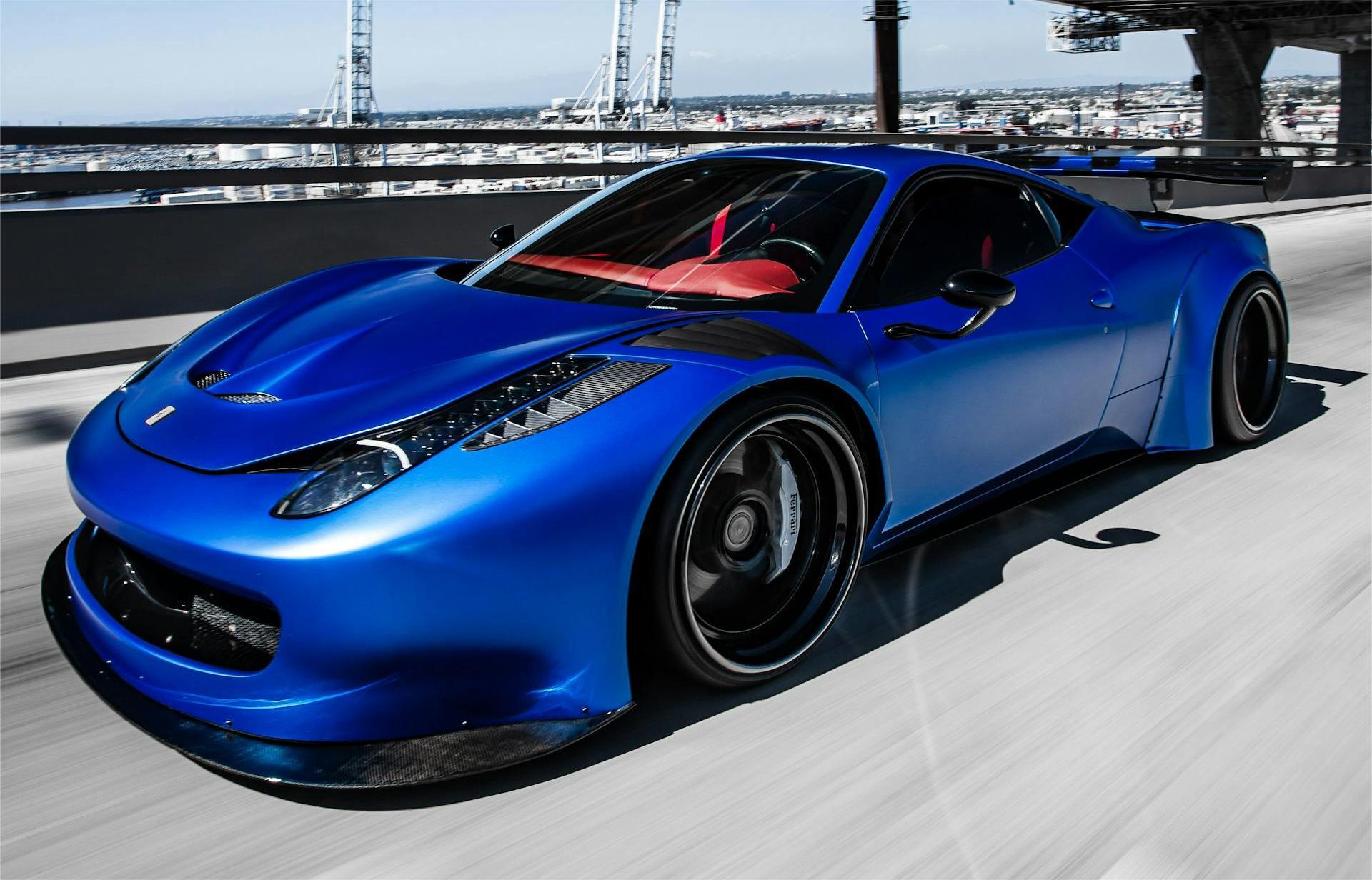
The kit featured in the image is the signature LB-Works widebody. It consists of several key components that change the silhouette entirely. These are the most iconic parts of any Liberty Walk build. The installers actually cut the original aluminum fenders of the Ferrari. Then, they bolt these massive flared arches directly onto the body. This allows for much wider wheels and a lower center of gravity. Furthermore, the exposed rivets give the car a raw, industrial look.
To balance the wider fenders, Liberty Walk adds a massive front splitter. This piece sits inches from the ground. It gives the car a “face” that looks ready for the racetrack. At the back, a larger diffuser works with the widebody to manage airflow. These parts aren’t just for show; they significantly increase the visual “weight” of the car’s bottom half. While some builds use a massive GT wing, many 458 owners opt for the “ducktail.” This spoiler pays homage to classic racing cars. It kicks up sharply at the rear, lengthening the car’s profile. Consequently, the Ferrari looks faster even when it is standing still.
The Art of Stance: Why This 458 Requires a ‘Bagged’ Setup

One of the most defining characteristics of the Liberty Walk Ferrari 458 is its aggressive, ground-hugging stance. You might notice in the image how the front lip sits millimeters from the floor; this is almost certainly achieved through a high-performance air suspension system, often from brands like AirLift Performance or AccuAir.
Using standard static springs at this height would make the car virtually undriveable on public roads. Instead, integrated air bags allow the driver to raise the chassis at the push of a button to clear obstacles. When it’s time for a show or a photo, they can ‘air out’ to achieve that perfect, tucked-wheel look that is essential to the Liberty Walk aesthetic. Without this adjustability, those massive wide fenders would lose their signature connection to the wheels.
Performance and Sound

Most Liberty Walk owners do not stop at the body. To match the loud visuals, they often install Frequency Intelligent (Fi) or Armytrix exhaust systems. These systems enhance the V8’s natural scream. Consequently, the car sounds like a Formula 1 machine from the 1990s. Performance-wise, the wider tires provide massive grip. However, the kit is primarily about “street cred” and style. It turns the 458 into a rolling piece of art. Owners prioritize the experience of driving something unique over shaving tenths of a second off a lap time.
Technical Prowess: Performance Under the Hood
The Ferrari 458 Italia does not just look fast. It possesses a heart forged in the fires of Formula 1. Specifically, the engine is a 4.5-liter V8. This naturally aspirated unit produces a staggering 562 horsepower. Additionally, it generates 398 lb-ft of torque. Because this engine lacks turbochargers, the power delivery is exceptionally linear. Consequently, the driver feels a direct connection between their foot and the road.
Performance enthusiasts often focus on the acceleration metrics of a Liberty Walk Ferrari 458. For instance, the 458 Italia reaches 0 to 60 mph in just 3.4 seconds. On a perfect surface with warm tires, some testers have even achieved 3.3 seconds. This speed remains competitive even against modern supercars. Furthermore, the car continues to pull hard long after the initial launch. It covers the quarter mile in approximately 11.2 to 11.5 seconds. During this sprint, it typically crosses the finish line at speeds exceeding 125 mph.
Top Speed and Aerodynamics
If you find a long enough stretch of pavement, the 458 Italia will keep climbing. The official top speed is 202 mph. Achieving this requires every bit of its aerodynamic engineering. Even with the Liberty Walk kit, the car remains a high-speed projectile. However, the added width from the widebody kit can increase drag. Therefore, a stock 458 might have a slight edge in a pure top-speed run. Regardless, the modified version provides a more dramatic sensation of speed.
Ferrari paired the V8 engine with a 7-speed dual-clutch transmission. This gearbox was a revelation when it first arrived. It shifts in roughly 50 milliseconds. Because of this speed, there is no interruption in power. You simply click the carbon fiber paddle and the next gear arrives instantly. This technology ensures that the car stays within its power band during aggressive driving. Stopping power is just as vital as acceleration. Ferrari equipped the 458 with carbon-ceramic brakes as standard equipment. These brakes provide immense stopping force without fading. In fact, the car can stop from 60 mph in about 107 feet.
Advanced Aero: The Deformable Winglets
One of the most fascinating features of the 458 is the “aeroelastic” winglets in the front grille. At high speeds, the wind pressure actually bends these small wings. This movement reduces the intake size and cuts down on aerodynamic drag. Consequently, the car becomes more slippery through the air. Liberty Walk builds often keep this functional piece intact. It serves as a reminder of Ferrari’s engineering genius. Even under a heavy body kit, the soul of a racer remains. This subtle technology helps the car maintain its 202 mph capability.
The Color Palette: Satin Blue

The specific car in the photo features a Satin Blue finish. This choice is brilliant for several reasons. First, satin finishes sit between matte and gloss. They catch the light on the edges of the widebody kit perfectly. Second, the blue provides a stark contrast to the black accents. The black wheels and carbon fiber splitters pop against the blue background. This color scheme moves away from the traditional “Rosso Corsa” red. It signals that this is not your typical, factory-spec Ferrari.
The Impact on Resale Value
We must address the elephant in the room: value. Traditionally, modifying a Ferrari lowers its resale price. Collectors usually want “matching numbers” and original paint. However, the Liberty Walk Ferrari 458 has carved out its own market. Because these builds are expensive and famous, they often hold their value well among younger enthusiasts. Some buyers specifically seek out “cut” Ferraris because they want the finished look without the work. Thus, it has become a legitimate sub-genre of car collecting.
Part 2: The Global Impact of Liberty Walk
Beyond the numbers, we must discuss the cultural shift Liberty Walk initiated. Before Wataru Kato, Ferrari owners rarely performed permanent modifications. Most collectors focused on preserving the factory condition. However, the 458 “LB-Works” build changed the conversation. It encouraged owners to treat their vehicles as personal statements. Today, a “cut” Ferrari is no longer a taboo. Instead, it represents a specific niche of automotive passion. These owners value the “presence” of the car above all else. They want a vehicle that stops traffic and wins awards at shows like SEMA. Consequently, the Liberty Walk Ferrari 458 has become a staple of car culture media. It appears in video games, music videos, and social media feeds daily.
The Cost of Perfection
Building a Liberty Walk Ferrari is not a budget-friendly endeavor. The widebody kit alone can cost upwards of $30,000. When you add high-end wheels and air suspension, the total investment often exceeds $60,000. Furthermore, you must pay for professional installation. Since the process involves cutting the original metal, mistakes are permanent. Therefore, only the best shops in the world handle these builds. Owning a modified 458 requires extra care. For example, the satin blue wrap in your photo needs special cleaning products. Standard wax can ruin the matte finish. Additionally, the air suspension requires regular inspections. You must ensure the lines are clear of debris to prevent leaks. However, most owners find these tasks rewarding. They view the maintenance as a labor of love for a unique machine.
The Visionary Behind the Blade: Wataru Kato and the Liberty Walk Origin
To truly appreciate the Liberty Walk Ferrari 458, you must understand the man who dared to cut it. Wataru Kato founded Liberty Walk in 1993 in Nagoya, Japan. Initially, the shop was humble. Kato started with a small lot that could only hold three cars. His early work focused on Japanese Domestic Market (JDM) cars and “Kei” cars. However, his heart belonged to the “Bosozoku” and “Kyusha” cultures of his youth. These styles prioritized rebellion, exaggerated fenders, and a total disregard for factory rules.
The transition to supercars happened in the late 2000s. Kato’s first major project was a Lamborghini Murcielago. Initially, the 2009 SEMA debut received a lukewarm response. People were confused by the aggressive rivets on such an expensive machine. Nevertheless, Kato remained undeterred. He famously promised a dying friend that he would make the Lamborghini the most famous in the world. This emotional drive pushed him to refine the “LB-Works” style. By the time the Ferrari 458 Italia kit launched in 2013, the world was finally ready for his vision.
A Technical Comparison: LB-Works vs. 458 Speciale
It is helpful to compare the Liberty Walk build to Ferrari’s own track masterpiece: the 458 Speciale. The Speciale focused on shaving weight and optimizing airflow for lap times. In contrast, the Liberty Walk build focuses on visual drama and presence. While the Speciale uses active aerodynamics to stay glued to the track, the LB-Works car uses its massive width to dominate the street.
Both cars share the same incredible V8 engine. However, they serve different purposes. The Speciale is a surgical tool for the circuit. The Liberty Walk 458 is a rolling piece of performance art. One is built for the stopwatch, and the other is built for the soul. Ultimately, both represent the absolute peak of what the 458 platform can achieve. They show that whether through factory engineering or aftermarket imagination, the 458 Italia remains a timeless icon.
The Final Verdict

The Liberty Walk Ferrari 458 is a masterclass in automotive theater. It combines the soulful heart of Italy with the rebellious spirit of Japan. While it might offend some purists, it inspires thousands of others. It proves that cars are more than just transportation. They are canvases for personal expression. If you want to stand out in a crowd of supercars, there is no better way to do it. The scream of the V8 and the wide stance create an unforgettable experience. This car will undoubtedly remain a legend for decades to come.