

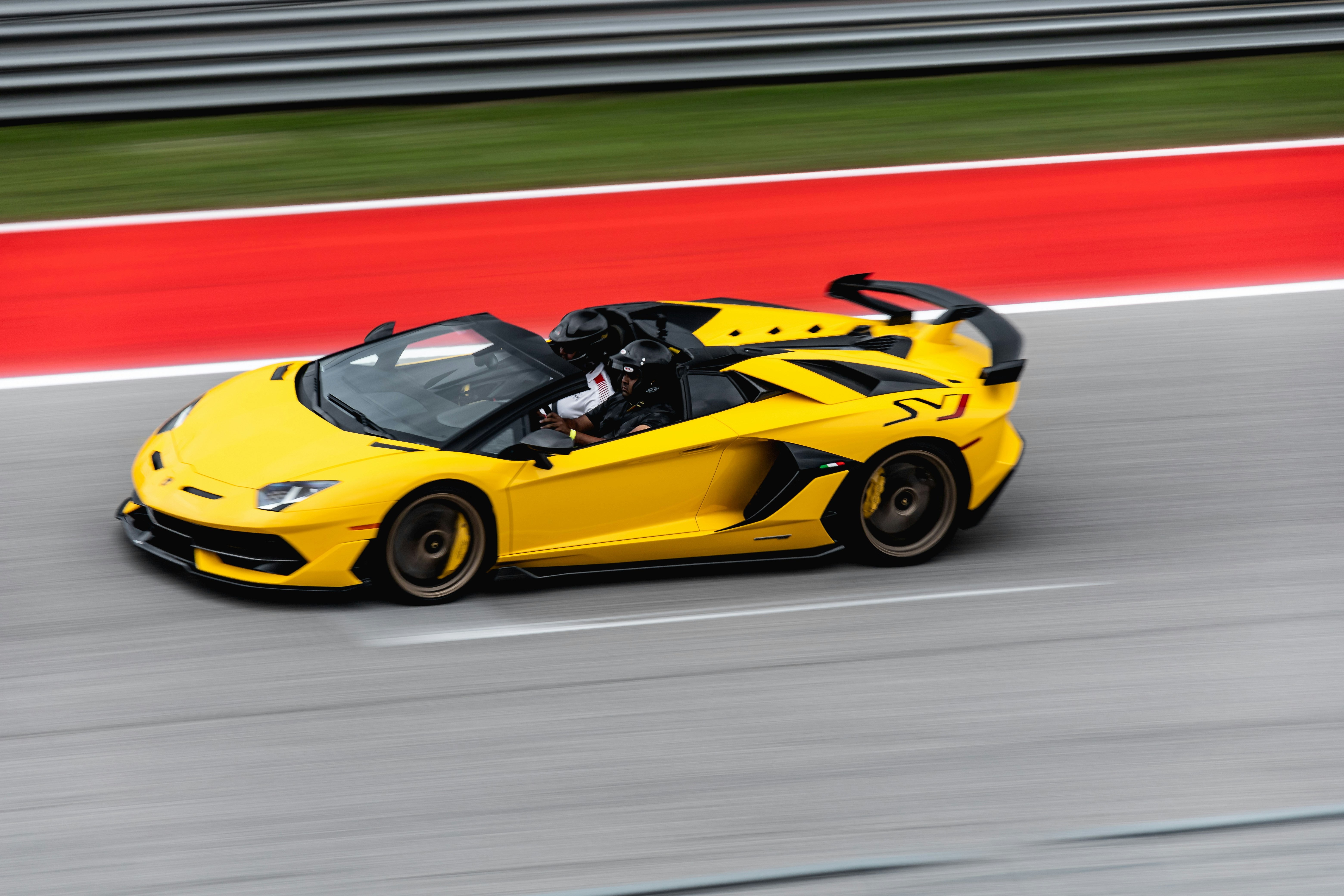

Featured Image by Wes Tindel on Unsplash
The Apex of Performance: Lamborghini Aventador SVJ
The Lamborghini Aventador SVJ stands as a shining example of Lamborghini’s enduring legacy. Widely regarded as the Aventador’s peak iteration, this remarkable car represents a significant high point for naturally aspirated V12 engines, a testament to an era where pure, unadulterated power reigned supreme. For decades, Lamborghini has stood as an icon of raw supercar power and bold design, crafting dream machines that ignite the passions of enthusiasts worldwide. These rolling sculptures, born in Italy, masterfully blend breathtaking speed with an undeniable aura of desire. In a contemporary automotive landscape increasingly dominated by electric and turbocharged powertrains, the limited-edition SVJ stands as a true masterpiece, meticulously engineered for ultimate performance. This track-focused weapon unequivocally redefines the very notion of street-legal speed.
Decoding the Name: Understanding the Super Veloce Jota Legacy
The SVJ designation is not merely a collection of letters; it’s steeped in Lamborghini tradition. “SV” stands for “Super Veloce,” Italian for “Superfast.” This name marks Lamborghini’s most powerful track cars. They have more power, less weight, and sharper handling. It signifies an evolution towards ultimate performance.


The crucial addition is the “J,” representing “Jota.” This harks back to a legendary, almost mythical, chapter in Lamborghini’s history: the Miura Jota. In the early 1970s, Lamborghini’s test driver, Bob Wallace, modified a Miura P400. This one-off car met FIA racing rules. This experimental machine, the Miura Jota, was lighter, more powerful, and aerodynamically optimized for track dominance. Though it never officially raced under the factory banner and tragically met its end in a crash, its legend persisted. Lamborghini later built a tiny handful of Miura SV/J models for special clients, incorporating some Jota-inspired upgrades. The Aventador SVJ’s “Jota” name honors this history. It shows this Aventador is built for the track. It’s like that original car focused on racing.

The Heart of the Beast: Exploring the 6.5L Naturally Aspirated V12 Engine
Today, many cars use turbos and hybrids for better power and efficiency. However, the Aventador SVJ still features a V12 engine. This engine type is a long-standing part of Lamborghini’s identity. Underneath its unique cover lies a 6.5-liter V12. This engine is an enhanced version of the one used in other Aventadors. Lamborghini’s engineers carefully tuned it for the SVJ. The result is 770 metric horsepower at 8,500 rpm. It also produces 720 Nm of torque at 6,750 rpm.
It wasn’t just about peak numbers; it was about how the power felt. The engine utilizes optimized intake runners, modified cylinder heads, lightweight titanium intake valves, and a redesigned, less restrictive exhaust system. The result is not only immense power but also breathtaking responsiveness and a soundtrack that is nothing short of operatic. The V12 sound goes from a deep roar to a high scream as it revs up. This pure engine noise is rare and loved by car fans. This engine is a tribute to internal combustion. As a result, its power comes on smoothly and excites. Furthermore, it needs the driver’s full attention and rewards skillful driving.
Taming the Power: The Seven-Speed ISR Transmission and All-Wheel Drive System
Harnessing the V12’s ferocious output is Lamborghini’s seven-speed Independent Shifting Rods (ISR) automated manual transmission. Other cars use smoother dual-clutch transmissions. The ISR gearbox is distinctively raw and engaging. It has four shifting rods. This allows fast gear changes. Shifts can be as quick as 50 milliseconds in “Corsa” mode.

The SVJ’s rapid but forceful shifts deliver a visceral driver connection unlike a DCT’s seamlessness. This aggressive engagement, paired with the untamed V12, amplifies the sense of occasion. A Haldex Generation IV all-wheel-drive system ensures crucial traction for effectively deploying the power, particularly when exiting corners.
Mastering Aerodynamics: Exploring the ALA 2.0 Active Aero System
The SVJ’s most significant tech advancement is its sophisticated active aerodynamics system: Aerodinamica Lamborghini Attiva 2.0 (ALA 2.0). This patented system represents a major leap beyond the aerodynamics of the preceding Aventador SV. ALA 2.0 actively manages airflow for maximum downforce in corners or minimum drag for acceleration and top speed.
The system uses electronic flaps in the front splitter and engine cover to feed air to the fixed rear wing. When ‘off’ (flaps closed), it generates maximum downforce for exceptional stability and grip in turns. When ‘on’ (flaps open), air is strategically channeled through internal ducts. At the front, opening the flaps reduces air pressure under the car, stalling the splitter and reducing drag. At the rear, air flows through the wing’s central pylon channels and exits via small vortex generators underneath. This energizes the airflow, reducing drag significantly and contributing to the SVJ’s impressive top speed.
Crucially, ALA 2.0 also enables ‘aero vectoring.’ During cornering, the system selectively opens rear wing flaps. Resulting in increased inner downforce and reduced outer drag, this enhances agility and minimizes steering input. This intelligent manipulation of air is a key factor in the SVJ’s phenomenal track performance and cornering capabilities.
Chassis, Suspension, and Steering: Engineered for Ultimate Control
Underpinning the SVJ is the Aventador’s signature carbon fiber monocoque chassis, providing exceptional structural rigidity while minimizing weight – a crucial foundation for high-performance handling. The SVJ pushes the envelope further with extensive use of carbon fiber for body panels, including the engine cover, front hood, fenders, and rear wing, further contributing to its lightweight design.
The suspension system features pushrod-actuated magneto-rheological dampers at all four corners. These dampers can adjust their stiffness in milliseconds based on driving conditions and the selected driving mode (Strada, Sport, Corsa, or the customizable EGO mode), offering a remarkable balance between track-ready firmness and acceptable road compliance (though comfort is relative in a car this focused). For the SVJ, the dampers were recalibrated, and anti-roll bar stiffness was increased by 50% compared to the Aventador SV, further enhancing body control and responsiveness.

Lamborghini’s four-wheel steering further enhances dynamic prowess by integrating front LDS and rear LRS. Specifically, at lower speeds, counter-steering shortens the wheelbase, thereby improving agility in tight spaces. Conversely, at higher speeds, in-phase steering virtually lengthens the wheelbase, thus boosting stability. Consequently, this system, working in concert with ALA 2.0 and all-wheel drive, provides surprising nimbleness despite its size and power.
Stopping Power and Tire Technology: Ensuring Ultimate Grip and Braking
To effectively stop the incredibly fast SVJ, Lamborghini includes a formidable carbon-ceramic braking system. Large rotors (400mm front, 380mm rear) and powerful multi-piston calipers deliver immense, fade-resistant stopping power, even on demanding tracks.
Connecting the car to the road are bespoke Pirelli P Zero Corsa tires developed specifically for the SVJ. These ultra-high-performance tires offer tremendous dry grip, essential for exploiting the car’s aerodynamic and mechanical downforce. Optional, stickier Pirelli P Zero Trofeo R tires enhanced track performance, further blurring the line between road and race car.
Inside the Cockpit: A Driver-Focused and Lightweight Interior
The Aventador SVJ’s interior prioritizes its track focus with abundant carbon fiber and Alcantara, emphasizing driver focus over comfort. The configurable digital cluster highlights key data, and aggressive carbon fiber seats provide maximum support. While navigation and infotainment exist, the driving experience—controls, visibility, and the V12 sound—takes precedence. Lamborghini’s Ad Personam program enabled extensive personalization within its performance framework.
The Nürburgring Conquest: Setting a Production Car Lap Record
The Lamborghini Aventador SVJ didn’t just claim to be fast; it proved it conclusively. Before its official debut in July 2018, a production SVJ lapped the Nürburgring. Lamborghini’s factory driver, Marco Mapelli, achieved a time of 6 minutes and 44.97 seconds. This lap broke the previous record for production cars. It confirmed the SVJ’s status as a true track machine. The car’s grip, powerful engine, and ALA 2.0 aerodynamics were effective. This Nürburgring record became a defining moment for the SVJ. It validated Lamborghini’s engineering on a very challenging track.
The Driving Experience: An Unfiltered and Thrilling Ride
Driving the Aventador SVJ is an event. It’s demanding, visceral, and utterly unforgettable. The start-up sequence, with the V12 barking to life, is pure theatre. The acceleration is fierce, forcing you into your seat. The engine revs relentlessly. The V12 soundtrack is exhilarating. The ISR transmission delivers forceful, exciting shifts that punctuate the acceleration.

Through corners, the SVJ demonstrates astounding levels of grip and stability, thanks to the combination of ALA 2.0, the sophisticated suspension, four-wheel steering, and sticky Pirelli tires. It demands respect and concentration; its limits are incredibly high, requiring skill and commitment to explore fully. While the four-wheel steering aids agility, it remains a wide, powerful machine that fills its lane. It’s not a delicate instrument but rather a force of nature, tamed just enough for road use but always feeling ready to unleash its full potential on a closed circuit. It’s an experience that assaults the senses – sight, sound, and the physical forces acting upon the driver.
Exclusivity Guaranteed: Production Numbers and Special Editions
Lamborghini ensured the Aventador SVJ remained a rare and coveted machine. Production of the coupe version was limited to just 900 units worldwide. Recognizing the enduring appeal of open-top motoring, Lamborghini also introduced the Aventador SVJ Roadster, offering the same breathtaking performance and technology but with the added sensory immersion of a removable carbon fiber roof panel. Roadster production was even more limited, capped at 800 units.
Furthermore, Lamborghini created the “SVJ 63” special editions for both the coupe and roadster. These paid homage to Lamborghini’s founding year, 1963, and featured unique color schemes and graphics packages. Production was extremely limited: 63 units for the SVJ 63 Coupe and 63 units for the SVJ 63 Roadster, making them instant collector’s items and highly sought after by Lamborghini enthusiasts. This carefully managed scarcity ensures the SVJ’s desirability and value retention in the collector car market.
Legacy: The Last Roar of a Naturally Aspirated V12 Icon?
The Lamborghini Aventador SVJ holds a significant place in automotive history as the pinnacle of the successful Aventador platform. Moreover, it represents one of the ultimate expressions of the large-displacement, naturally aspirated V12 engine, a configuration facing an uncertain future due to tightening emissions regulations and the industry’s shift towards hybridization and electrification. Therefore, many consider the Aventador SVJ the last of its kind in this pure, unadulterated form.
The SVJ is a celebration of raw, unadulterated performance achieved through meticulous engineering, advanced aerodynamics, and sheer V12 power. It’s a car built for maximum impact, both visually and dynamically. Owning an SVJ is not merely about possessing a fast car; it’s about owning a piece of Lamborghini history, a symbol of extreme performance from an era defined by the glorious excess of the internal combustion engine. It is a defiant, exhilarating machine that encapsulates the untamed spirit of the Raging Bull, leaving an indelible mark as one of the most extreme and memorable supercars ever created.

Comment