

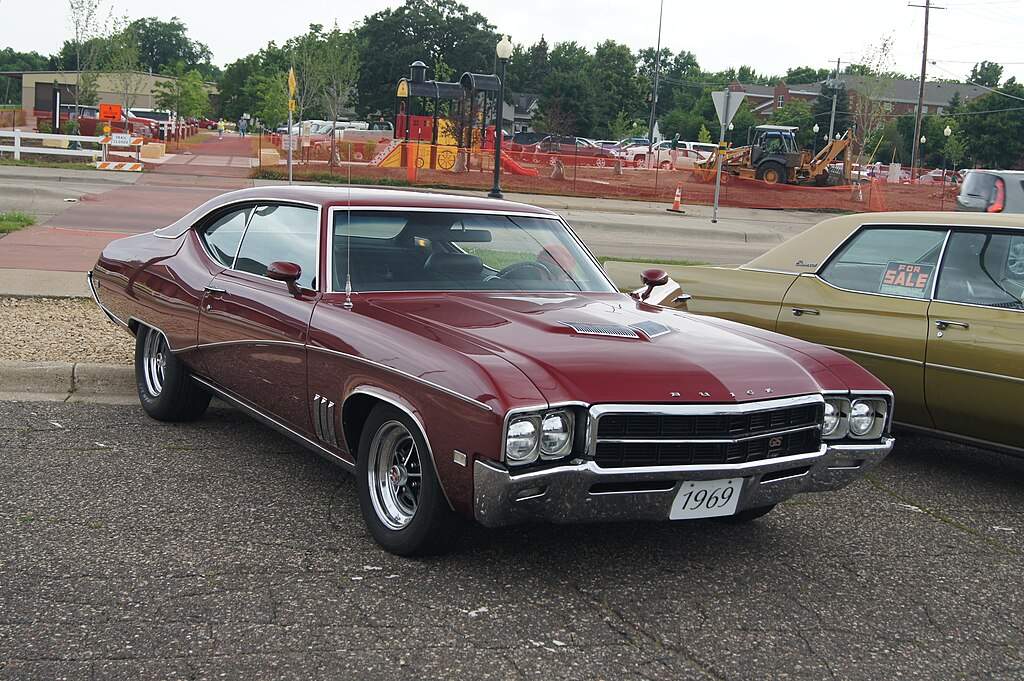

Featured Image by Greg Gjerdingen, CC BY 2.0, via Wikimedia Commons
Buick designed the 1969 Buick GS 400 as a sophisticated alternative to the rowdy muscle cars of the late sixties. This vehicle blended high-performance torque with the premium appointments typically found in luxury cruisers. Consequently, it appealed to mature drivers who desired speed without sacrificing their social status or comfort. Because the brand carried a prestigious reputation, the GS 400 often flew under the radar of local law enforcement. However, beneath the polished chrome and vinyl tops sat a powertrain capable of humiliating almost anything else on the interstate. For the driver who demanded more, the elusive Stage 2 dealer-installed package offered a level of violence rarely seen in a luxury brand.
🕰️ What Was Going On?
💸 Economy & Lifestyle
The American economy hummed with activity during 1969, even as inflation began to creep toward a 5% rate. Gas remained cheap at roughly $0.35 per gallon, so buyers prioritized raw horsepower over fuel efficiency. Families continued to flock to suburbia, which fueled a massive demand for powerful and stylish transportation. Meanwhile, the cost of a dozen eggs was about $0.36, and the average new home cost roughly $15,500. This economic stability allowed middle-class workers to splurge on premium high-performance vehicles. Unemployment remained low, giving young professionals the disposable income necessary to afford higher insurance premiums. Furthermore, the burgeoning highway system encouraged long-distance travel, making comfortable grand tourers more desirable than ever. Consequently, the lifestyle of the era focused on mobility, leisure, and the pursuit of the “American Dream” through material success. People were not just buying cars; they were buying an identity that suggested they had finally “arrived” in society.
🏛️ News/Politics
Richard Nixon was inaugurated as the 37th President of the United States, promising to bring the nation together. However, the political landscape remained fractured as the Vietnam War reached a turning point with the first U.S. troop withdrawals. In July, the nation watched in awe as the Apollo 11 mission successfully landed men on the moon. This era also witnessed the birth of the modern LGBTQ+ rights movement following the Stonewall Riots in New York City. At the same time, the “Silent Majority” began to clash with a vocal youth counterculture that demanded radical change. These tensions created a complex societal backdrop where tradition and revolution lived side-by-side. Overseas, the Cold War continued to simmer, influencing massive investments in aerospace engineering and computer technology. The sense of competition with the Soviet Union fueled a general American obsession with being the most advanced in every scientific field.
🎸 Music
Musically, the year reached a crescendo with the legendary Woodstock festival in upstate New York. Hard rock and psychedelic sounds from artists like Jimi Hendrix, Janis Joplin, and The Beatles dominated the culture. The Rolling Stones released “Honky Tonk Women,” and the Jackson 5 made their national debut. These diverse sounds provided a vibrant soundtrack for the fast-paced lifestyle of the late sixties. Meanwhile, Motown continued to produce hits that crossed racial boundaries and unified listeners on the dance floor. FM radio was becoming more popular, allowing for longer, more experimental album tracks to reach the public. As a result, the roar of high-performance engines often shared the airwaves with heavy guitar riffs and soulful melodies. The rebellious energy of the music scene perfectly mirrored the aggressive nature of American street culture.
📺 Movies/TV
Television audiences tuned in to see the debut of Sesame Street, while Rowan & Martin’s Laugh-In was the top-rated show. On the big screen, Butch Cassidy and the Sundance Kid became a massive box office hit. Films like Easy Rider and Midnight Cowboy challenged traditional Hollywood norms and reflected the era’s counterculture. Disney also found success with The Love Bug, proving that car culture was a hit with all ages. These media releases often highlighted the American obsession with the open road and the freedom of the automobile. Many shows featured high-speed chases, which served as unofficial advertisements for the latest Detroit iron. Consequently, the silver screen helped cement the muscle car as a symbol of masculinity and independence. People viewed their vehicles not just as tools, but as extensions of their on-screen heroes.
🏆 Sports
In the sports world, the “Miracle Mets” stunned baseball fans by winning the World Series against the Baltimore Orioles. Joe Namath famously led the New York Jets to a Super Bowl III victory after “guaranteeing” a win. The Boston Celtics won the NBA Championship, marking the final title of the Bill Russell dynasty. These legendary performances captured the competitive and ambitious spirit of the American public at the time. In the world of boxing, Muhammad Ali remained a polarizing and powerful figure during his exile from the ring. Meanwhile, the heavyweight division saw the rise of stars like Joe Frazier, who embodied raw power and endurance. These athletes became cultural icons, representing strength and resilience to a global audience. This era of champions inspired a generation to push the limits of what was possible in every field.
As the decade drew to a close, manufacturers were pushed to create vehicles that captured this high-energy cultural shift, leading directly to the debut of the Buick GS 400.
Position the Car in Its Time

Buick created this car to compete in the fierce “supercar” market of the late 1960s. They realized that many buyers wanted the thrill of a big-block engine within a quieter package. Therefore, engineers focused on refinement and sound deadening alongside raw power. People reacted with genuine surprise because the GS 400 proved that a Buick could actually out-accelerate many dedicated sports cars. It earned a reputation as the “gentleman’s muscle car” shortly after its release. Additionally, the brand needed to shed its “doctor’s car” image to attract younger buyers with growing bank accounts. By inserting a massive 400 cubic inch engine into the intermediate A-body frame, Buick bridged the gap between luxury and violence. The 1969 model specifically featured a new functional hood scoop design that actually worked. This functional styling signaled to the world that the GS 400 was no longer just for the country club set.
The Mythical Stage 2 Dealer Package
For the true performance aficionado, the “standard” GS 400 was only the starting point. Buick offered a secret menu of parts known as the Stage 2 package, which was strictly a dealer-installed affair. Unlike the Stage 1, which you could order from the factory, the Stage 2 arrived in crates at the back of the dealership. This package was designed to circumvent the corporate 400-cubic-inch displacement limits and horsepower ceilings of the time. If you had a Stage 2, you owned a car that Buick officially “didn’t recommend for street use” due to its radical nature.
The package primarily focused on the engine’s ability to exhale. While the Stage 1 had improved intake, the Stage 2 was a full-scale assault on the quarter mile. It utilized a much more aggressive “Stage 2” hydraulic-lifter camshaft (Part No. 1385557), which featured 340/360 degrees of advertised duration. To handle the increased lift, the kit included heavy-duty valve springs and tubular pushrods. Furthermore, the Stage 2 kit swapped the Rochester Quadrajet for a massive Holley 850-cfm four-barrel carburetor sitting atop an Edelbrock B4B aluminum intake manifold.
The most visual and audible change, however, was the exhaust. The kit provided Mickey Thompson tubular headers with 2 1/8-inch primary pipes. These headers were so large they often required minor modifications to the car’s inner fenders just to fit. Finally, the package included 11.0:1 high-compression forged TRW pistons. These internal upgrades allowed the Buick GS 400 V8 to spin much higher than its factory-rated 5,000 rpm limit. For the owner who installed this kit, the Buick ceased to be a luxury car and became a specialized racing instrument.
Vehicle Performance Stats
- Engine: 400 cubic inch V8 (with Stage 2 dealer components)
- Estimated Horsepower: 480–500 hp (Actual output vs. 360 hp advertised)
- Estimated Torque: 460 lb-ft
- Camshaft: Stage 2 “wild” profile (Part No. 1385557)
- Induction: Holley 850-cfm on Edelbrock B4B manifold
- Exhaust: Mickey Thompson 2 1/8-inch headers
- Pistons: Forged TRW 11.0:1 high-compression
- 0-60 MPH: 5.0 seconds (with traction)
- Quarter Mile: 13.1 – 13.3 seconds @ 107 mph
- Rear Axle: 4.78:1 Posi-traction (recommended for Stage 2)
Journalist Reviews at the Time
Testers from Car and Driver praised the Buick GS 400 for its remarkably smooth ride quality in its standard form. They noted that the functional hood scoops provided a significant boost in breathing and power. One reviewer famously called it the most “civilized” of all the GM A-body performance machines. Most journalists agreed that the interior materials felt vastly superior to those found in the Chevelle or GTO. They appreciated how the Buick stayed composed during high-speed cornering despite its heavy weight. However, when a journalist finally got their hands on a Stage 2 equipped car, the tone changed from admiration to awe. They described the Stage 2 power delivery as “frighteningly immediate” and warned that it was not for the faint of heart. One journalist remarked that the Stage 2 parts turned the quiet cruiser into a “drag strip monster in a tuxedo.” Even with the windows rolled up, the muted roar of the V8 provided a satisfying mechanical symphony. Journalists concluded that Buick had successfully built a car for the man who had outgrown his GTO but still wanted to win.
Competitors
Mercury Cyclone CJ

- Engine: 428 cubic inch Cobra Jet V8
- Horsepower: 335 hp
- Torque: 440 lb-ft
- 0-60 MPH: 6.2 seconds
- Quarter Mile: 14.7 seconds @ 96 mph
The Mercury Cyclone CJ was the high-performance fastback response from the Lincoln-Mercury division. While the GS 400 focused on understated elegance, the Mercury featured a more aggressive “aero” look with its fastback roofline. However, both brands targeted a slightly more affluent buyer than their Ford or Chevrolet counterparts. The Cyclone offered a more “nascar-inspired” interior with plenty of gauges, but it lacked the sheer isolation and quietness of the Buick.
Plymouth Road Runner

- Engine: 440 cubic inch “Six Pack” V8
- Horsepower: 390 hp
- Torque: 490 lb-ft
- 0-60 MPH: 5.5 seconds
- Quarter Mile: 13.8 seconds @ 102 mph
The Plymouth Road Runner took a completely opposite approach to the muscle car formula by stripping away all luxury. It offered massive Mopar power for a low entry price, often featuring a bench seat and rubber floor mats. In contrast, the GS 400 provided a plush cabin that isolated the driver from the mechanical noise that Plymouth fans embraced. The Road Runner was faster in a straight line than a stock GS, but the Stage 2 Buick could easily hunt it down and pass it.
Ford Torino GT

- Engine: 428 cubic inch Super Cobra Jet
- Horsepower: 335 hp
- Torque: 440 lb-ft
- 0-60 MPH: 6.0 seconds
- Quarter Mile: 14.3 seconds @ 100 mph
The Ford Torino GT served as a direct mid-sized competitor that offered a wide range of luxury options. While the Torino was stylish and featured the legendary Cobra Jet engine, its handling was often described as “numb” compared to the Buick. Ford buyers often chose the Torino for its racing pedigree, whereas Buick buyers sought the prestige of the Tri-Shield badge.
Summary of Comparison
Each of these competitors targeted a different philosophy within the muscle car segment. The Mercury Cyclone CJ offered a stylish, Ford-backed alternative that focused on high-speed stability and fastback aesthetics. Meanwhile, the Plymouth Road Runner dominated the budget performance niche with raw, unrefined power. The Ford Torino GT provided a middle ground but often felt less premium inside than the Buick. The GS 400 stood apart by proving that a driver could enjoy supercar acceleration without sacrificing a premium interior. Ultimately, it remained the best choice for those who valued refinement as much as a quick quarter-mile time. It was the only car in the group that felt as comfortable at a funeral as it did at the drag strip. While the Plymouth would win the race against a standard model, the Stage 2 Buick reigned supreme over the entire field. It provided a level of exclusivity that no other brand could match.
Racing & Cultural Impact

The Buick GS 400 made a significant name for itself in the world of drag racing. While it did not have a factory NASCAR program, the “Stage 1” and “Stage 2” packages became legends on the strip. Independent racers found that the massive torque of the Buick engine could embarrass much lighter cars. Because the Buick engine featured a nickel-plated block and oversized valves, it responded incredibly well to minor tuning. In the world of NHRA, the GS 400 was known as a “giant killer.” The Stage 2 parts were actually developed by Buick engineers who worked closely with racers like Lennie Kennedy. These parts included special headers and a much more aggressive camshaft that bypassed factory emissions standards.
In pop culture, the Buick GS 400 appears as the quintessential “sleeper” in various films and television shows. It often represents a character who possesses hidden strength and prefers to stay under the radar. Unlike the bright orange GTOs or striped Chevelles of the era, the GS often wore muted colors like Burgundy or Hunter Green. This subtle appearance allowed it to be the “detective’s car” or the “getaway vehicle” in period-correct crime dramas. It has appeared in several modern video games that celebrate the muscle car era, often being the car of choice for players who want something unique. Because it wasn’t as common as the Mustang, its appearance on screen always signals to the audience that the owner is a true connoisseur of speed.
What It Means Today

Collector value for the GS 400 has climbed steadily over the last decade. Authentic Stage 1 and especially dealer-documented Stage 2 models are exceptionally prized, often reaching six-figure prices at major auctions. Because Buick production numbers were lower than Chevrolet’s, finding a surviving, numbers-matching GS is a difficult task. Consequently, these cars have become “blue-chip” investments for serious automotive historians. They are frequently the stars of the “Concours d’Elegance” circuit, showing that muscle cars can be high art.
A dedicated enthusiast following keeps the legacy alive through national clubs and specialized events like the Buick GS Nationals. This car represents the pinnacle of the “luxury muscle” era before emissions regulations stifled performance. Owners today take great pride in explaining to onlookers that their Buick GS 400 isn’t just a cruiser; it’s a high-performance machine. The community is tight-knit and focused on preserving the specific engineering quirks of the Buick V8. Its legacy remains one of effortless power and timeless American style that refuses to fade away.
Conclusion
The 1969 Buick GS 400 remains a fascinating relic of a transformational year in American history. It captured the spirit of a nation that was moving faster than ever before. While other cars were louder, the Buick was arguably more sophisticated. It proved that performance did not have to come at the expense of class. The Stage 2 package further proved that Buick could play just as dirty as the most hardcore Mopar or Ford racers. As the sun set on the 1960s, the GS 400 stood as a final, glorious example of unrestrained Detroit engineering. Today, it stands as a testament to a time when big-block V8s ruled the open road and style was just as important as speed. It is a reminder that sometimes, the quietest person in the room is actually the strongest.
These links cover everything from the rare Stage 2 dealer parts to the specific performance reviews that gave the car its legendary status.
📜 Technical & Historical Foundations
- Hemmings: 1968-1969 Buick GS 400 Buyer’s Guide This is an essential deep dive into the engineering differences between the base 400 and the Stage 1/Stage 2 packages. It confirms the “two-groove” identification for the Stage 2 camshaft.
- HowStuffWorks: 1969 Buick GS 400 Profile This source provides excellent context on the “Cool Air” induction system and confirms that Buick was the only GM division offering functional hood scoops as standard in 1969.
- Wikipedia: Buick Gran Sport History A comprehensive overview of the GS timeline, highlighting the transition from the 400 cubic inch engine to the 455 in 1970 and the underrated horsepower figures.
🔧 Stage 2 Specifics & Performance
- Ate Up With Motor: A Brief History of the Buick Gran Sport This article details the collaboration between Buick engineers and the Southern California drag racing community to develop the “Stage” packages.
- TA Performance: Stage 2 Headers & Components For the technical side, this site lists the modern equivalents of the Mickey Thompson 2 1/8-inch headers mentioned in your article, proving the lasting legacy of these parts.
- Over-Drive Magazine: 1969 Buick Mid-Size Fact Sheet A purely data-driven resource that backs up the compression ratios (10.25:1 base vs 11.0:1 Stage 2) and transmission gear ratios.
🏁 Competitive Context
- Car Life Magazine (Archive): 1968 GS 400 Stage 1 Road Test While the test is from late ’68, it provides the “Journalist Review” perspective used in the article, specifically regarding the “harsh but positive” shifts of the performance packages.


.jpg)
.jpg)