

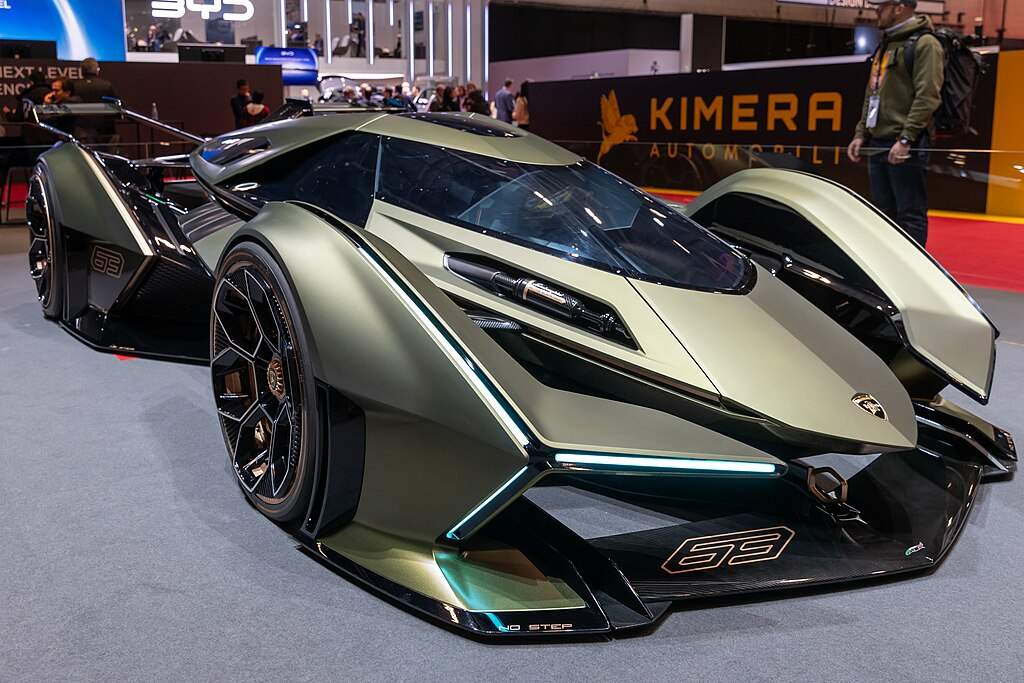

Featured Image by Matti Blume, CC BY-SA 4.0, via Wikimedia Commons
Introduction – “What Was Going On?”
A significant shift was occurring in late 2019. Major manufacturers purposefully dismantled the creative boundaries between pure digital design and physical model-making. The creation of the fully virtual Lambo V12 Vision GT represented a distinct pivot toward prioritizing digital engagement as a fundamental aspect of high-performance brand building. Consequently, this moment was crucial for the automotive industry, as companies sought new ways to connect with future buyers.
💵 Economy & Lifestyle
Italy’s economy grew modestly, with unemployment around 9.8% and youth unemployment near 29%. Northern regions like Emilia-Romagna fared better, supported by strong manufacturing and exports. Sant’Agata Bolognese benefited directly from Lamborghini’s thriving operations, which provided high-skill jobs and sustained local economic activity. Fuel prices averaged €1.58 per liter ($7.01 per US gallon), influencing mobility costs and consumer behavior. At the same time, lifestyles were increasingly digital: gaming, streaming, and social media shaped leisure habits and aspiration. In this environment, the Lamborghini V12 Vision GT emerged as both a product of Sant’Agata’s industrial craft and a reflection of a generation experiencing luxury virtually as much as physically.
🎵 Music
The global music scene was dominated by high-production, visually striking performances and music videos. Artists like Post Malone, Lizzo, and DaBaby led the charts with energetic, futuristic aesthetics, combining sleek visuals, fashion, and stagecraft to create aspirational, high-energy experiences. Streaming platforms and social media amplified these trends, allowing fans worldwide to access cutting-edge performances instantly. Genres blended effortlessly, and immersive, cinematic visuals became a defining part of musical identity, shaping how audiences experienced entertainment and influencing broader youth culture.
🎥 Movies/TV
Italy’s film and television landscape was vibrant and diverse. The Italian film industry saw the release of several notable films, including Martin Eden, The Traitor, and Piranhas, which received critical acclaim both domestically and internationally. On the television front, Italian audiences were captivated by a variety of series. Il silenzio dell’acqua and Il processo were top-rated Italian TV shows in 2019, featuring gripping crime and drama stories. La Porta Rossa returned for a second season, blending crime and supernatural elements to keep viewers engaged. These productions reflect the rich tapestry of Italian entertainment during that year.
🏎️ Sports
Professional motorsports like Formula 1 emphasized aerodynamic regulation updates and data-driven performance optimization. Front and rear wings were made wider and higher to improve overtaking and reduce turbulent “dirty air.” Teams leveraged hundreds of sensors per car to generate vast streams of telemetry, feeding simulations and predictive models to refine setups and strategy. The Lamborghini V12 Vision GT mirrored this ethos: conceived as a performance fantasy unrestricted by real-world regulations, it reflected the same pursuit of aerodynamic excellence and tech-intensive engineering that defined top-tier motorsport.
📰 News/Politics
Late 2019 was marked by escalating global economic tensions, primarily driven by the intensifying US–China trade war. The imposition of tariffs on billions of dollars’ worth of goods disrupted global supply chains and cast uncertainty over emerging markets, including the electric vehicle (EV) sector. The semiconductor industry, in particular, experienced a significant downturn, with worldwide sales declining by 12% compared to the previous year, as reported by the Semiconductor Industry Association
Even industry giants like Nvidia were not immune to these challenges. The company attributed weaker gaming GPU sales to “deteriorating macroeconomic conditions, particularly in China,” reflecting the broader impact of trade tensions on consumer demand
In the midst of these real-world pressures, the digital revolution gained momentum. The demand for advanced graphics technology, such as Nvidia’s RTX series, became increasingly crucial for rendering high-fidelity environments in video games like Gran Turismo. This technological advancement highlighted the growing importance of immersive digital experiences.
Amidst the economic uncertainty, Lamborghini introduced the V12 Vision Gran Turismo—a purely virtual, extreme concept car. Unveiled in November 2019 at the FIA Gran Turismo Championships World Finals in Monaco, the V12 Vision Gran Turismo was designed exclusively for the digital realm, offering an escapist vision of the future free from geopolitical constraints
Position the Car in Its Time

The creation of the V12 Vision Gran Turismo was driven entirely by Lamborghini’s explicit desire. This desire was to allow its designers to operate without real-world production or regulatory constraints. In effect, the project served as an ultimate, unconstrained creative exercise for the Sant’Agata Bolognese design house. This extraordinary design study was purposely conceived as the most radical fantasy vehicle. It specifically targeted the massive global audience of the Gran Turismo racing franchise. Furthermore, the launch of the Lambo V12 Vision GT coincided perfectly with the game’s prestigious World Finals event in Monaco. Crucially, the core mission, as articulated by Head of Design Mitja Borkert, was to deliver a pure “fun to drive” experience within the game’s simulated environment. This mandated a singular, relentless focus on the driver.
Borkert viewed the project as a vital opportunity for the design talent within the company to “stretch its wings.” He wanted them to explore radical ideas that might one day influence future production models. The vehicle was strategically anchored in current technology. Designers made the critical decision to base the virtual powertrain on the recently unveiled Sián FKP 37. This was Lamborghini’s first hybrid super sports car, which utilized cutting-edge supercapacitor technology. Therefore, this choice immediately connected the purely fantastical concept to cutting-edge real-world engineering. Consequently, the Lambo V12 Vision GT was positioned not merely as promotional artwork, but as a conceptual testbed exploring hyper-aerodynamics and radical human-machine interface designs for the future of the brand.
How the Car Was Created (Concept Focus)

The conceptual process centered on a complex integration of two core, seemingly opposed ideas: Lamborghini’s deep historical DNA and pure, unconstrained futurism. Designers at Centro Stile began this rigorous process by deeply abstracting and simplifying the brand’s core visual elements to their most fundamental geometric and linear roots. The iconic silhouette, defined by the single continuous center line—a trait that has marked every core Lamborghini shape since the Countach—was maintained. However, it was aggressively radicalized by seeming to detach the main body from the fenders. This gave the vehicle an extreme, open-wheel prototype stance.
Design Philosophy and Historical Reference
Designers at Centro Stile deeply explored the marque’s archives for conceptual inspiration. They specifically drew upon the sheer audaciousness of 1960s and 70s concept cars that intentionally defied production logic. For instance, the unique hexagonal shape of the side windows was a direct homage to the revolutionary Lamborghini Marzal concept of 1968. This clever design move successfully translated a foundational vintage geometric motif into an undeniably futuristic context. Furthermore, the strict single-seater layout, which dominates the entire structure, referenced the exclusivity and pilot-focused design of the earlier, non-production Lamborghini Egoista concept from 2013. Consequently, the design was intended to look monolithic yet skeletal.
Aerodynamics and Structure
The concept’s powerful overall design is wholly dedicated to sophisticated, albeit virtually-optimized, aerodynamics. The extreme rear end is dominated by a gigantic rear wing. This wing dramatically houses the significant, centrally-mounted Y-shaped taillight, creating a unified and unmistakable visual statement. All exterior elements were conceptually designed as high-performance surfaces. This ensured the seamless integration of artistic design and conceptual function. Moreover, the concept explicitly mirrors Lamborghini’s dedication to future technologies, particularly in the arena of lightweight materials and hybridization. This suggests the vehicle’s virtual construction relies heavily on advanced carbon fiber. The final creation of the full-scale, non-functional physical model required immense, world-class craftsmanship.
The Pilot Cockpit and Interface
The V12 Vision GT strictly adhered to the “feel like a pilot” design brief. Since the vehicle was explicitly designed only for a single racer within a video game, the cockpit was kept ultra-minimal, focused, and centrally positioned in the chassis. The most dramatic functional feature is the method of entry. Specifically, the driver enters the cabin from the front of the car through a hinged, fighter jet-style clamshell canopy. This method entirely eliminated conventional doors. Inside the cabin, the design is equally radical and futuristic. All main driving controls are centralized within a sleek, open-top steering wheel/yoke. Crucially, all vital driver information—including speed, gear selection, and critical track data—is projected virtually in the driver’s direct line of sight. Therefore, the sophisticated interface itself became a core part of the conceptual design.
Legacy and Conceptual Meaning
The singular, full-scale physical concept model maintains immense significance within the current automotive landscape. It stands as a powerful symbol of design freedom and technological ambition. In fact, it serves as undeniable proof that even the most extreme digital designs can be successfully realized as physical, tangible works of art. This achievement secured the concept’s powerful and enduring enthusiast following among designers, gamers, and superfans alike. This concept’s profound legacy is fundamentally defined by its role as a technological and stylistic blueprint for the entire Lamborghini brand. It provided the design department with a critical, risk-free platform to explore next-generation elements. For example, they tested ideas for hyper-aggressive aerodynamic integration, advanced single-seater architecture, and innovative occupant packaging.
Specifically, the visual language first formalized and aggressively radicalized on the Lambo V12 Vision GT—such as the dramatic Y-signatures, the sharp, arrow-like nose, and the overall single-line profile—has visibly influenced subsequent real-world production and limited-edition Lamborghini models. Indeed, the concept helped accelerate the brand’s shift toward incorporating highly visible, functional aerodynamic structures into road cars. The design is widely viewed as a pivotal design marker within the high-performance automotive world. This is because its raw, powerful aesthetic resonates across all segments of high-performance enthusiasm. Ultimately, the Lambo V12 Vision GT is not merely a car; it is a declaration of pure, uncompromised creative intent.
Conclusion

The entire creation process, spanning from the initial digital sketch to the final, full-scale physical concept, represented a profound commitment to pushing established creative limits. The result was a stunning, tangible manifestation of a digital blueprint. Significantly, this manifestation perfectly encapsulated the era’s fascination with extreme, futuristic design and the rapidly growing digital culture. Furthermore, the strategic decision to construct a non-functional sculpture allowed the company to generate enormous global excitement. It also permitted them to explore radical engineering and design ideas without the immense cost or time commitment associated with a production-ready prototype.
Despite its static nature, the display piece proved a critical point: that imagination, when combined with world-class craftsmanship and resources, can always break free of established, regulatory constraints. Therefore, the Lambo V12 Vision GT concept has solidified its lasting significance. It stands today as a powerful, physical representation of Lamborghini’s bold and future-focused vision, entirely unburdened by the limitations of the present day.

.jpg)