

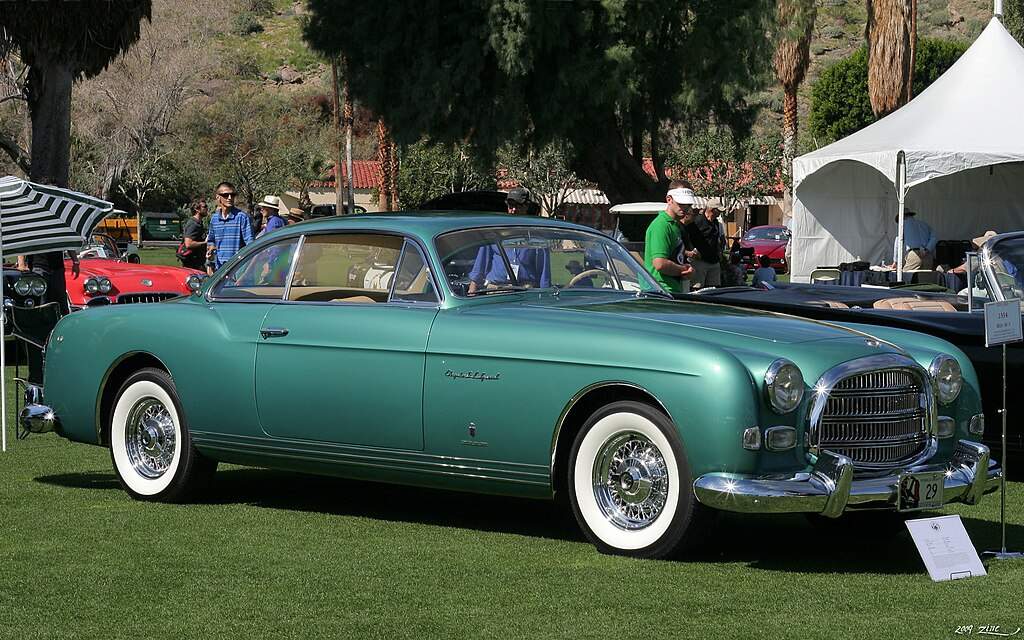

Featured Image is by Rex Gray, CC BY 2.0, via Wikimedia Commons
Introduction – What Was Going On?
The year 1954 was a time of notable transformation in the United States, representing a blend of post-war prosperity and burgeoning cultural shifts. Indeed, the nation’s focus was increasingly drawn toward leisure, consumption, and a desire for stylish, modern goods. Furthermore, the decade’s economic growth was substantial, with an overall expansion fueling an increased purchasing power for the burgeoning middle class. Inflation, by contrast, remained minimal thanks in part to prudent fiscal policies. Therefore, the concept of “buy now, pay later” began to take hold, giving rise to an economy increasingly driven by consumer credit, which profoundly shaped American spending habits.
💵 Economy & Lifestyle
Gas prices remained remarkably affordable compared to later eras, consequently encouraging longer road trips and a growing dependence on the automobile for suburban living. The cost of living was relatively stable, making homeownership a realistic goal for many families, especially veterans utilizing the GI Bill. Youth culture, nevertheless, was starting to assert its independence, laying the groundwork for the monumental changes that would follow. Notably, automobile trends were shifting away from the stodgy, pre-war designs still offered by some manufacturers, with consumers craving sleeker, lower, and more fashionable vehicles.
📰 News/Politics
In the political arena, major historical events unfolded, with the Supreme Court delivering the landmark Brown v. Board of Education decision, which legally mandated the desegregation of public schools. Globally, the Cold War tensions persisted, prompting continued military and technological development. Moreover, 1954 saw the U.S. involvement in Southeast Asia deepen, ultimately marking a pivot point in foreign policy.
🎵 Music
The music scene of 1954 reflected a fascinating period of transition. Although the pop charts were dominated by crooners and traditional singers, a new sound was emerging. Kitty Kallen’s “Little Things Mean a Lot” and Perry Como’s “Wanted” topped the Billboard charts, demonstrating the popularity of adult contemporary styles. However, the youthful exuberance of rock and roll was beginning its ascent. For example, Bill Haley & His Comets released “Shake, Rattle and Roll,” a critical precursor to the genre’s explosion.
🎥 Movies/TV
Motion pictures continued to draw large audiences, although the new technology of television was quickly becoming a primary source of entertainment in American homes. Classic films like Alfred Hitchcock’s suspenseful Rear Window and Elia Kazan’s powerful On the Waterfront were major releases, demonstrating a high-quality cinematic output. Popular television shows, such as I Love Lucy, nevertheless, reinforced traditional family and social values.
🏈 Sports
On the sporting fields, the year was filled with championships and notable feats. In baseball, the New York Giants swept the Cleveland Indians in the World Series, capturing the national title. The Cleveland Browns avenged an earlier defeat by crushing the Detroit Lions to win the NFL Championship. Furthermore, one of the most significant moments in athletic history occurred when Roger Bannister became the first person to run a mile in under four minutes. Such a feat captivated the public imagination, embodying the era’s sense of limitless potential.
Against this backdrop of consumer confidence and shifting style, a conservative Chrysler Corporation was struggling to shed its image of being behind the times. Thus, the exquisite 1954 Chrysler Ghia GS-1 was created, offering a dramatic vision of where the brand’s design was headed.
Position the Car in Its Time

A distinct crisis in styling had befallen the Chrysler Corporation after World War II. For many years, an engineering-first mandate dictated that the cars be tall enough for a gentleman to wear his hat inside comfortably. Consequently, rival manufacturers like General Motors and Ford were producing sleek, more modern-looking vehicles that captured the public’s imagination, leaving Chrysler’s offerings looking somewhat dated. The brand desperately needed a change to revitalize its conservative image.
Visionary designer Virgil Exner and Chrysler executive C.B. Thomas drove this new direction. Thomas, sought international flair to break the mold. Therefore, Chrysler forged a unique and successful partnership with the famed Italian coachbuilder, Carrozzeria Ghia, based in Turin. Ghia’s skilled craftsmen could hand-build stunning prototypes and low-volume specials that instantly projected an image of sophistication and advanced design. The resulting “Idea Cars,” like the earlier Ghia Specials, received high acclaim and proved Chrysler’s seriousness about style. The GS-1 evolved earlier designs. It became a limited production model for elite European customers, advertising Chrysler’s global ambition and countering its domestic aesthetic slump. The automotive press reacted with awe at its launch, praising the car’s elegant, well-proportioned lines that perfectly blended Detroit’s raw power with Italian sprezzatura.
Vehicle Performance Stats
- Engine: 331 cubic inch FirePower Hemi V8
- Horsepower (Est.): 200 bhp at 4400 rpm
- Carburetion: Single 4-Barrel Carburetor
- Transmission: PowerFlite Automatic
- Chassis: Modified Chrysler New Yorker Deluxe chassis (125.5-inch wheelbase)
- Brakes: 4-Wheel Hydraulic Drum Brakes
- Production: Approximately 9 bespoke examples built
Journalist Reviews at the Time
Contemporary journalists admired the GS-1’s blend of aesthetics and engineering. One reviewer asserted that the Ghia-bodied coupe demonstrated a sophisticated design that few American production cars of the era could rival. Another period test drive summary noted the car’s effortless power delivery from the Hemi V8, beautifully complementing the comfortable and luxurious interior appointments. Observers unanimously praised the masterful Italian coachwork, which featured a low, sleek profile and subtle design elements like the trapezoidal grille and smooth fender lines. A sense of exclusivity and bespoke luxury was strongly associated with the GS-1 from the very beginning.
Competitors
The Ghia GS-1 occupied a unique space—it was a luxury coupe mixing American muscle car components with handcrafted European coachwork, making direct comparisons difficult. Its true rivals were other high-end, limited-production, international GT cars that targeted the most affluent clientele.
GS-1 vs. Ferrari 250 Europa GT Comparison

- 1954 Ferrari 250 Europa GT
- Engine: 3.0L Colombo V12
- Horsepower (Est.): 200 hp
- Production: Very limited
The rivalry between the GS-1 and the Ferrari 250 Europa GT was less about direct competition and more about two different philosophies of performance. Specifically, the GS-1’s robust 331 cubic inch Hemi V8 delivered equivalent horsepower to the Ferrari’s celebrated 3.0L V12, but the Chrysler achieved it with far greater torque at lower RPMs. Furthermore, the Ferrari, an offspring of a racing dynasty, offered superior agility and a more thrilling engine note at high speeds. Consequently, the Italian marque catered to the dedicated sports car enthusiast, while the GS-1 provided a smooth, opulent Grand Touring experience, prioritizing luxury over track-day performance.
GS-1 vs. Maserati A6G/54 Comparison

- 1954 Maserati A6G/54
- Engine: 2.0L Inline-Six
- Horsepower (Est.): 150 hp
- Production: Very limited
Naturally, the Maserati A6G/54 presented a fascinating stylistic contrast to the Chrysler-Ghia collaboration. Although the A6G/54 was exquisitely bodied, its 2.0L Inline-Six engine was significantly less powerful than the GS-1’s Hemi, giving up 50 horsepower. Therefore, the Maserati emphasized lightweight, high-revving handling and technical sophistication typical of European racing tradition. Conversely, the GS-1 represented American power dominance; it provided effortless speed and a more relaxed driving experience, a characteristic of large-displacement engines that were becoming common.
GS-1 vs. Aston Martin DB2/4 Saloon Comparison

- 1954 Aston Martin DB2/4 Saloon
- Engine: 2.6L Lagonda Inline-Six
- Horsepower (Est.): 125 hp
- Production: Limited
Ultimately, the Aston Martin DB2/4 was a well-regarded, luxurious British Sports Saloon, but it fell short of the GS-1 in raw engine output. The Aston Martin’s 125 hp from its 2.6L engine meant it could not match the straight-line performance of the Hemi-powered Chrysler. However, the DB2/4 was an established nameplate in the high-society GT segment and possessed a four-seater configuration that made it more practical than the two-seater GS-1. Thus, while the Aston Martin was a polished, subtle option for the wealthy Briton, the GS-1 was a far bolder statement of American-Italian power and design fusion.
Summary: How the Ghia GS-1 Compared
The Ghia GS-1 successfully positioned itself as the high-powered alternative among the world’s most exclusive touring cars. Therefore, its massive Hemi V8 provided superior straight-line performance and low-end torque, surpassing the acceleration capabilities of the smaller-engined European rivals. In contrast, competitors like the Ferrari and Maserati generally excelled in chassis refinement and track-focused agility, reflecting their racing origins. Consequently, the Chrysler-Ghia blended American mechanical robustness with exceptional Italian coachwork, creating a distinct, powerful, and luxurious cross-continental Grand Tourer that defined style over circuit speed.
Racing & Cultural Impact
The Ghia GS-1 itself was never intended for formal racing circuits, unlike many of its direct competitors. Therefore, its contribution to NASCAR history is non-existent, and it was not an aero-car designed for high-speed ovals. The car was, however, a crucial design statement that had a profound effect on the Chrysler Corporation’s future styling direction.
This elegant coupe made its cultural mark not on the drag strip but in the rarefied atmosphere of international auto shows and high-society circles. For instance, the car’s sleek lines, particularly the low greenhouse and clean profile, influenced Virgil Exner’s famous “Forward Look” design language that would revolutionize Chrysler’s entire lineup a few years later. The GS-1, in essence, provided proof of concept, demonstrating that American V8 power could be wrapped in truly beautiful, modern bodywork. Although it was a limited-run European special, its image of sophisticated, international style trickled down, subtly shifting the perception of the entire Chrysler brand in the media.
What It Means Today

Today, the 1954 Chrysler Ghia GS-1 is revered as a highly significant artifact from a pivotal moment in American automotive history. Since only a handful of examples were ever produced, with as few as five known to exist, the collector value of the GS-1 is extremely high. When one comes up for auction, a world record sale price is often anticipated, reflecting its intense desirability. A passionate enthusiast following exists for all of the Exner-Ghia “Idea Cars,” and the GS-1 stands as one of the most successful examples of this fruitful trans-Atlantic collaboration. In the muscle car world, the GS-1’s legacy is important because it represents the Hemi V8 engine’s capability as a world-class power plant, capable of being married to the finest European design. It proved that the American V8 was a formidable, globally relevant performance piece, deserving of the most exclusive coachwork.
Conclusion
The 1954 Chrysler Ghia GS-1 perfectly encapsulated the era’s evolving tastes, merging the newfound affluence and power of post-war America with the classic, bespoke elegance of Italian design. It emerged from a necessity for Chrysler to drastically alter its visual identity. This coupe, a rare blend of Detroit engineering and Turin artistry, succeeded in demonstrating the corporation’s commitment to a stylish future. Truly, the GS-1’s lasting significance lies not in its production volume, but in its monumental impact as a design statement that heralded the “Forward Look” and fundamentally changed how the world viewed American luxury and performance.
Reference Links for the 1954 Chrysler Ghia GS-1 Coupe
1. Historical Context and Design Philosophy
These sources cover the partnership between Chrysler’s Virgil Exner and Carrozzeria Ghia, and the “Idea Car” program that led to the GS-1.
Exner, Ghia, and the Idea Car Program: When Chrysler wanted “wow” it called Ghia – Hagerty Media
GS-1 Development and Significance: 1954 Chrysler GS-1 Special Coupe – Auto History
Rarity and Specific Details: 1954 Chrysler GS1 Coupe – Hyman LTD
2. Technical and Mechanical Details
This section focus on the powertrain—the legendary FirePower Hemi V8—that supplied the GS-1’s performance.
331 CID Hemi Specs (1951-1958): 1951-1958 Chrysler Hemispherical V-8 Described – Over-Drive Magazine
1954 Hemi Power Output: GEN I HEMI Engine Heritage – DodgeGarage
3. Market Valuation and Auction Results
These resources are useful for discussing the car’s current status as a highly valuable collector’s item, detailing recent sales and estimated prices.
Price Range, Comps, and Sales History: 1954 Chrysler Ghia GS-1 Coupe – CLASSIC.COM
Recent Auction Listing and Result: 1954 Chrysler Ghia GS-1 Coupe – Bonhams Cars


.jpg)