

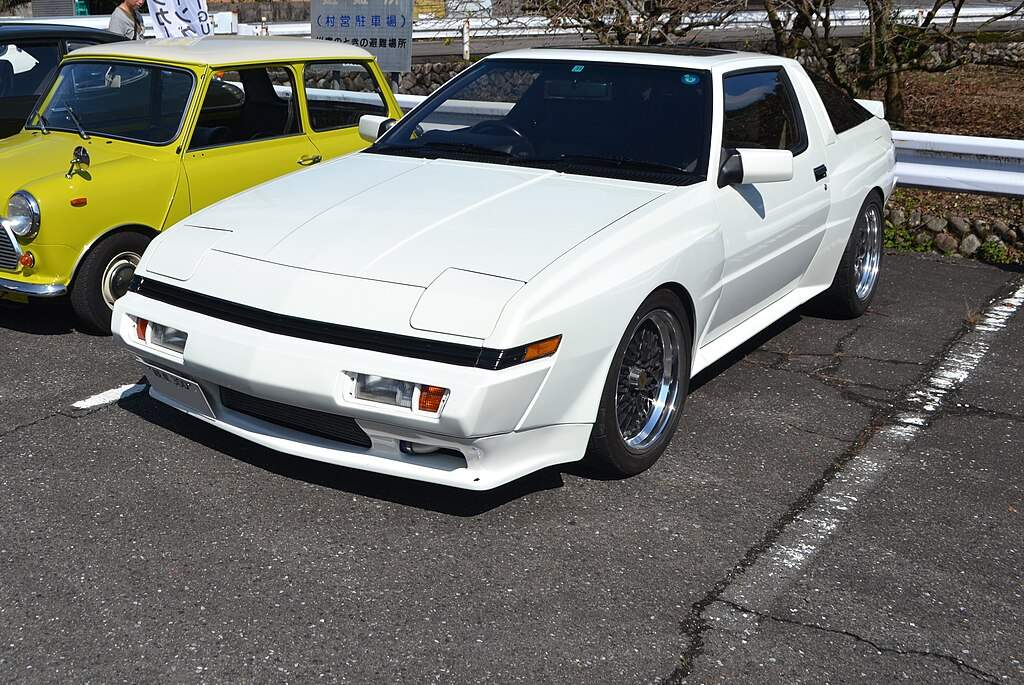

Featured Image by 先従隗始, CC0, via Wikimedia Commons
The Underrated Icon: Mitsubishi Starion
In the annals of automotive history, some cars are instantly recognizable icons, while others quietly carve out a niche, appreciated by those who truly understand their unique proposition. The Mitsubishi Starion, produced from 1982 to 1989, firmly belongs to the latter category. Often overshadowed by its more flamboyant contemporaries, the Starion was a fascinating blend of Japanese engineering prowess and a decidedly American aesthetic, offering a compelling package of performance, technology, and distinctive style. It was a true grand tourer, designed for both comfort on long journeys and exhilaration on winding roads, a testament to Mitsubishi’s ambition during a period of rapid growth and innovation.
What Was Going On?
💸 Economy & Lifestyle
Japan experienced a massive surge in wealth as the “Bubble Economy” began to take shape. Consequently, the cost of living in Tokyo became some of the highest in the world, yet the job market remained incredibly robust. Real estate prices started their historic climb, making land in Ginza more valuable than entire US cities. Young professionals, often called “Shinjinrui,” embraced a lifestyle of luxury consumption and high-tech gadgets. Furthermore, gas prices remained a concern for the island nation, driving a domestic obsession with fuel-efficient yet powerful small-displacement engines.
📰 News & Politics
In the realm of politics, the Liberal Democratic Party maintained a firm grip on power under the leadership of Yasuhiro Nakasone. Japan strengthened its ties with the West while simultaneously asserting its dominance in the global electronics and automotive sectors. Additionally, the nation focused on massive infrastructure projects like the expansion of the Shinkansen (bullet train) network. A spirit of national pride emerged as Japanese products became synonymous with world-class quality. As a result, the political climate was defined by stability and a relentless drive toward modernization.
🎵 Music
Music lovers in Japan were captivated by the rise of “City Pop,” a genre that blended disco, jazz, and synth-pop to soundtrack urban life. Artists like Tatsuro Yamashita and Mariya Takeuchi dominated the airwaves with sleek, high-production sounds. Furthermore, the “Idol” culture reached a fever pitch as young stars like Seiko Matsuda became national icons. The introduction of the Compact Disc (CD) by Sony in 1982 revolutionized how the public consumed their favorite tracks. Consequently, the Japanese music scene felt as polished and futuristic as the neon-lit streets of Shinjuku.
🎬 Movies & TV
Movie theaters showcased the growing mastery of Japanese animation, with Studio Ghibli being founded shortly after the Starion’s debut. Specifically, the release of Nausicaä of the Valley of the Wind signaled a new era for sophisticated, cinematic anime. On television, “Tokusatsu” shows featuring high-tech heroes and transforming robots captivated the youth culture. Similarly, gritty police dramas and variety shows reflected the fast-paced energy of the decade. Because of these creative booms, Japanese media began to exert a significant cultural influence far beyond its borders.
🏆 Sports
On the sports fields, baseball reigned supreme as the national pastime, with the Yomiuri Giants drawing massive crowds. Professional wrestling, or “Puroresu,” also saw a golden age with legends like Antonio Inoki and Giant Baba. In the world of boxing, Japanese fighters competed fiercely for world titles in the lighter weight classes. Furthermore, the 1982 Asian Games in New Delhi saw Japanese athletes dominate many track and field events. Therefore, the stage was perfectly set for a vehicle that blended futuristic technology with aggressive performance.
Starion’s Genesis: Mitsubishi’s Performance Ambition
The Starion’s genesis can be traced back to a time when Japanese manufacturers were making significant inroads into global markets, particularly in the United States. Having established a reputation for reliability and fuel efficiency, the next frontier was performance and a more engaging driving experience. Mitsubishi, then still a relatively smaller player compared to giants like Toyota and Nissan, aimed to make a statement. The result was a sleek, wedge-shaped coupe that looked like it had rolled straight off a futuristic concept car display.
The “Star of Arion” Theory (Mitsubishi’s Official Explanation):
Mitsubishi’s official stance is that “Starion” is a portmanteau (a blend of words) combining “star” and “Arion.” Arion was a mythical, incredibly fast horse from Greek mythology, often associated with Hercules. This explanation aligns with Mitsubishi’s history of using equine-related names for their cars (like the Colt and Eclipse, the latter named after a champion racehorse). Early Japanese TV commercials for the Starion even featured a horse’s head logo and a starry sky, with a voiceover connecting the car to Arion and stars.
The Starion’s Striking Debut and Design

From its debut in 1982, the Mitsubishi Starion, also sold as the Chrysler Conquest in North America (a badge engineering exercise that would become a common practice), immediately captured attention with its striking design. Its sharp lines, pop-up headlights, and wide, muscular stance gave it an undeniable road presence. The “wide body” versions, introduced later in its production run, further exaggerated these proportions, giving the car an almost pugnacious, race-bred look that endeared it to enthusiasts.
Starion’s Technological Edge: Turbocharged Power
Vehicle Performance Stats
- Manufacturer: Mitsubishi
- Engine: 2.0-liter (Japan) or 2.6-liter (US) SOHC Turbocharged Inline-4
- Horsepower: 145 hp to 188 hp (ESI-R models)
- Torque: 181 lb-ft to 234 lb-ft
- Transmission: 5-speed manual or 4-speed automatic
- Drivetrain: Rear-wheel drive
- 0-60 MPH: 7.9 seconds (ESI-R)
- Top Speed: 134 mph
Beneath the futuristic skin, the Starion packed serious technological punch for its era. Mitsubishi opted for a front-engine, rear-wheel-drive layout, a traditional sports car configuration that promised balanced handling. But the real magic lay under the hood. The Starion was one of the earliest Japanese production cars to widely embrace turbocharging.
Early models were powered by a 2.0-liter (initially a 2.6-liter in some markets like North America, later a 2.0-liter) SOHC four-cylinder engine, but it was the addition of a turbocharger and intercooler that truly transformed its character. This forced induction system, then a relatively nascent technology in mass-produced vehicles, delivered a surge of power that belied the engine’s displacement, offering impressive acceleration and a genuinely sporty feel. The 2.6-liter G54B engine, in particular, became synonymous with the Starion’s early years in the US, known for its robust torque delivery.
Journalist Reviews
Journalists at the time frequently praised the car for its punchy acceleration once the turbocharger finally kicked in. Car and Driver writers noted that the car felt like a “techno-box” that delivered surprising grip on winding roads. However, many reviewers criticized the recirculating ball steering for its lack of precision compared to rack-and-pinion systems. One period test drive summarized the experience as addictive yet unrefined, especially during heavy boost. Critics also lauded the highly adjustable seats and the futuristic “graphic equalizer” audio systems found in the cabin. Overall, the Starion earned a reputation as a competent, high-tech underdog that could humble more expensive rivals in a straight line.
Competitors
Toyota Supra (A60/A70)

- Manufacturer: Toyota
- Engine: 2.8-liter to 3.0-liter Inline-6
- Horsepower: 145 hp to 200 hp (Turbo)
- Torque: 155 lb-ft to 196 lb-ft
- Drivetrain: Rear-wheel drive
The Toyota Supra offered a more refined, silky-smooth power delivery thanks to its sophisticated six-cylinder engine. In contrast, the Mitsubishi Starion relied on raw turbo pressure to keep pace with the larger Toyota. While the Supra felt like a luxury grand tourer, the Starion felt like a street fighter. Furthermore, the Toyota brand commanded more prestige among conservative buyers during this period.
Mazda RX-7 (FB/FC)

- Manufacturer: Mazda
- Engine: 1.1-liter to 1.3-liter Twin-Rotor Wankel
- Horsepower: 100 hp to 182 hp (Turbo II)
- Torque: 105 lb-ft to 183 lb-ft
- Drivetrain: Rear-wheel drive
Mazda focused on lightweight agility and high-revving rotary engines to distinguish the RX-7 from its peers. Consequently, the RX-7 felt significantly more nimble in tight corners than the heavier Mitsubishi. However, the Starion provided much more low-end torque for daily driving situations. Additionally, the Starion’s widebody styling looked more aggressive than the smoother lines of the early Mazda models.
Summary of Competitor Comparisons
The Mitsubishi Starion occupied a unique middle ground between the luxury of the Supra and the agility of the RX-7. Although it lacked the prestige of Toyota and the balance of Mazda, it offered a distinctive turbocharged “kick” that neither could replicate. Moreover, its widebody ESI-R trim provided a visual presence that arguably surpassed both rivals. Therefore, it remained the choice for those who valued bold aesthetics and turbo technology over traditional refinement.
Evolution Through the 1980s
As the 1980s progressed, so too did the Starion. Mitsubishi continuously refined the car, introducing improvements in engine technology, suspension tuning, and interior appointments. The intercooled versions, for example, saw a significant boost in power output and improved thermal management. The introduction of electronically controlled fuel injection (ECFI) further enhanced performance and drivability. Transmission choices included a five-speed manual, a favorite among enthusiasts for its direct engagement, and an optional four-speed automatic for those seeking a more relaxed driving experience.
Interior: Functionality and Driver Focus
The interior of the Starion, while undeniably a product of the 1980s with its angular dashboard and digital displays (in some trims), was surprisingly well-appointed for a sports coupe of its time. Supportive bucket seats, a driver-centric cockpit, and a decent array of standard features made for a comfortable and engaging environment. While not luxurious in the traditional sense, it prioritized functionality and a sense of occasion, inviting the driver to become part of the machine.
To see the interior of the Mitsubishi Starion, click here to read the full article on MotorTrend
Challenges and Enduring Appeal
However, the Starion’s journey wasn’t without its quirks. Early models, particularly the 2.6-liter, earned a reputation for some reliability issues, notably head gasket failures. Mitsubishi addressed these over time, and later models generally proved to be more robust. Despite these initial hiccups, the Starion built a loyal following, appreciated for its strong performance potential, relatively affordable price point, and unique character. It was a car that offered a genuine alternative to more expensive European sports cars, delivering a similar level of thrill without the hefty price tag.
Motorsport Success and “Diamond in the Rough” Status

The Starion also saw its fair share of success in motorsport, particularly in rallying and various touring car championships. Its robust chassis and powerful turbocharged engine made it a competitive platform, further cementing its performance credentials and adding to its allure among enthusiasts. This racing pedigree, while perhaps not as widely publicized as some of its competitors, contributed to the car’s “diamond in the rough” reputation – a true performer waiting to be discovered.
End of an Era, Dawn of a New Generation
By the end of its production run in 1989, the automotive landscape had shifted considerably. Newer, more technologically advanced sports cars were emerging, and the Starion, despite its continuous improvements, began to show its age. Mitsubishi was also gearing up for its next generation of performance vehicles, most notably the 3000GT (GTO in Japan), which would push the boundaries even further with twin-turbochargers and all-wheel drive.
The Starion’s Enduring Cult Status

Today, the Mitsubishi Starion remains a cult classic. Its distinctive styling, turbocharged performance, and rear-wheel-drive dynamics make it a desirable car for collectors and enthusiasts looking for something a bit different. Parts availability can be a challenge, and finding well-maintained examples requires diligence, but the rewards are significant. Driving a Starion is a journey back to an era when turbo lag was a charming characteristic, pop-up headlights were the epitome of cool, and Japanese manufacturers were fearlessly pushing the boundaries of what was possible in a production car.
The Starion’s Enduring Legacy

The Starion may not have achieved the same iconic status as some of its contemporaries, but its legacy is undeniable. It was a bold statement from Mitsubishi, a testament to their engineering ambition and willingness to take risks. It carved out its own niche, proving that a diamond in the rough can shine just as brightly, sometimes even brighter, for those who truly appreciate its unique brilliance. For a brief but impactful period, the Mitsubishi Starion was a compelling answer to the question of what a modern, performance-oriented grand tourer could be, leaving an indelible mark on the automotive tapestry of the 1980s.
You May Like:
- Mitsubishi Starion Review | CCFS UK – Classic Cars For Sale: A review detailing what to look for when buying a Starion.
- What do you guys think of the Chrysler Conquest (Mitsubishi Starion)? I’m about to buy one. : r/cars: A Reddit thread with opinions and advice from Starion/Conquest owners.
- 10 Reasons Why We Love The Mitsubishi Starion – HotCars: An article listing 10 reasons why the Starion is a beloved cult classic.
- Mitsubishi Starion review – Unique Cars: An in-depth review featuring interviews with owners about their experiences.
- Driftworks Forum – Mitsubishi Starion 2.6 Turbo: A forum thread for enthusiasts discussing the 2.6L turbo model.

.jpg)
.jpg)
_coupe_(23525706190).jpg)

Great article. I remember vividly when the Starion came out—such a different and interesting approach from a Japanese manufacturer.
I haven’t seen a Starion or a Conquest on the road in a couple of decades and was surprised to see how often they appear on Bring A Trailer. Over a decade ago, I wrote a blog post about the Starion’s first year. Recently updated, it’s here:
https://eightiescars.com/2014/06/17/1983-mitsubishi-starion/
It’s been ages since I last saw a Starion or Conquest – probably not since my early twenties. I always wanted one; I remember my cousin bought one I believe it was a conquest. Honestly, I’d be shocked to see one on the road today.