
Featured Image by Maxim on Unsplash
I. The Core Vision: Deployment, Hardware, and Scale
The Tesla Cybercab is the physical realization of the company’s Robotaxi vision—an ambitious project to create a fully autonomous ride-hailing network. This vision involves a vast fleet of self-driving Tesla vehicles capable of transporting passengers without any human intervention. The Cybercab itself is the purpose-built vehicle intended to fulfill this concept. In fact, this vehicle has been a primary focus for the company for many years. Although still under development, the Cybercab concept has the potential to revolutionize transportation. It will significantly impact urban mobility in the coming decade. Consequently, the entire automotive world watches its successful deployment closely.
Key Technological Features
The foundation of the Robotaxi service is Tesla’s unique technology suite, known as Full Self-Driving Capability (FSD).
- FSD Software Stack: The Robotaxi network relies heavily on the FSD software. This system uses an array of cameras, internal hardware (HW3 or the latest HW4), and ultrasonic sensors. Thus, it perceives the environment and navigates complex traffic scenarios.
- Vision-Only Approach: Tesla uniquely rejects LiDAR and most radar. Instead, it aims to replicate human vision using a highly sophisticated, multi-camera setup. The system must fuse 2D images to generate a 3D perception of depth, speed, and distance.
- Neural Network Training: The FSD software uses a highly sophisticated neural network. Therefore, it continuously learns and improves its driving abilities. It achieves this by analyzing a massive dataset of real-world driving data collected from its global fleet of over four million vehicles. Clearly, this crowd-sourced data gives Tesla a significant edge in training volume.
II. Potential Benefits: Reshaping Society and Economics
The potential advantages of widespread autonomous ride-hailing services, such as the Robotaxi network, are substantial. They promise major societal shifts in urban planning and daily life.
- Improved Safety Metrics: Advocates strongly argue that autonomous vehicles will dramatically reduce the number of accidents. This is primarily because they eliminate the root causes of over 90% of crashes, such as human errors, distraction, or fatigue. Cameras and sensors do not blink, feel tired or get distracted, resulting in predictable operations.
- Reduced Urban Congestion: Robotaxis could help alleviate gridlock in urban areas. Specifically, they optimize traffic flow and reduce the reliance on privately owned, single-occupancy vehicles. When a single Robotaxi replaces multiple private cars, parking demand also decreases significantly.
- Increased Transportation Accessibility: These services could provide essential transportation for many people. This includes the elderly, individuals with disabilities, or those who are temporarily unable to drive. Hence, the Robotaxi provides a necessary, accessible option, particularly in areas lacking reliable public transit.
- Economic Transformation: The development and deployment of this vast fleet will also create a new economic ecosystem. These roles will be centered in high-tech vehicle maintenance, AI software development, and specialized fleet management services. Furthermore, lower operating costs will make transportation more affordable for consumers.
III. The Competitive Landscape: Tesla vs. The Industry
Tesla’s approach to the Robotaxi network is fundamentally different from nearly every other major player in the self-driving industry. This difference creates a critical debate about the path to true autonomy. Therefore, a direct comparison is essential to understanding the market dynamics.
Waymo (Alphabet)

- Core Technology: Waymo uses a multi-sensor suite, combining cameras with high-resolution LiDAR and Radar. This redundancy is critical to their safety model.
- Strategy: Waymo focuses on Level 4 (L4) autonomy within specific, highly detailed, pre-mapped areas called geofences (e.g., Phoenix, San Francisco, Los Angeles). Because they operate at L4, no human backup driver is required in the vehicle.
- Operational Scale: Waymo is currently the industry leader in commercial operation, having logged tens of millions of driverless miles. They actively serve hundreds of thousands of weekly riders. In contrast to Tesla, Waymo is already a functioning, revenue-generating ride-hailing service in its operational domains.
Cruise (General Motors)

- Core Technology: Similar to Waymo, Cruise employs a multi-sensor array (LiDAR, Radar, and cameras).
- Strategy: Cruise also targets L4 autonomy in complex urban environments. They rapidly expanded in cities like San Francisco and Austin. However, operational setbacks and safety incidents have recently led to a temporary scaling back of their driverless operations.
Zoox (Amazon)

- Core Technology: Zoox uses a fully redundant, multi-sensor suite (cameras, LiDAR, and radar) for 360-degree coverage.
- Unique Design: Zoox is notable for its purpose-built, symmetrical, bidirectional vehicle. The robotaxi has carriage-style seating (riders face each other), allowing it to drive forward or backward with equal capability, which significantly enhances urban maneuverability.
- Operational Status: Zoox has been testing in California and Nevada and recently launched an initial free public robotaxi service in Las Vegas using its custom vehicle. It is one of the few companies to commercially deploy a dedicated, purpose-built Level 4 robotaxi.
IV. The Great Technology Debate: Vision vs. Multi-Sensor
The most profound philosophical split in the autonomous vehicle (AV) industry is the sensor debate. Tesla champions the “Vision-Only” approach, while almost every other major player, including Waymo, Cruise, and Zoox, favors the “Multi-Sensor” approach.
Tesla’s Vision-Only Argument (The Human Approach)
Tesla’s belief is that if humans can drive safely using only their eyes (vision) and brains (neural network processing), an advanced AI should be able to do the same.
- Advantages: This approach simplifies hardware significantly, drastically lowers vehicle cost, and allows for rapid, scalable deployment across the entire fleet. It aims for a general intelligence solution that can handle any road, anywhere, without reliance on expensive, pre-mapped data.
- Challenges: The system must overcome visual difficulties that challenge human drivers, such as heavy rain, fog, glare, and low-light conditions. It must also flawlessly infer depth and speed, a task typically handled passively by LiDAR.
The Multi-Sensor (The Redundancy Approach)
Competitors use a fusion of sensors, believing that relying on a single data stream (vision) is too risky for safety-critical systems.
- LiDAR: Uses laser pulses to create a precise, high-definition 3D point cloud map of the environment. It is highly accurate in measuring distance and depth and is unaffected by light or shadows.
- Radar: Uses radio waves to measure the range, velocity, and angle of objects. It performs well in poor weather (rain/fog).
- Sensor Fusion: The data from cameras, LiDAR, and Radar are combined to provide a robust, redundant perception system. If one sensor fails or is obscured, the others compensate, greatly enhancing safety within the geofence.
V. The Purpose-Built Tesla Cybercab: Design and Production

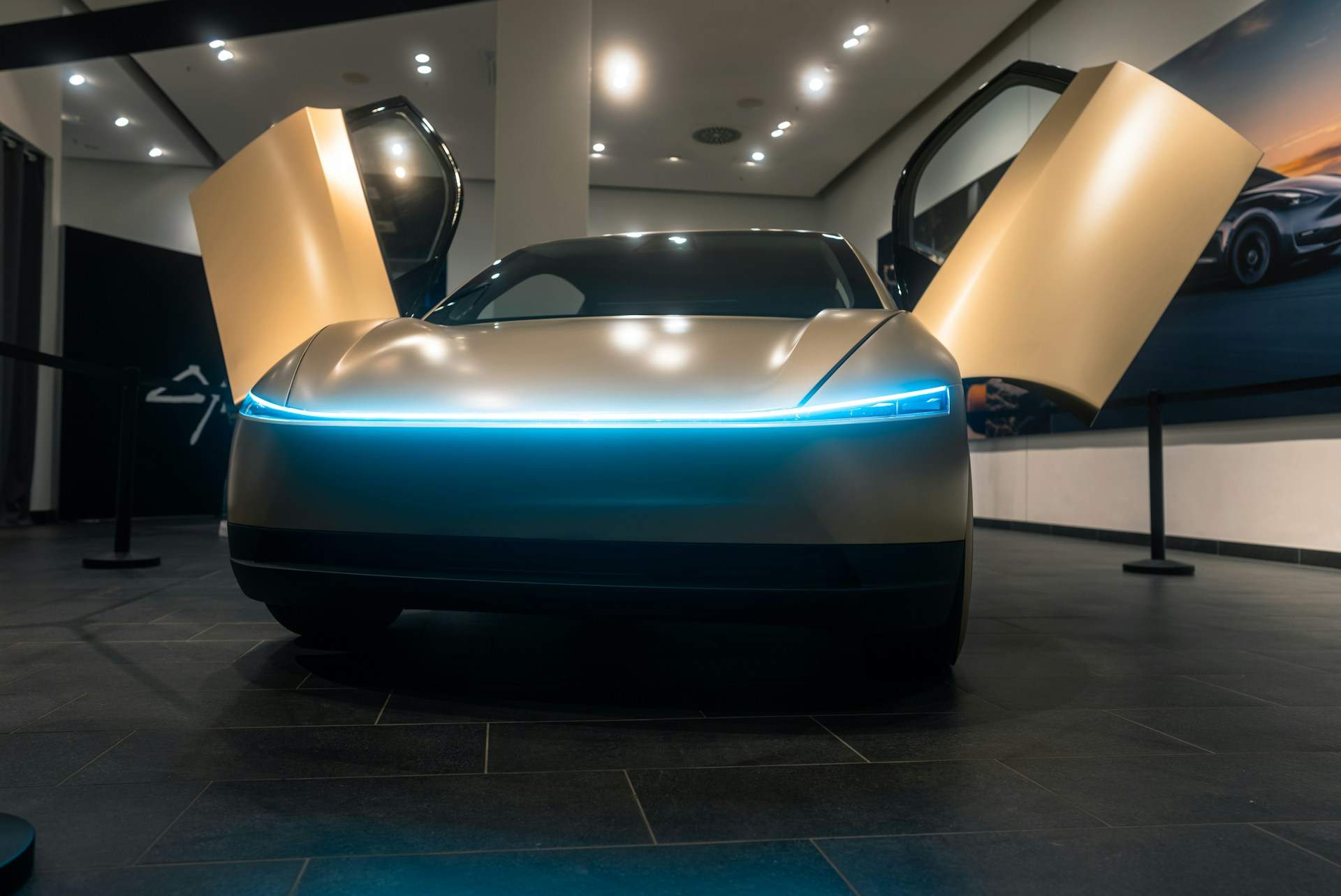
The ultimate realization of the Robotaxi vision is the purpose-built vehicle, the Cybercab. This vehicle is intended to replace the adapted consumer Teslas currently being tested within the Robotaxi service. The design of the Tesla Cybercab features no steering wheel or pedals, emphasizing its exclusive role in the autonomous ride-hailing network.
Tesla Cybercab Specifications
- Design: The Cybercab, unveiled in concept form in October 2024, is designed for ride-hailing only. Consequently, the prototype vehicle has no steering wheel, pedals, or external charge port. It features two butterfly doors and two passenger seats.
- Efficiency and Range: Tesla claims the Cybercab will have a highly efficient, small battery pack (estimated at approx 35 kWh) to achieve a city range of approx 200 to 300$ miles. The streamlined, aerodynamic design is a key factor in this impressive energy efficiency.
- Charging: The vehicle is expected to utilize inductive (wireless) charging built into the taxi hubs. This allows the Cybercab to autonomously enter a charging spot and power up without any human interaction.
- Timeline: Production is officially planned to commence sometime before 2027 at the Gigafactory Texas. This timeline gives competitors a significant window to further scale their L4 operations.
VI. Regulatory and Ethical Hurdles: The Road to Acceptance
The final and arguably most challenging barrier to mass Robotaxi deployment is achieving public and governmental acceptance.
A Patchwork Regulatory Landscape
There is currently no unified federal framework for the deployment of L4 autonomous vehicles. Instead, a patchwork of state-level rules dictates where and how driverless testing can occur.
- California DMV: California has the strictest requirements. Manufacturers must log a minimum number of miles under a Drivered Testing Permit, then a Driverless Testing Permit, and finally a Deployment Permit. Furthermore, detailed reporting on disengagements and crashes is mandatory.
- Federal NHTSA: The National Highway Traffic Safety Administration (NHTSA) is slowly updating Federal Motor Vehicle Safety Standards (FMVSS). This includes creating new exemption processes for vehicles, like the Cybercab, that lack traditional controls (steering wheels and pedals). Successfully navigating this regulatory patchwork (see the NHTSA Regulatory Update) is essential for the mass market deployment of the Tesla Cybercab.
Ethical and Societal Dilemmas
Beyond technical safety, society must grapple with profound ethical questions.
- The Trolley Problem: Autonomous systems must be programmed to make split-second decisions in unavoidable accident scenarios. How should the system prioritize outcomes? This is an ongoing ethical debate with no easy consensus.
- Job Displacement: The mass adoption of Robotaxis will inevitably displace millions of professional drivers… The economic and social costs of this displacement require careful, proactive policy planning.
- Cybersecurity and Privacy: A centralized fleet of autonomous vehicles creates a massive target for cyberattacks. Security breaches could lead to catastrophic fleet-wide control failures or the misuse of sensitive passenger travel data.
VII. Conclusion: The Transformative Imperative

Tesla’s Cybercab—the physical embodiment of the Robotaxi vision—represents a monumental, system-level shift in global transportation. Clearly, significant technical, regulatory, and ethical challenges remain, yet the potential benefits are profound. The battle between the Vision-Only approach and the Multi-Sensor strategy will define the speed and safety of the transition. Continued technical research and rigorous ethical scrutiny, along with careful regulatory cooperation, will be crucial. The successful implementation of this transformative technology will ultimately redefine urban life, making transportation safer, more accessible, and more efficient for everyone.