

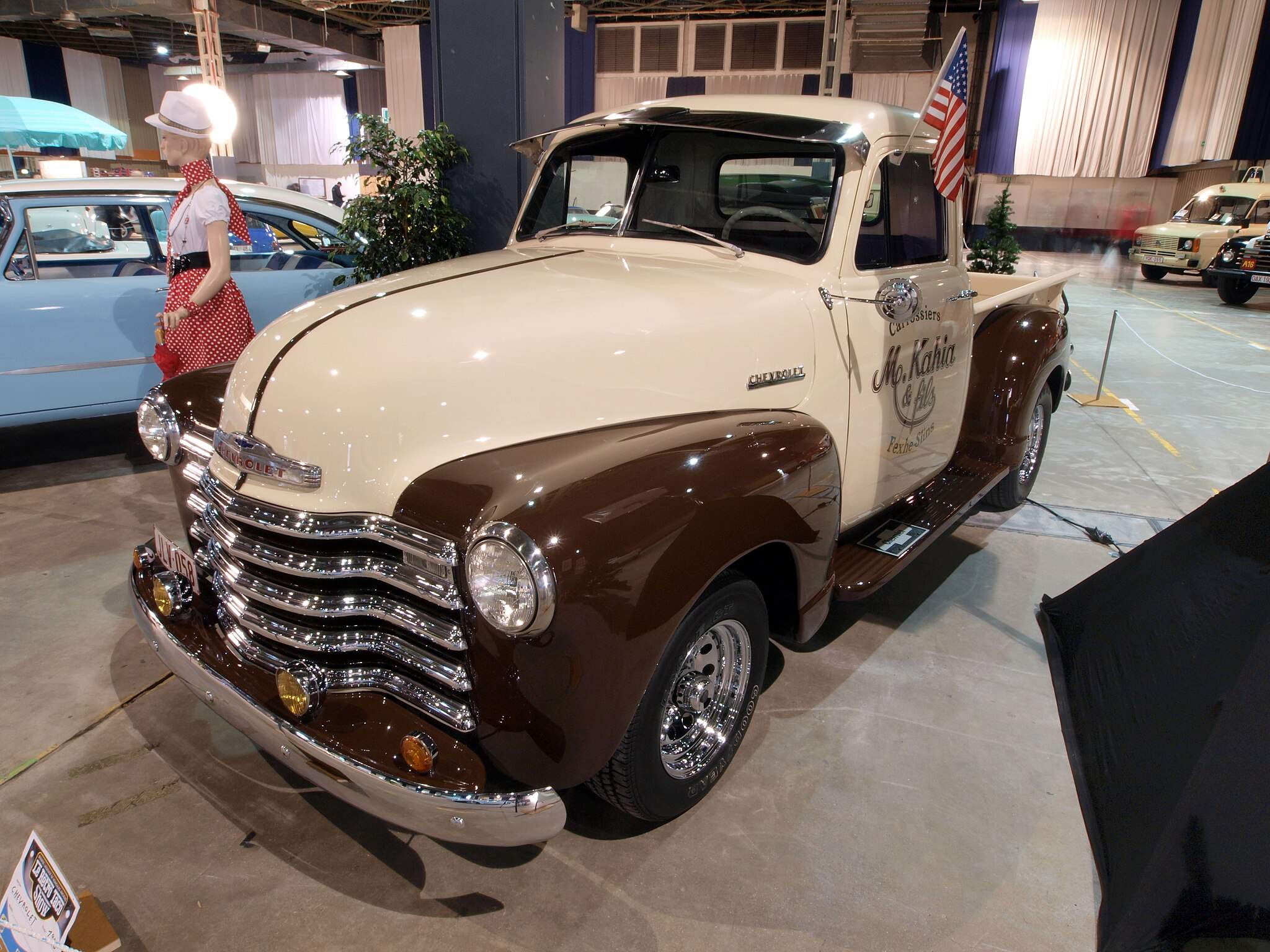

Featured Image by Alf van Beem, CC0, via Wikimedia Commons
Few vehicles in American automotive history command the enduring respect and affection of the Chevrolet 3100 pickup. More than transport, it embodies post-war prosperity, a symbol of rugged utility. The 3100, an Advance Design truck from 1947-1955, was a partner in progress, engineered masterpiece, still captivating enthusiasts.
Birth of an Icon: The Advance Design Revolution
The most striking innovation of the Advance Design was its focus on the driver. The cab was significantly wider, offering an unprecedented amount of hip, head, and legroom—a welcome luxury compared to the cramped confines of earlier models. To further enhance the driving experience, Chevrolet incorporated thicker dash and floor mats, coupled with improved insulation, to drastically reduce cabin noise. A full-width bench seat, designed to comfortably accommodate three individuals, was a revelation. It even featured an ingenious adjustment mechanism that raised the seat slightly as it moved forward, providing shorter drivers with improved visibility. Speaking of visibility, the larger windshield area was a significant upgrade, and the optional corner panel windows, famously known as “five-window” cabs, offered a panoramic view that virtually eliminated blind spots, a critical safety feature for a working vehicle.

Beyond the cab, the truck’s fundamental purpose as a hauler was not forgotten. The cargo bed was thoughtfully widened to a full 50 inches, allowing for greater versatility in carrying various loads. Stronger bed panels and a more robust tailgate ensured that the truck could withstand the rigors of daily work, reinforcing the 3100’s reputation as an unyielding workhorse. These practical, yet revolutionary, enhancements cemented the 3100’s status as the benchmark for light trucks of its time.
The Heart of the Workhorse: The Stovebolt Six

At the mechanical core of the Chevrolet 3100 lay the legendary “Stovebolt” overhead-valve inline-six engine, a powerhouse of reliability and simplicity. For most of its production life, the 216-cubic-inch version was the standard powerplant. This engine, typically mated to a robust three-speed synchromesh transmission (with a four-speed often available as an option), was not built for speed but for an unwavering dependability that became its hallmark. It provided ample torque, perfectly suited for hauling heavy loads and navigating diverse terrains, cementing its reputation as a true workhorse.
A significant upgrade arrived in 1954 with the introduction of the more robust 235-cubic-inch six-cylinder engine. This larger displacement engine, boasting full-pressure oiling and durable insert bearings, offered enhanced performance and longevity. Prior to this, the 235 engine had primarily been reserved for Powerglide-equipped passenger cars, making its inclusion in the trucks a notable advancement. Complementing these engine upgrades, 1954 also saw the availability of a heavy-duty three-speed transmission and, for the first time in a Chevrolet truck, the Hydra-Matic automatic transmission. These options further broadened the 3100’s appeal, making it more accessible and easier to operate for a wider range of drivers.
Evolution of Form: Subtle Changes, Lasting Impact
While the foundational design of the Advance Design trucks remained remarkably consistent throughout their production run, a discerning eye can trace the subtle evolutionary changes that mark different model years. Early models, spanning from 1947 to 1950, are distinctly characterized by their lack of vent or “wing” windows, a feature that became standard equipment starting in 1951. The period of the Korean War (1951-1953) saw a practical, if aesthetically muted, reduction in chrome trim due to material rationing, a clear reflection of the nation’s priorities. The year 1952 brought another functional upgrade with the standardization of convenient pushbutton door handles.
However, arguably the most significant visual transformation occurred with the 1954 and early 1955 “first series” trucks. These models are immediately identifiable by their sleek, one-piece windshield, a modern departure from the earlier split design. The front fascia was reimagined with a bold, crosshair-shaped grille, giving the truck a more assertive and contemporary appearance. The cargo box also underwent refinements, featuring higher walls and a flat top rail, enhancing both capacity and structural integrity. The 1954 model year further distinguished itself with a redesigned hood ornament and unique, squared-off taillights, signaling a subtle yet effective refresh.
Enduring Legacy: From Utility to Icon

The Chevrolet 3100 pickup swiftly became an ubiquitous fixture across the American landscape. This powerful pickup was the backbone of farms, the essential tool for tradespeople, and reliable transport for small businesses. Rugged, dependable, and comfortable, it was a vital partner in America’s post-war economic boom. Beyond its utility, the 3100’s clean lines, balanced proportions, and understated elegance gave it inherent aesthetic appeal. It simply looked right, whether hauling heavy loads or gleaming on a Sunday drive.
An Enduring Legacy: From Workhorse to Coveted Classic

Today, the Chevrolet 3100 stands as one of the most highly coveted classic trucks. Its lasting appeal stems from historical significance, robust mechanics, and undeniable visual charm. Restored examples fetch premium auction prices, values varying by originality, condition, and sought-after features like five-window cabs. A vibrant enthusiast community and readily available parts make restoration fulfilling for preserving these automotive treasures.
More Than Metal: An Automotive Icon’s Lasting Impact

The 3100’s legacy extends far beyond its status as a collector’s item. It fundamentally shaped the trajectory of future Chevrolet truck designs, solidifying the brand’s reputation as a leader in the light truck segment. Its honest, no-nonsense design speaks volumes about a bygone era of American ingenuity and perseverance. Whether spotted at a prestigious car show, gracefully cruising down a scenic backroad, or simply admired in vintage photographs, the Chevrolet 3100 pickup remains a powerful and poignant reminder of a time when vehicles were meticulously engineered to work hard, and built with the unwavering intention to last. It is, without question, a true American icon, its silhouette instantly recognizable and forever etched into the collective automotive consciousness.


_pic2.JPG)
Comment