


Photo by Akbar Nemati at Pexels.com
What was going on
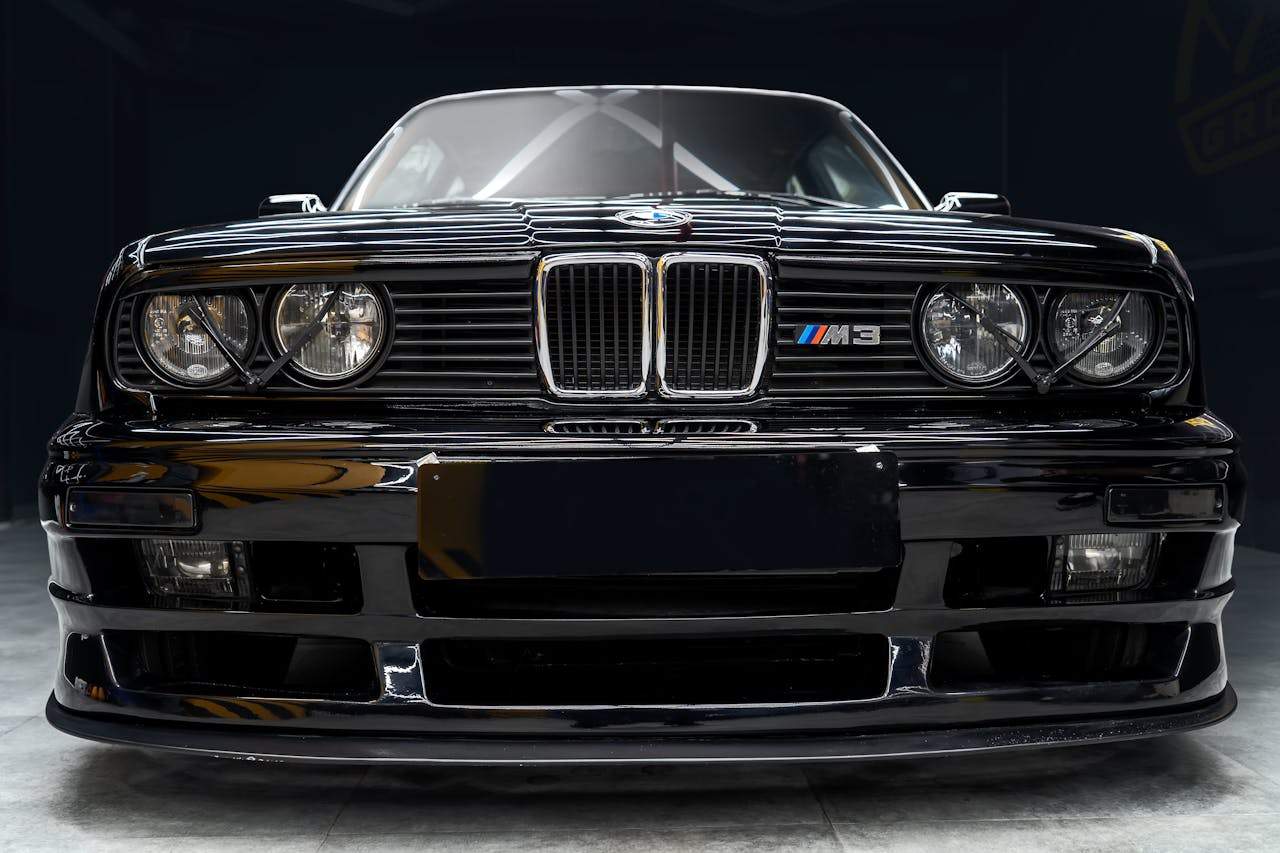
The BMW E30 M3 debuted in 1986. West Germany enjoyed economic strength at that time. The Cold War tension was present. A culture of speed and style was emerging. This car was more than a simple upgrade. BMW built it to race. The car responded to intense touring car pressure. The society valued competitive success. They also cherished engineering excellence.
💵 Economy & Lifestyle
The mid-eighties represented the fourth consecutive year of a strong economic upswing in the Federal Republic of Germany. Output and employment grew robustly, and unemployment fell, even if slightly. The economy enjoyed near zero inflation, giving consumers significant purchasing power. This stability and affluence fueled a lifestyle where sophistication and technological advancement were prized. The German consumer had the means and the desire for high-quality, high-performance goods. This period saw a rise in the aspirational driver who wanted a car that spoke to both a serious driving pedigree and a successful professional life.
📰 News/Politics
In 1986, the Cold War created a geopolitical reality. West Germany formed the front line. The West Berlin discotheque bombing highlighted this drama in April. The attack targeted La Belle, a club popular with American soldiers. It killed three people and injured over 200. The US government blamed Libya for this terror act. This crisis showed international tensions on German soil. Still, people noted an overall relaxation in Berlin. They focused more on practical cooperation. West Berlin and East Germany improved telephone links. They also worked on rail operations.
🎵 Music
German popular music was heavily influenced by the rise of Euro Disco and synth-pop, with homegrown acts dominating the charts. The German duo Modern Talking had massive hits, including “Brother Louie,” which reached number one. The Austrian artist Falco also maintained a strong presence with “Jeanny” and its sequel “Coming Home (Jeanny Part II).” Beyond international pop, the German rock scene thrived with bands like BAP and artists like Herbert Grönemeyer, whose albums often held top spots, showing a continued appreciation for German-language rock.
🎥 Movies/TV
West German cinema in 1986 focused on critically acclaimed dramas and social commentary. Films like Margarethe von Trotta’s Rosa Luxemburg, which won the Best Feature Film award at the German Film Awards and the Best Actress prize at Cannes, demonstrated a focus on historical and political themes. The cinematic output often explored contemporary social issues, such as the plight of a Turkish wife locked into her apartment in the drama 40m² Deutschland. Meanwhile, television continued to be a staple, offering both domestic programming and foreign imports that shaped the popular culture of the two German states.
⚽ Sports
Football (Soccer) reigned supreme, and 1986 was dominated by the FIFA World Cup in Mexico. The West German national team, managed by Franz Beckenbauer, defied mixed expectations and powered their way to the Final. In an iconic match, they faced Argentina and ultimately finished as Runners-up after a dramatic 3-2 defeat, with legendary players like Lothar Matthäus and Karl-Heinz Rummenigge defining the squad. This intense, high-profile competition solidified the national passion for performance and competition, aligning perfectly with the ethos of a new racing machine.
This environment of financial confidence, critical political tension, and a deeply competitive sporting and cultural scene is why the BMW E30 M3’s debut was so impactful. It was a machine that perfectly captured the era: precise, technologically advanced, and forged in the crucible of fierce German competition.
A Purpose-Built Champion: Born for the Track

The E30 M3’s very existence was dictated by the Group A touring car racing regulations of the 1980s. To compete, manufacturers had to build a minimum of 5,000 road-going versions of their race cars. BMW, with its “M” (Motorsport) division, embraced this challenge wholeheartedly. The result, unveiled at the IAA Frankfurt in 1985, was a sensation.
Unlike its standard 3 Series siblings, the E30 M3 shared little beyond its hood. Every other panel, from the subtly flared “box” fenders to the more aggressively raked rear window and higher decklid, was unique. They were meticulously crafted to improve aerodynamics and accommodate wider tracks for racing. This wasn’t merely cosmetic; it was functional art, screaming its racing pedigree without being overtly ostentatious.
The Heart of the Beast: The S14 Engine

Powering the E30 M3 was its 2.3L (later 2.5L) S14 inline-four engine. While its cast-iron block was derived from the humble M10, its four-valve cylinder head was a direct descendant of the M1’s racing engine, featuring individual throttle bodies and a high-revving nature. Initial U.S.-spec models produced around 192 horsepower, with European versions offering slightly more.
While these figures might seem modest by today’s standards, consider the E30 M3’s svelte curb weight of just over 2,600 pounds. This power-to-weight ratio allowed the original 2.3L M3 to achieve 0-60 mph in approximately 6.7 seconds on its way to a top speed of 146 mph. This performance, combined with a precise 5-speed “dog-leg” manual transmission (with first gear positioned down and to the left), delivered a visceral and engaging driving experience. Later, the 2.5L Sport Evolution produced 238 hp, pushing the top speed up to 154 mph, confirming its performance.
The Competitors
Mercedes-Benz 190E 2.3-16 Cosworth

- Manufacturer: Mercedes-Benz collaborated with legendary engine builder Cosworth to create its own homologation special to compete in the same racing series as the M3.
- Performance Stats: The 2.3-16 Cosworth’s 2.3-liter inline-four engine initially produced 185 horsepower and 170 lb-ft of torque. This allowed for a 0-60 mph time of approximately 7.5 seconds and a top speed of over 140 mph.
- Comparison: The 190E was the M3’s most direct competitor. While it offered competitive power and outstanding stability, its feel was more refined and sedan-like. It possessed a solid, high-speed demeanor, but it lacked the M3’s raw, frenetic energy and aggressive, flared-arch styling.
Ford Sierra RS Cosworth

- Manufacturer: Ford developed this high-performance version of its Sierra line, primarily for European touring car racing, featuring its massive rear wing and potent turbocharger.
- Performance Stats: The Sierra RS Cosworth utilized a turbocharged 2.0-liter Cosworth YBB engine, generating 204 horsepower and 205 lb-ft of torque. Thanks to its turbo boost, it could hit 0-60 mph in a quicker 6.2 seconds, with a top speed of over 150 mph.
- Comparison: The Sierra offered raw, straight-line speed that easily outpaced the BMW, thanks to its turbocharged engine. However, its handling, particularly its rear-wheel-drive setup, was considered more demanding and less predictable than the impeccably balanced M3, especially in adverse conditions or tight corners.
Porsche 911 Club Sport (Carrera 3.2)

- Manufacturer: Porsche created the 911 Club Sport by taking the venerable 911 Carrera 3.2 and systematically removing nearly 150 lbs of non-essential weight to create a more focused, driver-oriented machine.
- Performance Stats: Utilizing the famous 3.2-liter flat-six engine, the Club Sport maintained the Carrera’s powerful output of 231 horsepower and approximately 209 lb-ft of torque. Due to the weight reduction, its 0-60 mph time was around 5.5 seconds, and it achieved a top speed over 150 mph.
- Comparison: The 911 Club Sport offered a vastly different driving philosophy. While significantly faster in a straight line, its rear-engine layout demanded much more skill and commitment from the driver compared to the M3’s approachable and balanced front-engine setup. It stood as the established German sports car benchmark the M3 had to prove itself against.
Complete Summary of Competitor Comparisons
The BMW E30 M3’s genius lay in its balance. Against its direct German sedan rival, the Mercedes-Benz 190E 2.3-16 Cosworth, the M3 was the more aggressive, race-focused machine. While the Ford Sierra RS Cosworth offered superior turbocharged acceleration, the M3 delivered a more usable, engaging, and predictable high-performance experience. Compared to the powerful, pure-sports-car benchmark of the Porsche 911 Club Sport, the M3 was the practical racing champion. It established a new standard by translating pure motorsport pedigree into a thrilling, cohesive, road-going package. It was a true legend from the very start.
Dominance on the DTM and Beyond

The E30 M3’s true playground was the racetrack. It quickly became the most successful touring car in history, dominating series like the Deutsche Tourenwagen Meisterschaft (DTM), British Touring Car Championship (BTCC), and the European Touring Car Championship (ETCC). It secured multiple championships and amassed over 1,500 individual race victories, often besting rivals with larger engines. Its success in endurance races like the 24 Hours Nürburgring and Spa 24 Hours further showcased its remarkable durability and engineering prowess.
BMW continuously refined the E30 M3 throughout its production run (1986-1991) with various “Evolution” and special editions (like the Cecotto and Ravaglia editions), each designed to keep the car competitive on the track and offering slight performance enhancements for the road.
The Enduring Legacy and Value

The E30 M3’s impact extends far beyond its racing accolades. It established the M3 as the benchmark for high-performance sports sedans, influencing countless vehicles that followed. Its back-to-basics approach to performance – lean, analog, and visceral – continues to resonate with purists and collectors today.
This enduring appeal has translated into significant appreciation in value. While mileage and condition heavily influence pricing, clean examples of the E30 M3 regularly command six-figure sums, with rarer special editions fetching even higher prices. This is a testament not only to its historical significance but also to the timeless joy it offers behind the wheel.
In an automotive landscape increasingly dominated by digital interfaces and turbocharged power, the BMW M3 E30 remains a powerful reminder of a simpler, more engaging era of performance. It is, unequivocally, one of the most important and celebrated BMWs ever made.


