
Featured Image By Mustang Joe, CC0, via Wikimedia Commons
Introduction: What Was Going On?
The late 1960s in America were turbulent, transformative, and bursting with energy. Gasoline averaged 34 cents per gallon, yet cars remained central to daily life. Teenagers and young adults embraced cars as symbols of freedom, status, and individuality. Muscle cars were more than transportation; they embodied raw power, style, and rebellion. In 1968, Dodge introduced the second-generation Charger, a car designed to dominate streets, drag strips, and eventually racetracks, all while making an unmistakable visual statement.
A Nation in Turmoil: America 1968-1970
America in 1968–1970 was socially and politically charged. The Vietnam War sparked nationwide protests, particularly on college campuses. The assassinations of Martin Luther King Jr. and Robert F. Kennedy left a nation reeling, while civil rights movements demanded systemic change. Yet, technological achievements inspired hope: in 1969, Neil Armstrong’s first steps on the moon were broadcast globally, a triumph that united the country despite ongoing social turmoil.
The Soundtrack of an Era: Music in the Late 1960s
Music reflected the era’s intensity. The Beatles released The White Album, blending experimental rock with social commentary. Jimi Hendrix’s guitar ignited crowds at Monterey and Woodstock, and Janis Joplin’s soul-stirring voice became the soundtrack of rebellion. Motown stars like Stevie Wonder, Marvin Gaye, and The Temptations dominated radio, while folk and protest songs echoed the desire for social change. Woodstock in 1969 symbolized peace, music, and freedom.
A Mirror to Society: Movies and TV in the Late 1960s
Movies and television mirrored society. Bullitt (1968) introduced iconic car chases; Easy Rider (1969) captured counterculture and the open road; 2001: A Space Odyssey challenged perceptions of storytelling. TV shows like Star Trek, westerns, and sitcoms such as Bewitched offered both escapism and reflection of contemporary issues.
Heroes Amidst Chaos: Sports in the Late 1960s
Sports provided heroes amid chaos. The Boston Celtics and Los Angeles Lakers clashed in consecutive NBA Finals, showcasing Bill Russell and Jerry West. The New York Knicks captured their first NBA title in 1970, highlighted by Willis Reed’s legendary Game 7 performance. Joe Namath’s Super Bowl III guarantee propelled the New York Jets into history. The Detroit Tigers dominated the 1968 World Series. Muhammad Ali, both revered and controversial, remained a boxing legend while challenging societal norms. Against this dynamic backdrop, the Dodge Charger arrived, ready to define an era.
Positioning the Charger in Its Time

A Statement of Intent: The Redesigned Dodge Charger
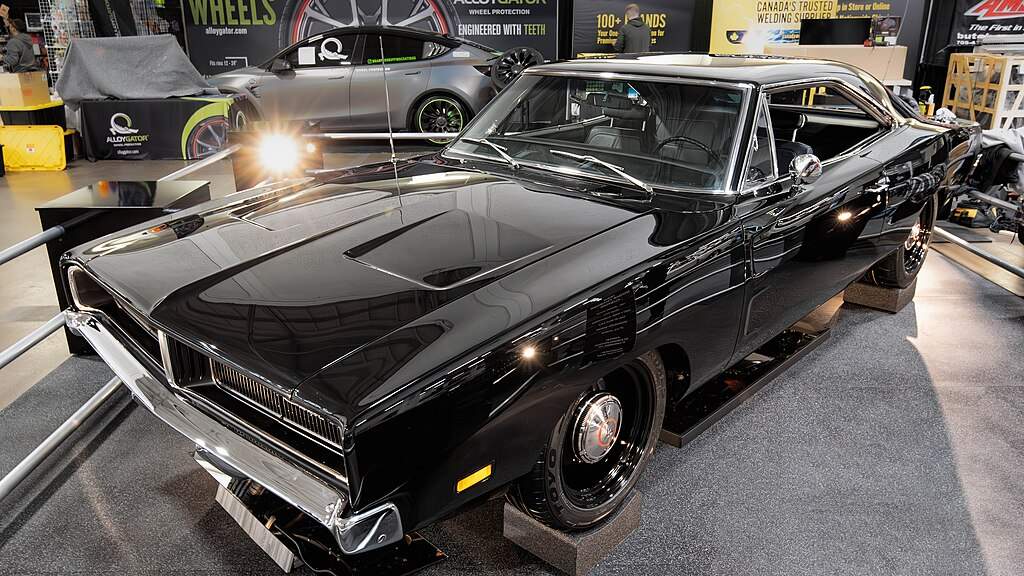
The second-generation Dodge Charger was more than a new model—it was a statement of intent. Dodge sought to create a car that could appeal to both performance enthusiasts and everyday drivers. Its new fastback roofline, hidden headlights, and sweeping Coke-bottle design gave the car a sleek, aggressive profile. From afar, the Charger looked like a predator poised to strike, a visual cue that matched its engineering.
Targeting a New Generation: The Charger’s Marketing Strategy
Marketing played a crucial role. Dodge targeted younger buyers who wanted style, performance, and personal expression. Optional vinyl tops, bold paint schemes, interior color choices, and stripe packages allowed owners to customize their vehicles. Buyers could make their Charger a reflection of their personality, a critical selling point in a culture where individuality was celebrated.
Dominating the Market: The Charger’s Engine Strategy
Engine options were wide-ranging. Base models used a 225 Slant-6 for economy-minded drivers. Mid-range buyers had 318 and 383 V8 options, while performance enthusiasts could choose the 440 Magnum or the 426 HEMI. This variety allowed Dodge to dominate multiple segments of the muscle car market. Sales figures validated the strategy: over 96,000 units sold in 1968, with growth continuing through 1969 and 1970. Dodge had succeeded in blending performance, luxury, and style.
Performance Meets Practicality: The Versatile Dodge Charger
The Charger was also practical. Its long wheelbase offered comfort for highway cruising, while optional air conditioning and power features provided daily usability. Despite its size, it handled well on city streets and drag strips alike. Buyers appreciated a car that could serve as a weekend thrill machine and a reliable daily driver.
A Cultural Icon: The Charger and the 1960s
Culturally, the Charger fit perfectly. Muscle cars were becoming symbols of rebellion and personal freedom. Dodge tapped into this desire, making the Charger a car that allowed drivers to feel connected to the wider cultural movements of the late 1960s. The combination of aggressive styling, customizable options, and powerful engines ensured that the Charger would become both a commercial success and a cultural icon.
Charger Performance Stats

- Base Engine: 225 cu in Slant-6
- Popular V8s: 318, 383, 440 Magnum
- Top Engine: 426 HEMI V8, 425 hp, 490 lb-ft torque
- Transmission: 3-speed manual, 4-speed manual, TorqueFlite automatic
- 0–60 mph (426 HEMI): ~5.3 seconds
- Quarter Mile (426 HEMI): ~13.5 seconds @ 105 mph
- Weight: 3,500–3,800 lbs
- Brakes: Front disc optional, rear drum
- Suspension: Torsion bar front, leaf spring rear
Journalists’ Impressions
Car and Driver described the Charger as “a commanding presence on the road, impossible to ignore.” Motor Trend praised its blend of luxury and power, noting the hidden headlights and fastback roofline as distinguishing features. Reviewers remarked that handling was slightly less precise than lighter cars like the Mustang, but few competitors could match the combination of comfort, engine options, and style.
HEMI models were described as beasts, delivering instant acceleration that thrilled drivers at every stoplight. The 383 V8 offered a balance of power and drivability, making it a favorite among those who wanted performance without the overwhelming intensity of the HEMI. Reviewers often noted that the Charger could function as both a daily driver and a weekend race car, a versatility that few rivals could achieve. The overall impression: the second-generation Charger was a muscle car that didn’t compromise on style, comfort, or power.
Muscle Car Rivals
The late 1960s muscle car segment was fiercely contested. Dodge went head-to-head with true midsize muscle rivals like the Chevrolet Chevelle SS 396/454, Ford Torino Cobra/GT, Pontiac GTO, and AMC Rebel “The Machine.” Each offered impressive power and distinct styling, but the Charger stood out by combining aggressive fastback design, roomy comfort, and a wide range of potent engines, appealing to enthusiasts who wanted both performance and presence.
Chevrolet Chevelle SS 396 / 454 (1968–1970)

The Chevelle Super Sport directly competed with the Charger in the midsize segment. Its big-block engines made it a formidable threat on both the street and the drag strip.
Stats:
- 396 cu in V8, 325–375 hp
- 454 cu in V8, 360–450 hp
- 0–60 mph: 6.0–6.5 sec
- Quarter-mile: low 14s, high 13s with 454
Ford Torino Cobra / GT (1968–1970)

Ford needed a larger alternative to the Mustang to challenge the Charger in size and power. The Torino Cobra, equipped with the 428 Cobra Jet and later 429 engines, gave Ford a serious muscle car contender.
Stats:
- 428 cu in Cobra Jet V8, 335 hp
- 429 cu in Super Cobra Jet, 360–375 hp
- 0–60 mph: ~6.5 sec
- Quarter-mile: mid to high 14s
The Torino’s weight and size allowed it to compete both on the streets and in NASCAR, making it a natural Charger rival.
Pontiac GTO (1968–1970)

The GTO remained one of the most famous muscle cars of the era. With powerful V8s and distinctive styling, it was the benchmark for midsize muscle performance.
Stats:
- 400 cu in V8, 350–366 hp
- Ram Air IV option, 370 hp
- 0–60 mph: ~6.0 sec
- Quarter-mile: low 14s
AMC Rebel “The Machine” (1970)

AMC’s answer to the big boys was the 1970 Rebel “The Machine.” Its patriotic paint scheme and 390 V8 made it a surprise contender in the muscle car segment.
Stats:
- 390 cu in V8, 340 hp
- 0–60 mph: ~6.4 sec
- Quarter-mile: mid-14s
Street Rivalries
The Charger dominated city streets and drag strips alike. While rivals like the Chevelle SS, Ford Torino Cobra, Pontiac GTO, and AMC Rebel “The Machine” offered serious performance, the Charger stood out for its combination of aggressive styling, engine variety, and commanding presence. Drag strip reports often highlighted HEMI-powered Chargers leaving Chevelles and GTOs behind in the quarter-mile, while everyday drivers appreciated the comfort and usability of the base V8 and Slant-6 models. Enthusiasts embraced the Charger for its blend of style, roar, and speed, cementing its status as a premier American muscle car of the late 1960s.
NASCAR: From Misses to Mastery

The 1968 Charger struggled in NASCAR. Its recessed grille and tunneled rear window caused aerodynamic drag, leaving it behind Ford’s Torino Talladega. Dodge engineers responded with the 1969 Charger 500, featuring a flush-mounted grille and a revised rear window to reduce drag. This improved high-speed performance and made the car competitive on superspeedways.
The 1969 Charger Daytona represented a leap forward. Dodge added a pointed nose cone and a 23-inch rear wing, improving aerodynamics and stability at speeds exceeding 200 mph. Buddy Baker became the first driver to break 200 mph at Talladega in a Daytona. The innovations sparked debate over “aero cars,” leading NASCAR to implement restrictions in 1971, highlighting Dodge’s engineering ingenuity.
By 1970, Bobby Isaac drove a Charger to 11 victories, winning the NASCAR Grand National Championship. Each race showcased the car’s transformation from a street performer to a racing champion. Dodge’s aerodynamic improvements allowed it to dominate, forcing competitors to adapt. The Charger’s NASCAR success cemented its legacy, proving that it was more than a street car—it was a race-winning machine.
Hollywood Fame
Hollywood amplified the Charger’s legend. In Bullitt (1968), a black Charger R/T chased Steve McQueen’s Mustang through San Francisco in one of cinema’s most iconic sequences. The General Lee, a 1969 Dodge Charger, became a television staple in The Dukes of Hazzard, famous for jumps, stunts, and bright orange paint. Later appearances in the Fast & Furious franchise reinforced its image as a symbol of raw power, rebellion, and freedom.
Other films like Dirty Mary, Crazy Larry and Vanishing Point showcased Chargers in high-speed chases, further embedding the car in popular culture. For enthusiasts, these appearances reinforced the Charger’s status as a muscle car icon. It was no longer just a street vehicle—it had become a symbol of cinematic cool and cultural rebellion.
Driving Experience

Driving a Charger is visceral. The long hood and wide stance dominate the road. Steering is heavy, requiring focus, but the payoff is thrilling acceleration. HEMI engines launch with authority, while mid-range 383 V8s provide exciting but manageable performance. Suspension tuning balances comfort and control, and the roar of the exhaust engages all the senses. Driving the Charger evokes the culture and spirit of late-1960s America.
Options, Trims, and Everyday Theater
Dodge offered trims from base six-cylinder to R/T performance editions. Options included vinyl tops, interior upgrades, stripe packages, and power features. Every drive became an event, whether cruising, racing, or attending car shows. The Charger turned everyday driving into a performance spectacle.
Modern Relevance

Today, second-generation Chargers are highly collectible. Original 426 HEMI models sell for six figures. Standard V8s are sought for restorations. Collector clubs, car shows, and drag strip events celebrate the Charger. Modern Dodge vehicles borrow design cues from this platform, preserving its influence for new generations.
Conclusion
From 1968 to 1970, the Dodge Charger became an American muscle car icon. Its styling, engine lineup, NASCAR success, and Hollywood appearances cemented its legacy. Collectors and enthusiasts continue to celebrate it as a symbol of power, freedom, and style. The second-generation Charger is more than a car—it is a rolling legend, an enduring representation