

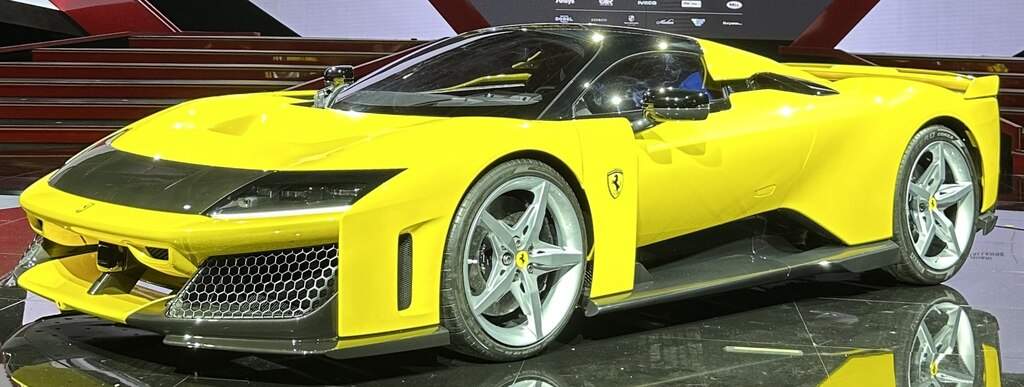

Featured Image Pauls.127, CC0, via Wikimedia Commons
The Evolution of Ferrari’s Flagship Hypercars
Maranello’s halls buzz with anticipation for the Ferrari F80. Ferrari consistently redefines road car performance with its flagship hypercars, a name synonymous with speed, luxury, and unparalleled racing pedigree. These “F” designated or founder-named machines represent Ferrari’s engineering and design pinnacle.
From the raw F40 to the technological LaFerrari, each generation pushes boundaries, captivating enthusiasts. As the LaFerrari era ends, the world awaits the next chapter: the whispered Ferrari F80.
The Anticipation of the Ferrari F80

Though Ferrari hasn’t officially announced an F80 as of early 2025, the name feels like a natural, inevitable placeholder. It follows a loose, evocative numerical progression, resonating with milestones or lineage advancement. Regardless of its final name, the F80 represents LaFerrari’s conceptual successor, destined for the top of the Prancing Horse hierarchy. It embodies the promise of future technology, radical design, and performance figures that likely defy current comprehension. To understand what this future hypercar might entail, one must first appreciate the giants upon whose shoulders it will stand.
The Genesis of the Modern Ferrari Hypercar: The F40

The modern Ferrari hypercar dynasty truly began with the F40, launched in 1987 to celebrate the company’s 40th anniversary. It was Enzo Ferrari’s last approved car, conceived as the ultimate road-going racing technology. Raw, uncompromising, and brutally fast, the F40 eschewed luxury in favour of lightweight construction and aerodynamic efficiency. Its twin-turbo V8 delivered explosive power. The minimalist interior, with bare carbon fiber and pull-strap door releases, underscored its track focus. The F40 was an event: a visceral statement prioritizing driver engagement and pure speed. It remains an icon, celebrated for its challenging nature and its direct connection to Ferrari’s racing soul.
The F50: A Formula 1 Heart for the Road

Following the F40 came the F50 in 1995. While sharing the “F” prefix, the F50 represented a philosophical shift. Instead of turbocharging, Ferrari opted for a naturally aspirated V12 engine derived directly from its 1990 Formula 1 car. The engine bolted directly to the carbon fiber monocoque chassis, acting as a stressed motorsport-derived member. The F50 aimed to replicate the F1 experience on the road, prioritizing engine sound, throttle response, and chassis rigidity.
It offered an open-top Targa configuration, further enhancing the sensory experience. Though sometimes debated against the F40’s rawness, the F50 was a technological masterpiece. It showcased Ferrari’s mastery of naturally aspirated engines and advanced chassis, offering a different, yet equally compelling, hypercar performance.
The Enzo Ferrari: A Tribute to the Founder and F1 Technology

The turn of the millennium brought the Enzo Ferrari, launched in 2002. Named in honour of the company’s founder, the Enzo represented another leap forward, heavily leveraging contemporary Formula 1 technology. Its design was dictated by aerodynamics, featuring sharp angles, active aerodynamic elements, and a distinctive nose cone reminiscent of F1 cars. Power came from a new, bespoke V12 engine, coupled with an F1-style automated manual transmission that delivered lightning-fast gear changes. Carbon-ceramic brakes, previously reserved for racing, became standard. The Enzo was a showcase of computational fluid dynamics, advanced materials, and sophisticated electronic systems, setting new benchmarks for road car performance while retaining the V12 heart that defined Ferrari’s top-tier offerings. It was less raw than the F40, more technologically focused than the F50, representing the cutting edge of early 21st-century automotive engineering.
The LaFerrari: Hybridization Defines a New Era

A decade later, in 2013, Ferrari unveiled the LaFerrari. Its name, translating simply to “The Ferrari,” signified its definitive status as the ultimate expression of the brand. The LaFerrari marked Ferrari’s entry into the era of hybridization for its flagship models. It paired a monumental naturally aspirated V12 engine with a HY-KERS electric motor system, derived from F1 kinetic energy recovery technology. The combined output was staggering, but the hybrid system wasn’t just about straight-line speed; it was used for torque-fill, improving throttle response and performance out of corners, while also offering a marginal increase in efficiency. The LaFerrari’s design was a flowing, more organic evolution compared to the Enzo, integrating active aerodynamics seamlessly into its sculptural form. It represented the harmonious blending of traditional V12 power with state-of-the-art hybrid technology, creating a hypercar of unprecedented performance and technological sophistication.
The Anticipated Ferrari F80: Ferrari’s Next Frontier
This brings us to the present void, the space eagerly awaiting the arrival of the LaFerrari’s successor – the conceptual “F80.” What can we realistically expect from such a machine? Speculation is rampant, fueled by advancements in technology, evolving regulations, and Ferrari’s own recent developments showcased in models like the SF90 Stradale and the 296 GTB, as well as its continued involvement in Formula 1 and its Le Mans-winning Hypercar program.
The Revolutionary Hybrid Powertrain
The Ferrari F80, anticipated to commence production in 2025, will utilize a sophisticated hybrid powertrain. This system combines a 3.0-liter twin-turbocharged 120° V6 petrol engine with three electric motors. The internal combustion engine, a Tipo F163 CF 120° V6 with a displacement of 2992 cc and twin turbocharging, produces a maximum power output of 900 PS (662 kW; 888 hp) at 8750 rpm and a maximum torque of 850 Nm (627 lb-ft) at 5550 rpm, achieving a specific power output of 300 hp/liter and a maximum engine speed of 9000 rpm (dynamic limiter at 9200 rpm).
Its architecture and many components are derived from the engine of the Ferrari 499P. The hybrid system includes three electric motors: two front axle motors (litz wire wound, radial flux, in-house developed, each producing 105 kW/142 hp and 121 Nm peak torque) and one rear axle starter/hybrid motor (MGU-K, in-house developed, providing 60 kW/81 hp and 45 Nm peak torque, also enabling energy recovery).
The F80’s Electrifying Performance
The design of these electric motors is inspired by Ferrari’s Formula 1 technology. The total combined power output of the system is 1200 PS (883 kW; 1184 hp), making the F80 Ferrari’s most powerful road car. It is powered by an 800-Volt Lithium-ion battery with an energy of 2.28 kWh and a maximum power of 242 kW (charge/discharge), located behind the seats.
The hybrid system features all-wheel drive (e-4WD) thanks to the front electric motors, torque vectoring, electric turbochargers (e-turbos), boost optimization to mimic a naturally aspirated feel, and no dedicated EV mode. In summary, the Ferrari F80 employs a cutting-edge hybrid powertrain centered around a high-performance twin-turbo V6 engine and three advanced electric motors, leveraging technology from Ferrari’s racing success to deliver unprecedented power and performance.
Ferrari F80: Aerodynamic and Material Innovations
Beyond the powertrain, the “F80” will inevitably showcase breakthroughs in aerodynamics and materials science. Lessons learned from F1 and the World Endurance Championship (WEC) Hypercar class, particularly regarding active aerodynamics and underbody airflow management (ground effects), will surely find their way into the design.
Expect intricate active wings, flaps, and diffusers working in concert to maximize downforce during cornering and minimize drag on straights. The use of advanced carbon composites, potentially incorporating novel materials and construction techniques, will be critical for keeping weight down despite the complexity of hybrid systems, ensuring agility and responsiveness remain paramount.
The F80’s Evolutionary Design Language
The design language itself is another area of intense speculation. Ferrari’s current design direction, seen in cars like the Daytona SP3 and the Purosangue, blends retro nods with futuristic forms. The LaFerrari successor will need to be visually stunning, instantly recognizable as a Ferrari flagship, yet push the aesthetic boundaries. It must look fast standing still, its form dictated by aerodynamic function but executed with Italian flair and artistry. Expect a low-slung silhouette, dramatic proportions, and intricate surfacing that manages airflow while creating an unforgettable visual impact.
The F80’s Driver-Focused Interior and Advanced Technology
Inside, the focus will likely remain driver-centric, but with advancements in digital interfaces and connectivity. While Ferrari hypercars typically avoid overly luxurious appointments in favour of a focused environment, the integration of technology will be sophisticated.
Expect advanced digital displays, configurable driving modes influencing everything from powertrain response to aerodynamic settings, and perhaps even augmented reality elements enhancing the driving experience. However, the core tactile sensations – the feel of the steering wheel, the feedback through the chassis, the sound of the engine – will remain central to the car’s appeal.
The F80’s Inherent Exclusivity
Exclusivity will, of course, be a defining characteristic. Like its predecessors, the LaFerrari successor will be produced in strictly limited numbers, available only to Ferrari’s most valued clients. This scarcity is part of the mystique, ensuring these cars remain coveted treasures, automotive unicorns that are rarely seen but always discussed. The selection process itself adds to the legend, creating a halo effect around the car and the brand.
Ferrari F80: Legacy, Evolution, and Future
Ultimately, the car tentatively dubbed the “F80” represents more than just the next hypercar from Maranello. Ultimately, the car tentatively dubbed the “F80” represents more than just the next hypercar from Maranello. This machine symbolizes the relentless pursuit of performance, the evolution of automotive technology, and the enduring allure of the Prancing Horse.
It must honor the legacy of the F40, F50, Enzo, and LaFerrari while simultaneously charting a new course for the future, delivering performance that redefines benchmarks, incorporating genuinely next-generation technology, and possessing a design that captures the imagination.
The Enduring Legacy and Future of Ferrari’s Hypercars
While we await official confirmation, specifications, and even the final name, the anticipation surrounding the LaFerrari’s successor continues to build. It is a testament to Ferrari’s enduring legacy that the mere idea of their next flagship can generate such excitement and debate. Whether it arrives as the F80 or under a different banner, it is destined to be a landmark automobile, a machine that will push the boundaries of possibility and once again demonstrate why Ferrari remains the undisputed king of the hypercar realm. The world watches, waits, and imagines the unimaginable, eager for the unveiling of the next icon from Maranello.

.jpg)